
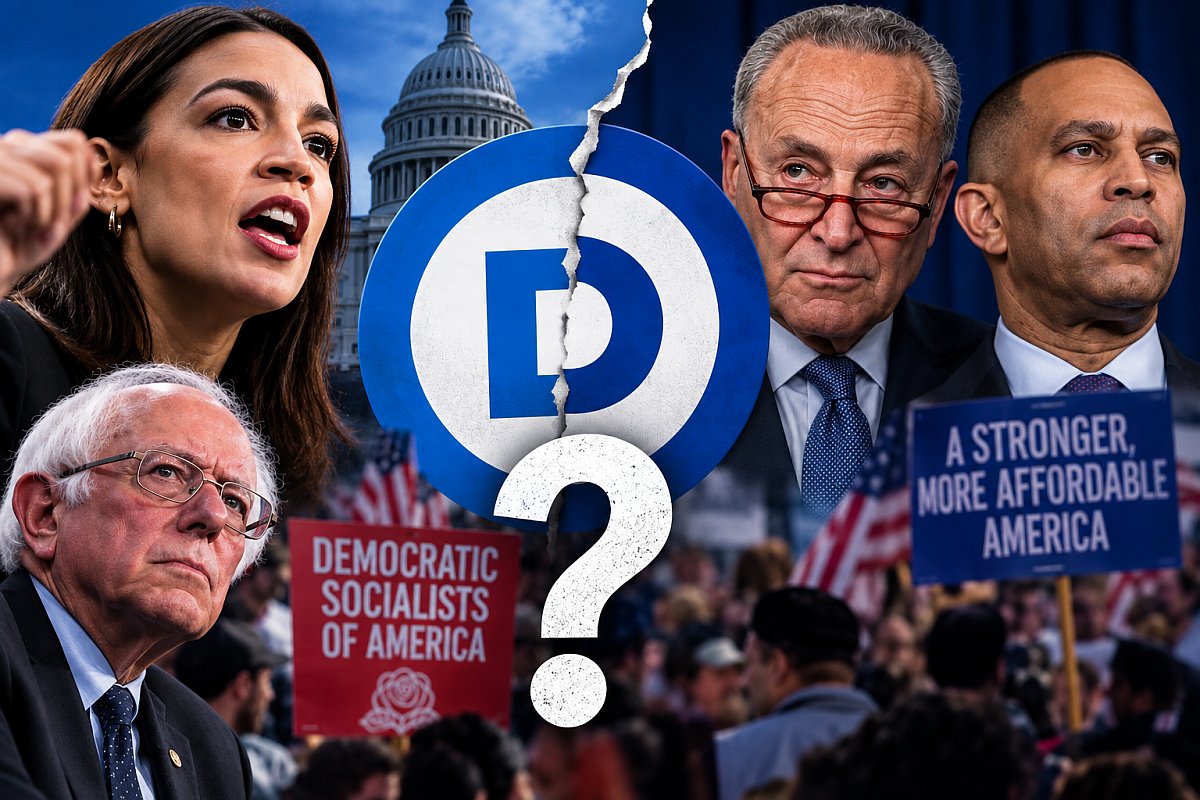
Democrats have been handed the kind of political opportunity opposition parties dream about. Donald Trump’s approval has fallen, voters are angry about the cost of living, Republicans are suddenly defending races in states they never expected to worry about, and national polling increasingly points to a difficult midterm environment for the GOP.
Yet barely a month before Election Day, Democrats are still wrestling with a surprisingly basic question: What kind of party are voters being asked to put back in power?
The disagreement burst into the open again this week as Democratic candidates in competitive races began explicitly declaring themselves capitalists, not socialists. That is not exactly the message a party would choose to spend precious campaign time delivering if there weren’t some concern about how voters see it.
Democrats Are Now Saying It Out Loud: We’re Capitalists
Reuters reported Wednesday that Democratic candidates in competitive races are pushing back against legitimate Republican efforts to associate them with socialism and the Democratic Socialists of America. Some have signed a “Promise to America” declaring their support for capitalism, while others are emphasizing moderate voting records and distancing themselves from the party’s socialist wing.
There is an obvious Republican campaign strategy behind the attacks. Republicans would much rather make the election about socialism than about $6 diesel, inflation, health care costs or Trump’s approval rating. Calling every Democrat a socialist doesn’t make it true, either, though it’s not too far off. The Democratic Party includes everyone from moderates representing competitive districts to politicians who openly identify as democratic socialists.
But that diversity is also the problem Democrats haven’t resolved. While candidates in swing districts are telling voters they are capitalists, DSA-backed candidates have been winning Democratic primaries and building influence in heavily Democratic cities and districts. The two groups may share a party label, but they don’t necessarily share the same vision of what that party should become.
The Socialist Wing Is Winning Races
This isn’t entirely a Republican invention. Democratic socialist candidates have enjoyed a series of real victories this cycle, particularly in deep-blue territory. DSA-aligned candidates have won races by campaigning on housing, government-run or heavily subsidized services, higher taxes on wealthy Americans and corporations, and a much larger role for government in the economy.
Those victories have generated enthusiasm on the left and helped democratic socialists argue that their ideas have a constituency. They also create an obvious headache for Democrats trying to win places that look nothing like New York City.
That tension is showing up on the campaign trail. Axios reported this week that Democrats in several competitive races have kept Rep. Alexandria Ocasio-Cortez at a distance. Some campaigns have reportedly made clear that they do not want her appearing with their candidates, even as other potential 2028 Democratic figures travel into battlegrounds to campaign.
That doesn’t mean AOC or DSA controls the Democratic Party. It means Democrats running in competitive territory understand that Republicans want voters to believe they do.
So Who Actually Defines the Democratic Party?
Officially, the answer is still the establishment. Hakeem Jeffries leads House Democrats, Chuck Schumer leads Senate Democrats, and the national campaign committees control enormous amounts of money and campaign infrastructure. The candidates they are trying to elect in competitive districts generally sound much more like traditional Democrats than democratic socialists.
Jeffries has also been explicit about his own relationship with DSA. Asked about the organization earlier this year, he responded that DSA could speak for itself because he isn’t part of it.
But leadership titles don’t completely settle an argument about a party’s identity. Political parties are ultimately shaped by the politicians their voters nominate, the activists who provide energy and money, and the ideas that begin migrating from ideological factions into the broader party.
That’s where Democrats find themselves in an awkward position. The establishment needs the energy of younger and more progressive voters, while candidates fighting for independents in competitive states have an incentive to make sure voters don’t confuse them with the party’s socialist wing.
Democrats Have Had This Argument Before
If all of this sounds familiar, it should. Democrats were having almost exactly the same argument after the 2020 election.
Virginia Democrat Abigail Spanberger (now Governor Spanberger) had just narrowly survived a difficult reelection campaign when she unloaded during a private House Democratic conference call. Republicans had spent the 2020 campaign trying to tie vulnerable Democrats to socialism and the “defund the police” movement, even when the candidates themselves tried to disavow the rampant leftist ideology consuming the party.
Spanberger’s warning was blunt. She told fellow Democrats they should never use the words “socialist” or “socialism” again and argued that slogans like “defund the police” were hurting candidates running in competitive districts. Other moderate Democrats made similar complaints, while progressives pushed back against the idea that their policies were responsible for the party’s losses.
The important part wasn’t whether every Republican attack was fair. Spanberger’s argument was that the attacks worked. Candidates in swing districts could carefully explain their own positions, but they were still being forced to answer for statements and slogans coming from the party’s left wing.
Six years later, Democrats are confronting a remarkably similar problem. The slogan has changed, but the political dilemma hasn’t. Candidates trying to win independents are once again spending part of their campaigns explaining that the most visible voices on the Democratic left don’t necessarily speak for them.
Republicans Have Given Democrats an Enormous Opening
The strange part is that Democrats are having this argument while the electoral environment is moving strongly in their direction. Our 2026 midterm election coverage has tracked the deterioration for Republicans for weeks, and it is increasingly visible across the map.
The latest Senate polling shows competitive races in places Republicans would normally expect to hold comfortably. Iowa has become a genuine battleground, South Carolina is producing surprisingly close polls, and Republicans are being forced to spend time and money defending territory they hoped would be secure.
The battle for the House may be an even bigger problem. Democrats have consistently led recent generic congressional ballot polling, while Republican groups are pouring money into districts that were previously considered safe.
Trump himself isn’t helping. A recent Reuters/Ipsos poll put his approval at 32%, with only 17% approving of his handling of the cost of living. Diesel prices have soared, the Iran war has divided Republicans, and candidates in competitive races have begun putting some distance between themselves and the president.
In other words, Democrats don’t necessarily need to convince voters that everything about the Democratic Party is wonderful. Republicans are giving unhappy voters plenty of reasons to consider voting against the party currently in power.
But What Are Democrats Asking Voters to Vote For?
This is where the Democratic message becomes more complicated. It would be wrong to say the party has no agenda at all. The Democratic Congressional Campaign Committee says a Democratic House would focus on lowering costs, ending Trump’s tariffs, reversing Republican Medicaid cuts and restoring Affordable Care Act tax credits, though it’s not clear how any of that would be accomplished.
Democrats have also begun coalescing around what strategists call the “cost of corruption,” an attempt to connect allegations of self-dealing and favoritism in the Trump administration with the economic frustrations voters already feel. Jeffries has increasingly talked about accountability and has promised aggressive oversight if Democrats regain control of the House.
There is plenty of oversight waiting for them. A Democratic House would regain subpoena power, and Democratic committee leaders have already made clear that investigations of the Trump administration and companies connected to it would be a major priority.
That may appeal to Democratic voters who have spent two years wanting Congress to confront Trump more aggressively. But investigations don’t answer every question about what Democrats would do with power, particularly for voters whose main concerns are grocery bills, housing, health care and energy prices.
The party has individual proposals on all of those issues. What it still lacks is a simple national governing identity that voters can easily describe. There is no modern equivalent of a short Contract with America-style document defining what Democratic control of Congress would mean on Day One, and candidates in different parts of the country are often selling very different versions of the Democratic Party.
An Anti-Trump Vote Isn’t Necessarily a Democratic Mandate
That distinction could become important after Election Day. If Democrats win the House or make major gains in the Senate races, party leaders will understandably argue that voters rejected Republican government. The current polling gives them plenty of reason to believe that could happen.
But rejecting one party isn’t automatically an endorsement of everything the other party wants to do. Some voters may support Democrats because they want lower health care costs. Others may simply want a check on Trump. Progressive voters may see Democratic victories as support for a more aggressive left-wing economic agenda, while moderate Democrats may interpret the same results as proof that candidates who kept their distance from socialism can win competitive territory.
Those are very different lessons from the same election.
Republicans faced a version of this problem after 2024. Trump won a clear victory and Republicans took control of Washington, but voters who supported him did not necessarily agree on everything that followed. Two years later, some of those disagreements are contributing to the difficult environment Republicans now face.
Democrats could find themselves having the same argument much sooner than they expect.
First They Have to Win
None of this erases the opportunity in front of Democrats. The governor races, House map and Senate contests give the party multiple opportunities this November, and Republicans would gladly trade their current problems for an internal debate about what to do after winning.
Democrats also have a perfectly plausible argument for keeping the campaign focused on Republicans. Opposition parties usually benefit when elections become referendums on an unpopular president, and Trump is giving Democratic candidates an enormous amount of material to work with.
But winning power eventually forces a party to decide what that power is for. That’s the question lurking behind this week’s spectacle of Democratic candidates publicly assuring voters that they believe in capitalism.
The establishment wing says affordability, health care and institutional oversight should define a Democratic majority. The socialist wing believes its recent victories show voters are ready for something much more ambitious. Candidates in competitive states are increasingly making sure voters understand there is a difference.
Democrats may not have to settle that argument to win the 2026 midterm elections. If voters put them back in power, they may have to settle it very quickly afterward.