
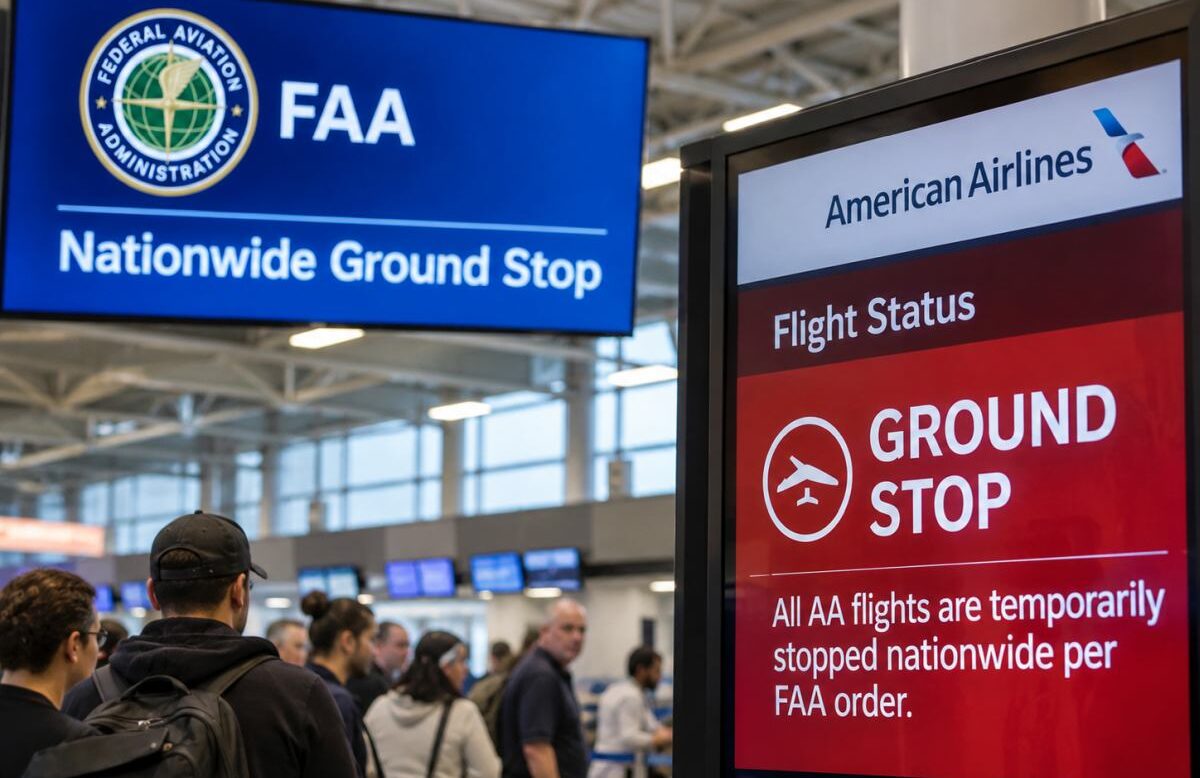
For several hours Friday afternoon, the busiest air transportation system in the world effectively stopped launching airplanes.
The Federal Aviation Administration ordered a nationwide ground stop after communications failures began affecting multiple air traffic control centers. The FAA initially described the problem only as a communications issue and said technicians were investigating. By Friday night, however, officials and outside reporting had begun to fill in more of the picture. The FAA said its information remained preliminary.
CBS News reported, citing multiple sources, that an update to the private communications network connecting the nation’s air traffic control system caused the network to reboot, crash and lose communications. That network is operated by L3Harris. Homeland Security Secretary Markwayne Mullin said new security patches introduced into the older system appeared to overwhelm its routers, while Transportation Secretary Sean Duffy said the routers became overloaded with data and began producing inconsistent information.
That is not yet a final root-cause finding, and neither the FAA nor L3Harris had publicly issued one by Saturday morning. But if that sequence is confirmed, Friday’s outage becomes easier to understand and harder to excuse: a routine software or security update appears to have exposed how fragile parts of the FAA’s aging communications backbone still are.
What Actually Happened Friday?
The FAA Telecommunications Infrastructure network, or FTI, connects air traffic control centers and other FAA facilities and carries critical voice and operational data. Harris Corp., now part of L3Harris, was awarded the contract to modernize and operate that network in 2002. CBS reports that an FAA safety review in 2023 had already described parts of the network as obsolete and dependent on aging telecommunications technology.
Duffy’s explanation Friday night was straightforward: older routers were hit with more data than they could reliably handle. Once the information moving through the system became inconsistent, the FAA stopped departures nationwide rather than risk operating with questionable communications and radar data. The ground stop was lifted at 8:15 p.m. Eastern after the FAA tested the system and determined it was stable enough to resume operations.
Officials also said they had found no indication that the outage was caused by a cyberattack or some other hostile act. That matters because the first hours of the shutdown produced plenty of speculation about what could have caused something so unusual. As of Saturday morning, the emerging explanation was much more mundane: an update interacting badly with old infrastructure.
That does not make the failure less serious. In some ways, it raises a more troubling question. Why was a communications network important enough to halt departures across the entire country still vulnerable to being destabilized by a software or security update?
Washington Has Been Modernizing Air Traffic Control for More Than 20 Years
That question leads directly to NextGen, the FAA’s massive effort to modernize the National Airspace System. The program began in 2003 with an original goal of transforming air traffic management by 2025 through satellite navigation, digital communications, automation and other new technology.
By the end of 2024, the FAA had spent more than $15 billion on NextGen, according to the Department of Transportation inspector general. The agency had originally projected roughly $36 billion in total government investment, with the aviation industry also expected to spend billions on new equipment and training. The inspector general found that NextGen had delivered real improvements and more than $12 billion in estimated benefits through 2024.
So this is not a story about $15 billion simply disappearing. NextGen produced more precise navigation, better digital communications, more efficient flight paths and other capabilities now used every day. The problem is that the overall modernization effort took longer than planned, some major systems remained unfinished, and the old infrastructure did not disappear nearly as quickly as Washington once expected.
Congress Helped Create the Stop-and-Start Problem
Part of the delay can be traced directly to Congress. A 2015 Government Accountability Office review found that government shutdowns, sequestration, continuing resolutions and repeated short-term funding decisions disrupted FAA planning and delayed portions of NextGen. The 2013 shutdown delayed a major investment decision for a digital communications program, while sequestration postponed other airspace modernization work. GAO said the uncertainty delayed benefits and undermined confidence among industry partners.
That history stretches across Republican and Democratic administrations and Congresses. FAA modernization repeatedly became hostage to broader budget fights even as lawmakers demanded faster progress from the agency.
But congressional dysfunction is only part of the story. The FAA also struggled with management, scheduling and oversight problems of its own.
The FAA Knew the Legacy Systems Were Becoming a Problem
After the 2023 nationwide airspace shutdown, the FAA conducted a broad assessment of 138 air traffic control systems. In 2024, GAO reported that 51 of those systems were rated unsustainable because of issues such as obsolete technology and difficulty obtaining replacement parts. Another 54 were rated potentially unsustainable. Those categories are not the same and should not be combined as though all 105 systems were failing, but the numbers showed how much aging infrastructure remained in service.
GAO also found that the FAA was moving too slowly to replace some of the most critical systems. Certain modernization projects were still six to 13 years away from completion, and several systems did not yet have replacement projects underway at all.
The communications network implicated in Friday’s outage fits directly into that broader problem. GAO’s most recent modernization review describes FAA telecommunications as the backbone connecting thousands of facilities, radars, voice systems and flight-data networks. The report says some copper cables still date to the 1960s and warns that unsupported communications technology can have an immediate impact on air traffic operations when it fails.
Congress Put Another $12.5 Billion Into the System
In July 2025, Congress appropriated another $12.5 billion for the FAA’s newer modernization effort, now called the Brand New Air Traffic Control System. The money included $9 billion for systems and $3.5 billion for facilities. That was an appropriation, not evidence that the entire amount had already been spent.
The FAA has made measurable progress with that money. GAO reported in September that by May 2026 the agency had replaced 2,560 of 5,170 old and fragile copper connections with high-speed fiber. The first phase of the new effort is supposed to accelerate replacements in communications, surveillance, weather and other systems, with a target of completing that phase by the end of 2028.
But the same GAO report also found a familiar management problem. The FAA still did not have a comprehensive, well-supported estimate for what the entire modernization program would cost over its lifetime. It also lacked a true integrated master schedule tying the work together. Instead, GAO found 11,389 individual project schedules that had not been fully integrated.
That is not a minor bookkeeping issue. Without a reliable overall cost and schedule, Congress has a harder time knowing whether the agency is replacing the highest-risk systems first, whether projects are interfering with one another, when old equipment will actually be retired and how much additional money will ultimately be required.
Now the FAA Wants Tens of Billions More
The administration was already asking Congress for another major infusion before Friday’s outage. Duffy and White House budget director Russ Vought formally requested an additional $30.1 billion on Thursday. According to Roll Call, that request included more than $10 billion for air traffic control upgrades, including funding for cloud computing and national airspace telecommunications.
After Friday’s ground stop, Duffy went further and publicly called for roughly $50 billion to complete a broader overhaul. That figure should not be confused with money already appropriated or spent. Congress has already provided $12.5 billion for the current modernization effort; the administration formally asked for another $30.1 billion before the outage; and Duffy then cited $50 billion as the scale of funding he believes will be needed to finish rebuilding the system.
Friday’s outage does not by itself prove that another $30 billion or $50 billion would have prevented the failure. That would require knowing exactly what failed, how the update was tested, whether backup systems worked as designed and whether newer equipment was available but not yet installed.
The Update Raises Questions Beyond Old Hardware
If the early reporting about the L3Harris-operated network is confirmed, Congress should be asking more than whether the FAA owns enough new routers.
Who approved the update? How was it tested before deployment? Was it rolled out nationwide at once or in stages? Why did a reboot cascade into a communications failure broad enough to halt departures across the country? What redundancy existed if the primary network became unstable? And how much responsibility belongs to the contractor versus the FAA officials overseeing the system?
Those are different questions from the broader debate over aging equipment, but they are related. Modernization is not simply replacing a copper wire with fiber or buying a newer switch. It also means designing systems that can survive routine maintenance, software updates and individual component failures without producing a nationwide disruption.
That is where the story becomes bigger than one contractor or one administration. Washington has known for years that the FAA was operating old systems while trying to replace them. Congress repeatedly made the funding environment less predictable. FAA repeatedly struggled to manage massive modernization programs on schedule. Contractors continued operating technology that in some cases had been designed decades earlier. Then on Friday, something as ordinary as an update appears to have exposed just how little margin for error remained.
Congress Should Demand More Than Another Funding Number
The United States obviously needs to finish modernizing its air traffic control system. The equipment GAO and the FAA themselves have described as obsolete cannot remain in service forever, and stopping modernization now would only extend the problem.
But the lesson from Friday should not simply be that Congress needs to write a larger check.
Before approving another tens of billions of dollars, lawmakers should require the FAA to identify the legacy systems carrying the greatest operational risk, publish a credible timetable for retiring them, establish an integrated schedule for the modernization program and provide a defensible estimate of the full cost. Congress should also demand answers about Friday’s update, the testing process, backup communications and contractor oversight.
After more than two decades of modernization, more than $15 billion spent on NextGen, another $12.5 billion appropriated for the latest overhaul and tens of billions more now being requested, taxpayers deserve something more concrete than another promise that the old systems will eventually be replaced.
The question Congress should ask before writing the next check is simple: What exactly will the FAA deliver, when will the most vulnerable legacy systems finally be shut off, and what safeguards will prevent the next routine update from grounding the country?
This is our bureaucracy at its finest. Everyone is to blame all at once, but no one is responsible for it.