
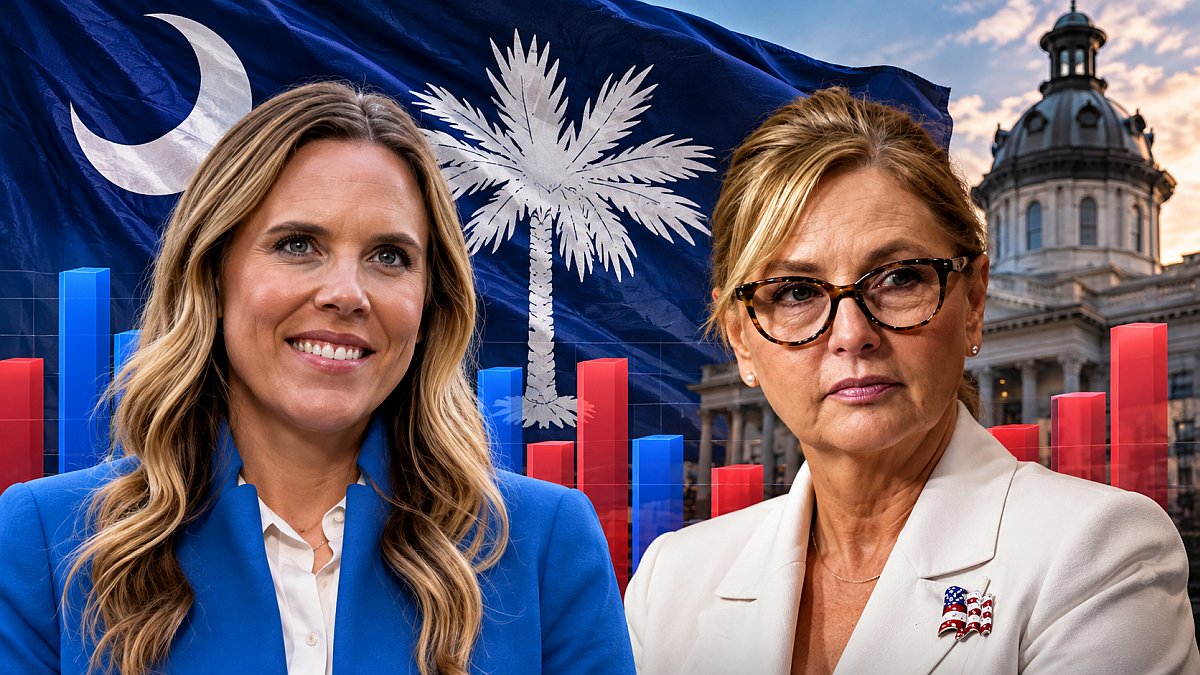
South Carolina is not supposed to be a Senate battleground. Republicans have dominated statewide elections there for years, Donald Trump comfortably carried the state in 2024, and Democrats haven’t elected anyone to statewide office since 2006.
Yet with about five weeks until Election Day, three consecutive public polls have Republican Darline Graham Nordone leading Democrat Annie Andrews by single digits. The newest survey, conducted by Republican-aligned Trafalgar Group, has the race separated by barely one point.
One strange poll in South Carolina would be easy to dismiss. Three of them are harder to ignore, particularly when they arrive alongside warning signs for Republicans in Iowa, Alaska, Kansas and other states that weren’t supposed to consume this much attention. There is also growing evidence from Republican campaigns themselves that the party’s problems extend well beyond a few ugly public polls.
A One-Point Race in South Carolina?
The latest numbers come from Trafalgar Group, which surveyed 1,087 South Carolina voters from Sept. 23 through Sept. 25. The poll has a margin of error of plus or minus 2.9 percentage points.
Trafalgar Group (Sept. 23-25, 1,087 respondents, ±2.9 points)
- Darline Graham Nordone (R): 43.4%
- Annie Andrews (D): 42.3%
- Other: 5.9%
- Undecided: 8.5%
That’s Graham Nordone by just 1.1 points, well within the poll’s margin of error. The poll also found nearly 14.5% either undecided or supporting someone else, leaving plenty of voters still up for grabs.
The partisan makeup of the Trafalgar sample makes the result particularly interesting. According to the poll, 59.1% of respondents identified as Republicans compared with 29.3% as Democrats. Despite that heavily Republican sample, the Republican Senate nominee held only a narrow lead.
And Trafalgar isn’t alone. Two other recent public polls have also found a single-digit race.
InsiderAdvantage (Sept. 8-9, 1,200 likely voters)
- Darline Graham Nordone (R): 45%
- Annie Andrews (D): 43%
Rasmussen Reports (Sept. 14)
- Darline Graham Nordone (R): 48%
- Annie Andrews (D): 43%
None of these polls has Andrews ahead, which is important context. But none shows the kind of Republican advantage normally associated with a South Carolina Senate race either. The RealClearPolling average currently has Graham Nordone at 45.3% and Andrews at 42.7%, a Republican advantage of just 2.6 points.
South Carolina Shouldn’t Be This Close
That’s what makes the numbers noteworthy. Democrats haven’t won a statewide election in South Carolina since 2006, and they haven’t held one of the state’s U.S. Senate seats in more than two decades. When this seat was last on the ballot in 2020, Lindsey Graham defeated Democrat Jaime Harrison by more than 10 points, despite Harrison raising enormous amounts of money and receiving national attention.
This year’s race is unusual because of Graham’s death and the special election that followed. His sister, Darline Graham Nordone, won the Republican nomination after a divisive primary and now faces Andrews, a pediatrician and former congressional candidate. There are also signs that some supporters of defeated Republican Ralph Norman remain unhappy with the result, including talk of a write-in effort that could pull votes from Graham Nordone’s right.
Those circumstances give South Carolina its own political dynamics, and they are good reasons not to assume every close poll there represents a national trend. But election analysts have seen enough to move the race. The Cook Political Report recently shifted South Carolina from Solid Republican to Likely Republican, while RealClearPolitics currently lists the race as leaning Republican.
Graham Nordone remains the favorite in both assessments. The important change is that a South Carolina Senate race is being seriously discussed at all.
This Is Bigger Than South Carolina
South Carolina becomes much more interesting when placed alongside what is happening elsewhere. We just saw it in Iowa, where a Marist poll showing Democrat Josh Turek eight points ahead initially looked like a possible outlier. More polls arrived, including likely-voter surveys, and the broader picture still showed a genuinely competitive Senate race in a state Trump carried by more than 13 points in 2024.
The warning signs aren’t confined to the Senate. Reuters reported over the weekend that Republican groups and donors have poured money into 39 House races that had previously been considered safe. That’s particularly important with control of the chamber resting on a relatively small group of competitive House races.
That’s important because campaigns have information the rest of us don’t. Public polls give us snapshots of the electorate, but campaigns are also looking at their own polling, turnout models, fundraising, volunteer activity, voter contacts and what they are hearing on the ground. When a party suddenly starts spending money to protect dozens of seats it previously considered safe, the spending itself becomes another piece of evidence about the political environment.
That’s Why Halperin’s Warning Is Worth Hearing
Mark Halperin has been sounding increasingly serious warnings about what Republican campaign officials are telling him privately. His recent description of a potential “worst nightmare” for the GOP is dramatic, but the substance of his reporting is more important than the phrase.
Here’s Halperin with Megyn Kelly explaining the situation GOP campaigns are seeing on the ground:
Halperin says Republican professionals working in campaigns are increasingly worried that the party’s problems are spreading beyond the traditional battlegrounds. These aren’t simply outside analysts looking at the same RealClearPolitics averages everyone else can see. They are people involved in the campaigns, with access to internal polling and field information.
That doesn’t mean every private warning will prove correct on Election Day. Campaign operatives can misread an electorate just like public pollsters can, and political professionals have their own reasons for sounding alarms. But the public evidence is increasingly lining up with what Halperin says he is hearing privately.
Republicans are spending heavily to defend House seats they once considered safe. Iowa is polling like a battleground. Alaska has produced an extremely close Senate poll. Kansas has attracted attention that Republicans would rather be spending elsewhere. And now South Carolina has produced three consecutive public polls showing a race within five points.
There Is a Trump Problem Too
All of this is happening as Trump’s approval has weakened and Republicans deal with voter frustration over the economy, the cost of living and the war in Iran. Those issues have begun colliding in particularly painful ways as fuel prices have soared.
We’ve already seen Republican candidates respond. Ashley Hinson in Iowa has broken with Trump over the Iran war while calling for emergency action on diesel prices. Other Republicans in competitive races have also put some distance between themselves and the president as November approaches.
There is evidence of an enthusiasm problem as well. Reuters recently accompanied Republican organizers in Michigan and found the party working to overcome lagging voter energy. Other reporting has found disappointment among some people who voted for Trump in 2024 but are unhappy with what they have seen since.
That doesn’t mean those voters suddenly become Democrats. Many won’t. Some will vote Republican despite their disappointment, others may become more engaged as Election Day approaches, and some may simply stay home. That last group is particularly important in a midterm election, where turnout can matter as much as persuasion.
The distinction also helps explain why a state like South Carolina can become unexpectedly close without suddenly becoming a Democratic state. Democrats don’t necessarily need huge numbers of Trump voters to switch parties. A combination of Democratic enthusiasm, independent movement and some discouraged Republican voters staying home can change the margins considerably.
The Polls Aren’t Predictions, but They Aren’t Meaningless Either
After the polling failures of recent elections, skepticism is healthy. We made exactly that point when Marist showed Democrats eight points ahead in Iowa. A poll is an estimate, not an Election Day result, and individual surveys can be very wrong.
But polling also reflects something real about the political environment at the moment it is conducted. When several independent polls begin showing the same race as competitive, when national congressional polling moves in the same direction, when campaign professionals privately report trouble and when parties begin moving large amounts of money to defend previously safe territory, it becomes harder to dismiss everything as noise.
That still doesn’t tell us what will happen on Nov. 3. Graham Nordone leads every recent independent public poll in South Carolina. Republicans have significant financial resources, and the party still has opportunities of its own in Democratic-held Senate seats. Five weeks is also plenty of time for the political environment to change.
But Republicans shouldn’t have to be worrying about South Carolina. They shouldn’t have to spend heavily protecting dozens of House seats that were supposed to be safe. And they would much rather be spending the final weeks of the campaign expanding the map than defending territory Trump carried comfortably two years ago.
One bad poll can be dismissed. One strange race can be explained away. What Republicans are dealing with now is a growing collection of public polls, internal warnings and campaign spending decisions that are increasingly telling the same story.