
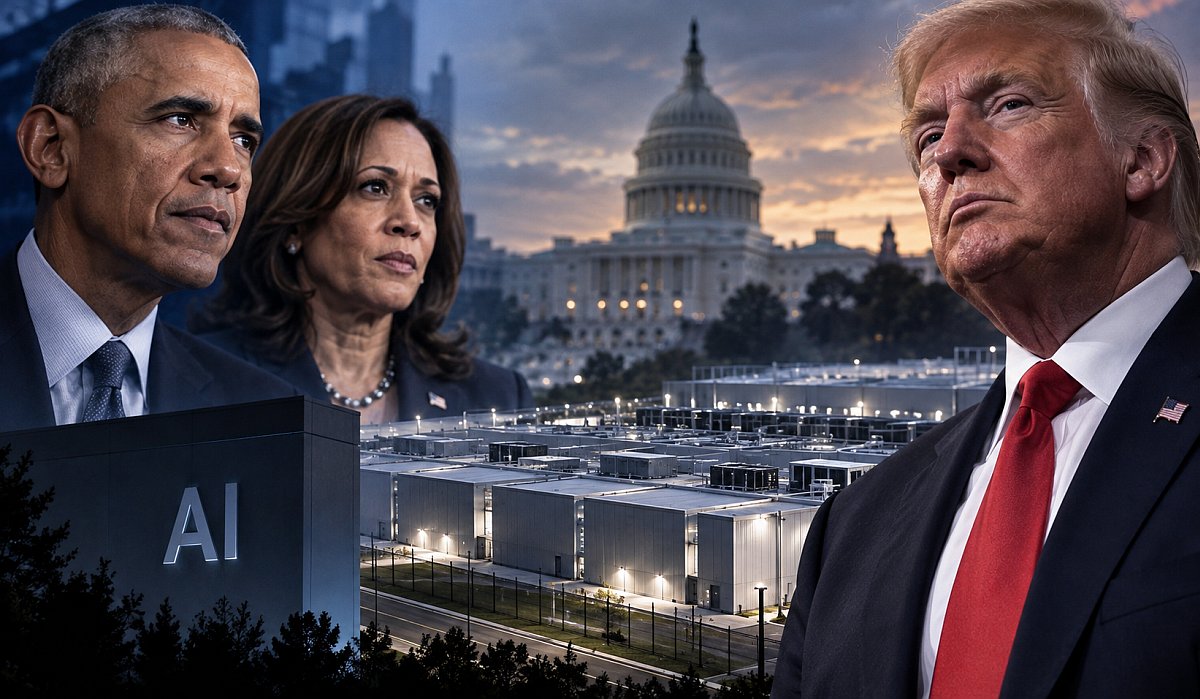
For years, Americans have been warned that artificial intelligence could take their jobs, manipulate their children, spread misinformation and perhaps someday become powerful enough that humans cannot control it.
Then something changed. Almost overnight, artificial intelligence became a political issue in Washington.
Barack Obama is urging Democrats to put AI near the center of their agenda. Kamala Harris and other prominent Democrats are calling for new safeguards. Elizabeth Warren now supports pausing the development of the most advanced AI systems. More than 100 House Democrats demanded that Congress remain in Washington to address AI risks before leaving for the midterm campaign.
President Trump has gone emphatically in the other direction. He is defending rapid AI development, defending the enormous data centers needed to power it and dismissing some of the most dire warnings as a “HOAX.” His argument is that America is in a technological race with China and cannot afford to stop running.
It would be easy to ignore this as another partisan policy debate. The timing suggests something more interesting is happening. Artificial intelligence is becoming a campaign issue, and both parties are beginning to understand what they can get out of the fight.
Democrats Have Discovered an Opening
The sudden Democratic interest is not simply an impression. Former President Obama told Democrats at a private fundraiser last week that AI should become a major part of the party’s agenda.
“Certainly if I were running for president next year, this would be one of my central agendas, and I would have a very clear plan,” Obama said, according to a transcript of his remarks reported by The Washington Post.
Obama went further. He urged House Minority Leader Hakeem Jeffries to develop a framework for a public debate over AI if Democrats capture the House in November.
Other Democrats quickly began talking about the issue. Warren announced Wednesday that she supports a pause in advanced AI development. Harris has called for greater federal oversight. Jeffries declared this week that “the AI safety issue is not a hoax” and said Congress should act before leaving Washington.
The change has been measurable. The Post found that mentions of AI, OpenAI and Anthropic among prominent politicians viewed as potential presidential candidates were six times as common last week as they had been during the comparable period a month earlier.
More revealing is what has been happening away from the cameras. According to the Post, a group of Democratic strategists met last week specifically to discuss AI policy and how Democrats could “own the issue” heading toward the next presidential election.
That does not prove that every Democrat talking about AI received the same talking points, but clearly a memo went out somewhere and everyone decided to get on board.
One Democratic strategist made the electoral calculation particularly clear during a strategy meeting reported by Politico. Morris Katz argued that if Democratic leaders promised to pass a moratorium on data centers after winning Congress, the party would pick up House seats. That’s not a coincidence, it’s a policy choice driven by the current political winds.
AI Is Almost Perfect for the Politics of Anxiety
Democrats appear to have recognized something important about artificial intelligence. Most Americans are not AI researchers. They do not know exactly how a large language model works, how close anyone is to artificial general intelligence or whether today’s warnings about superintelligence will look prescient or ridiculous ten years from now.
What people understand is uncertainty, and liberals love serving up heaping portions.
They understand being told that software might eventually do their job. Parents understand worrying about what an AI chatbot might tell their children. Workers understand wondering whether the next productivity breakthrough means their company will need fewer of them. And increasingly, people understand data centers. They can see those as physical representations of this technology.
That creates a political opportunity for Democrats to present themselves as the people standing between ordinary Americans and a powerful technology industry moving extraordinarily fast. The argument is familiar even if the technology is new: corporations have enormous incentives to push forward, government is behind the curve and somebody needs to protect the public.
Some of the underlying concerns are real and should not be dismissed simply because politicians have discovered them. AI systems already present difficult questions involving employment, cybersecurity, privacy, education and fraud. Some of the people calling for stronger safeguards are the executives and researchers building these systems themselves.
But legitimate concerns can also become politically useful concerns. Those two things can be true at the same time.
Trump Has Chosen the Other Side of the Argument
Trump is making a very different bet.
“AI taking over the World, destroying Humanity, and all other things bad, is a HOAX,” Trump wrote this week. In another post, he complained that there is a “SICK conspiracy going on against AI and Data Centers” and said China would be the beneficiary if the United States slowed development.
The president’s argument is not difficult to follow. AI could become one of the most important technologies of the century. The United States currently has enormous advantages in the field. China wants those advantages. Why would America voluntarily slow itself down? Trump is correct on the merits, the hype is overblown to the point of paranoia. Many of the previous dire predictions from just the past few years never materialized as far as AI goes.
That gives Trump a message that fits comfortably with the rest of his politics: build in America, attract enormous investment and beat China. It also explains why the White House has become so enthusiastic about data centers. Advanced AI requires extraordinary amounts of computing power, and computing power requires buildings, chips and enormous quantities of electricity.
There is just one problem with that argument. A lot of Americans do not want those buildings near them.
The Data Center Is Where AI Becomes Real
The abstract AI debate asks people to think about what a computer might be capable of five or ten years from now. The data center debate asks whether an enormous industrial complex should be built down the road.
That is a much easier political question for voters to understand. Data centers can bring investment, construction jobs and tax revenue. They are also enormous electricity consumers. New facilities can require additional generation and transmission infrastructure, while some projects raise concerns about water consumption, noise and land use.
Northern Virginia has been living with this fight longer than almost anywhere else in America. The region became the country’s dominant data center hub long before the current AI boom, and arguments over transmission lines, electricity demand, land use and the location of new facilities have become a regular feature of local politics.
Now the rest of the country is getting a version of the same argument. And this is where the partisan lines become much less useful. Opposition to unrestricted data center development is not confined to Democrats. Republican voters do not necessarily want a massive data center built near their homes either.
Republicans Know They Have a Problem
Perhaps the most revealing evidence comes from Trump’s own political orbit.
Tony Fabrizio, Trump’s longtime pollster, circulated a memo this week advising Republican candidates on how to handle the data center issue. According to Axios, Fabrizio warned Republicans against offering unconditional support for more data center construction.
His polling found that voters were considerably more receptive to data centers when developers were required to meet enforceable conditions involving electricity costs, power generation and natural resources. His advice was essentially to support AI infrastructure while making clear that local residents should not be stuck with the costs.
Notice the difference between that message and Trump’s. The White House is talking about China and America’s need to win the AI race. Republican candidates are being advised to talk first about electric bills, water and protecting the communities where these facilities will actually be built.
That is not necessarily a disagreement over whether America should develop AI. It is a recognition that national economic policy and local politics are two different things. A voter can believe America should beat China in artificial intelligence and still be furious about a 500-acre data center proposed near his home. He can support Trump and still wonder why his electric grid should be rebuilt for one of the richest technology companies in the world.
Democrats have noticed the gap.
Congress Suddenly Finds Something It Can Agree On
If there were any doubt that data centers have become politically sensitive, the House provided an answer Wednesday.
On one of its final days in Washington before members left to campaign, the House passed the Ratepayer Protection Act by a vote of 417 to 3. The bill requires state utility regulators to consider standards designed to prevent large electricity users such as data centers from shifting the cost of the infrastructure they require onto existing customers. It does not ban data centers, and supporters continue to describe AI infrastructure as important to American technological leadership.
The vote was nevertheless extraordinary for a Congress that has struggled to agree on much of anything. Republican Rep. Gabe Evans of Colorado, one of the bill’s sponsors, framed the principle simply: data centers should pay for the infrastructure necessary to serve them rather than passing those costs to families and small businesses.
Even Republicans representing rural communities are emphasizing the distinction. Kentucky Republican Hal Rogers said after voting for the bill that AI growth needs guardrails to make sure rural families and businesses do not end up paying the bill. That is where the politics of AI in 2026 are becoming much more complicated than a simple Republican versus Democratic argument.
Democrats Can Play Defense Against the Unknown
The Democratic political opportunity is fairly obvious.
Trump has attached himself to rapid AI development. He has attached himself to the data centers required to support it. He has attached American AI development to the competition with China. And now he has publicly mocked some of the warnings about where the technology could lead.
Democrats can position themselves on the other side without having to persuade voters that every frightening prediction about AI will actually happen.
They can ask whether AI will eliminate jobs. They can ask what children are being exposed to. They can question whether companies should be allowed to develop increasingly powerful systems without independent oversight. And when the conversation becomes too abstract, they can point to electric bills and data centers.
That is a potentially useful political position because the technology is moving faster than public understanding of it. The unknown itself becomes part of the argument.
The message does not have to be that artificial intelligence is going to destroy humanity. It can simply be that nobody really knows where this is going, Trump wants to accelerate it anyway and Democrats want to put some brakes and guardrails on the process.
That is a much easier political message to communicate than explaining transformer architecture.
Trump Has an Argument Too
There is an obvious response from Trump and Republicans.
America cannot regulate its way to technological leadership while China keeps building. AI has the potential to produce enormous gains in medicine, science, manufacturing and productivity. Data centers represent billions of dollars in investment and are the physical infrastructure behind an industry in which American companies currently lead much of the world.
There is also a danger that politicians respond to uncertainty by regulating technology they do not understand any better than the voters they are trying to reassure.
That gives Trump a straightforward counterargument: Washington has panicked before, technological disruption has happened before, and allowing fear to slow American companies could produce exactly the outcome China wants.
The weakness in that argument remains the same. Somebody still has to build the data centers somewhere.
Everyone Has Suddenly Found Their AI Position
What makes the past week so interesting is not that concerns about artificial intelligence suddenly appeared. Those concerns have existed for years.
What changed is that Washington discovered their political value. Obama is telling Democrats to make AI a major agenda item. Democratic strategists are discussing how to own the issue. Potential presidential candidates are suddenly talking about it far more frequently. Warren is calling for a pause in advanced development. House Democrats wanted to remain in Washington to pass safeguards.
Trump, meanwhile, has drawn an equally clear line. Keep building. Do not panic. Do not let regulation hand China an advantage. And caught between those two messages are Republican candidates looking at voters who may agree completely with Trump’s desire to beat China while having no desire whatsoever to put another data center in their county.
That may be the most important part of this new political fight. Democrats did not invent public anxiety about AI, and Republicans did not invent the economic case for developing it. Both sides have discovered that those arguments can now be organized into campaign messages.
For years, AI was something Americans were told would change the future. Seven weeks before an election, Washington has finally figured out that it might change some votes too.