
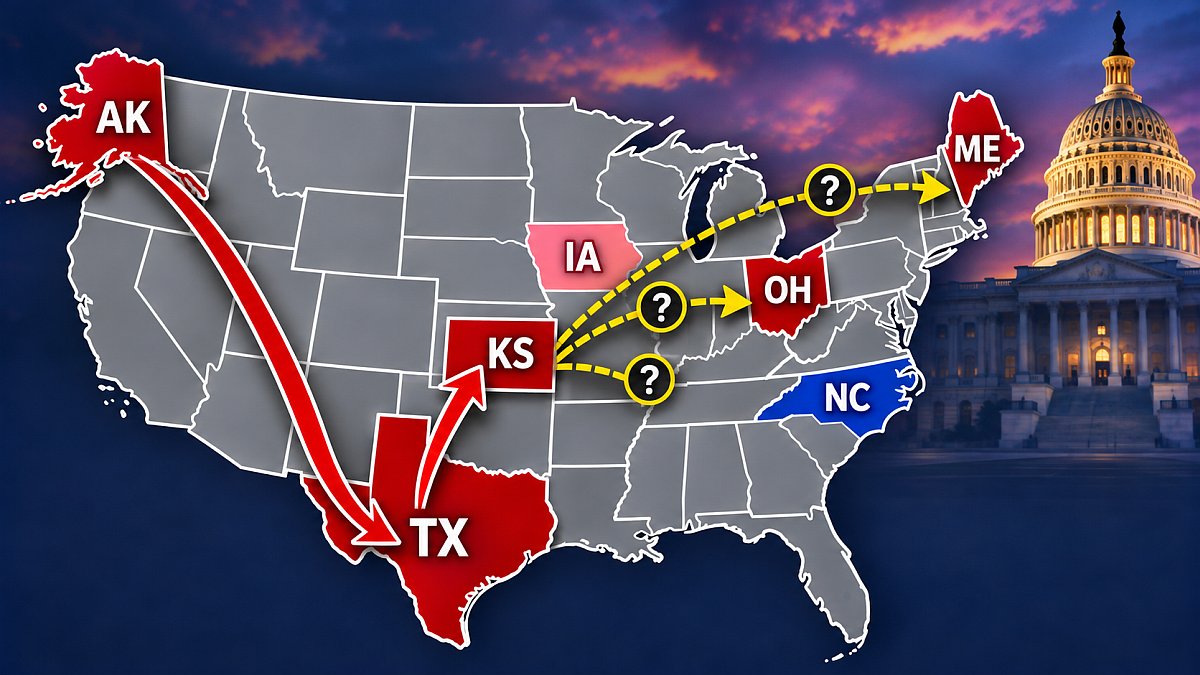
Republicans enter Election Day in a difficult position in the battle for the Senate, but the math is not nearly as hopeless as some of the late polling might make it appear.
The GOP currently holds a 53-47 majority, and Democrats need a net gain of four seats to take outright control. Republicans have one important advantage in the arithmetic: they only need to get back to 50 seats. A 50-50 Senate would leave Vice President JD Vance with the constitutional power to break tie votes, allowing Republicans to retain control of the chamber.
That leaves four fairly clear Republican survival paths. They all depend on one major assumption, however: Ashley Hinson has to hold Iowa, where the final polling is extremely close.
The Republican Path Starts at 50, Not 51
The easiest way to understand the map is to start with the Republican seats that appear relatively secure and then look at the endangered group. If North Carolina flips Democratic and Iowa remains Republican, the GOP can still preserve control by winning enough of Texas, Alaska, Kansas, Ohio and Maine.
Those five states are where the paths begin to separate. Current polling favors Democrats in all five, but most of the margins are small enough that Republicans do not need anything resembling a national miracle to get back to 50.
Cook Political Report’s final Senate analysis gives Democrats a slight advantage for control, but it also keeps seven Senate races in its Toss Up category and explicitly says both parties still have viable paths to the majority.
Four Paths to Republican Control
- Path 1: Texas and Alaska both stay Republican. The GOP then needs just one of Kansas, Ohio or Maine
- Path 2: Texas stays Republican, but Alaska flips. Republicans need two of Kansas, Ohio and Maine
- Path 3: Alaska stays Republican, but Texas flips. Republicans again need two of Kansas, Ohio and Maine
- Path 4: Texas and Alaska both flip. Republicans have to sweep Kansas, Ohio and Maine
The first scenario gives Republicans the most room to maneuver. If they can hold both Texas and Alaska, they only need one more survivor from Kansas, Ohio or Maine to reach 50. Lose either Texas or Alaska, and the pressure on the remaining battlegrounds increases considerably.
Path 1: Hold Texas and Alaska, Then Find One More Seat
This is the broadest Republican route because it leaves three different opportunities to find the deciding 50th seat. Texas, Alaska and Kansas would do it. So would Texas, Alaska and Ohio. Even Susan Collins winning Maine could provide the final seat if Kansas and Ohio both fall.
The late polling makes Texas and Alaska uncomfortable starting points, but neither race is far out of reach. As of Nov. 2, the RealClearPolling averages had Democrat James Talarico ahead of Ken Paxton by roughly 2.5 points in Texas and Mary Peltola ahead of Dan Sullivan by about 1.4 points in Alaska.
Those margins look very different from the states’ presidential results. Trump won Texas by roughly 14 points and Alaska by about 13 in 2024, which shows the size of the Republican electorate available in both states. It does not mean those voters will automatically support the Republican Senate candidates, but it explains why both races remain plausible GOP holds despite Democratic polling leads.
Kansas May Be the Most Interesting 50th Seat
If Texas and Alaska hold, Kansas may be the cleanest example of how Republicans could get to 50. Trump won the state by more than 16 points in 2024, and Kansas Republicans held a voter-registration advantage of roughly 380,000 as of Oct. 1.
Yet Republican Sen. Roger Marshall is trailing Democrat Adam Hamilton in the current polling. Emerson’s late-October survey had Hamilton ahead 50% to 47% after undecided voters’ leanings were included, with Hamilton performing especially well among independents.
That creates one of the central tensions on the Senate map. Kansas has very strong Republican fundamentals, but the Senate race itself has behaved much more competitively than the state’s recent presidential voting would suggest. The GOP does not need Kansas specifically, but a Marshall victory would make several Republican control scenarios much easier.
Ohio Gives Republicans Another Route
Ohio is almost the mirror image of Kansas. Its Republican fundamentals are also strong, and Trump carried the state by 11.2 points in 2024, but Democrat Sherrod Brown has already demonstrated that he can run substantially ahead of the Democratic presidential ticket.
Brown lost his 2024 Senate race by only about 3.6 points even while Trump won Ohio by double digits. That roughly 7.6-point difference illustrates why the presidential margin alone is not enough to assume Republican Jon Husted will automatically win this year’s special election.
Still, the current polling deficit is relatively modest. Brown leads by roughly three points in the late average, putting Ohio firmly in the group of races where even a normal-sized polling miss could change the result. Inside Elections rates Ohio Tilt Democratic while treating Kansas as a Toss Up.
Do Not Forget Susan Collins
Maine gives Republicans a very different kind of path because Collins has spent much of her career outrunning the Republican presidential ticket. She won reelection by 8.6 points in 2020 even while Joe Biden comfortably carried Maine, and public polling before that election frequently showed Democrat Sara Gideon ahead.
That history matters because Republicans do not necessarily need Collins to win a conventional Republican electorate. They need her to rebuild enough of the crossover coalition that has repeatedly separated her from national GOP candidates.
The current numbers show why that cannot be taken for granted. Late polling has Democrat Troy Jackson ahead, including a Marist survey showing him leading 49% to 47% among likely voters and performing well with independents. But if Collins does outperform her polling again, she gives Republicans another way to reach 50 without winning every red-state battleground.
Path 2: Texas Holds, Alaska Flips
Alaska cannot simply be penciled into the Republican column because Peltola has already demonstrated substantial crossover appeal. She won Alaska’s 2022 House race and then lost narrowly in 2024 even as Trump carried the state by roughly 13 points.
If Peltola defeats Sullivan, Republicans can still preserve control by holding Texas and then winning two of Kansas, Ohio and Maine. Texas plus Kansas plus Ohio gets them there, while Collins can substitute for either Kansas or Ohio if she wins.
This scenario is important because it recognizes that not every state has to move in the same direction. Republicans could outperform their polling nationally and still lose Alaska because of Peltola’s individual appeal while surviving in Texas, Kansas and Ohio.
Path 3: Alaska Holds, Texas Flips
Texas has one of the strongest Republican voting histories of any state on this battleground list, but Republicans cannot treat it as guaranteed. Talarico has led Paxton in much of the late polling, and polling from the University of Texas has shown somewhat weaker consolidation behind Paxton among Republican identifiers than Talarico receives among Democrats.
If Democrats do flip Texas but Sullivan survives in Alaska, Republicans still have several routes to 50. Alaska plus Kansas plus Ohio works, but so does Alaska plus Kansas plus Maine.
That second combination is particularly interesting because it allows Republicans to lose both Texas and Ohio and still retain Senate control through Sullivan, Marshall and Collins. It is a reminder that the Republican path does not depend entirely on saving Texas.
Path 4: Lose Texas and Alaska, Then Sweep the Rest
This is where the Republican road becomes much narrower. If Democrats win North Carolina, Texas and Alaska, the GOP has already used up the three seats it can afford to lose while still finishing at 50.
Republicans would then have to win Kansas, Ohio and Maine, with no room for another loss. Each individual victory has a plausible case behind it: Kansas has a large Republican base, Ohio has shifted substantially toward the GOP in recent elections, and Collins has a long record of crossover support.
The problem is having all three happen simultaneously when current polling favors the Democratic candidate in each contest. This route exists, but unlike the first three scenarios, it leaves Republicans no spare seat and no alternative if one of those candidates falls short.
There Is One Big Catch: Iowa
Every one of these four paths assumes Republicans hold Iowa, and that is not a trivial assumption. Hinson leads Democrat Josh Turek by only a fraction of a point in the final RealClearPolling average, making Iowa one of the closest races on the entire Senate map.
If Iowa flips Democratic and Republicans do not make an offsetting pickup elsewhere, the math becomes considerably harder. Instead of needing three of Texas, Alaska, Kansas, Ohio and Maine, Republicans would need four.
That means a Texas-and-Alaska hold would no longer leave Republicans needing only one of Kansas, Ohio or Maine. They would need two. If either Texas or Alaska also flips, Republicans would need all three of Kansas, Ohio and Maine. If both Texas and Alaska flip along with Iowa, even sweeping those three would leave the GOP at only 49 seats.
Could the Polls Simply Be Wrong?
A polling miss of only a few points could dramatically reshape this map, but recent history is a warning against simply adding an automatic Republican bonus to every race.
Texas offers a good example in both directions. In 2018, the final RealClearPolling average had Ted Cruz ahead by 6.8 points, but he won by only 2.6, meaning the polls overstated the Republican margin by more than four points. In 2024, the average had Cruz ahead by 4.4, and he won by 8.5, understating the Republican margin by roughly four points.
A miss of that size in Republicans’ favor this year could reverse several of the narrow Democratic polling leads. A miss in the opposite direction could make the GOP map considerably worse. Polling error matters precisely because these races are so close, but its direction cannot be known in advance.
The Republican Path Is Narrow, but It Is Easy to Understand
The simplest version is this: Republicans need to hold Iowa and then win any three of Texas, Alaska, Kansas, Ohio and Maine. Texas and Alaska are especially important because holding both gives the GOP three different chances to find the final seat, while losing both forces Republicans to sweep the remaining three.
That is why Election Night could become a seat-by-seat exercise rather than a single national wave. Republicans can lose several races and still retain control, but once Texas, Alaska or Iowa begin slipping away, the margin for error shrinks quickly.
Cook’s final analysis gives Democrats a slight advantage in the overall fight, and Inside Elections projects a Democratic gain of four to six seats. But the underlying math also explains why Republicans still have several realistic combinations that end at exactly 50.
Follow the latest polling and individual battlegrounds in our 2026 Senate election guide.