
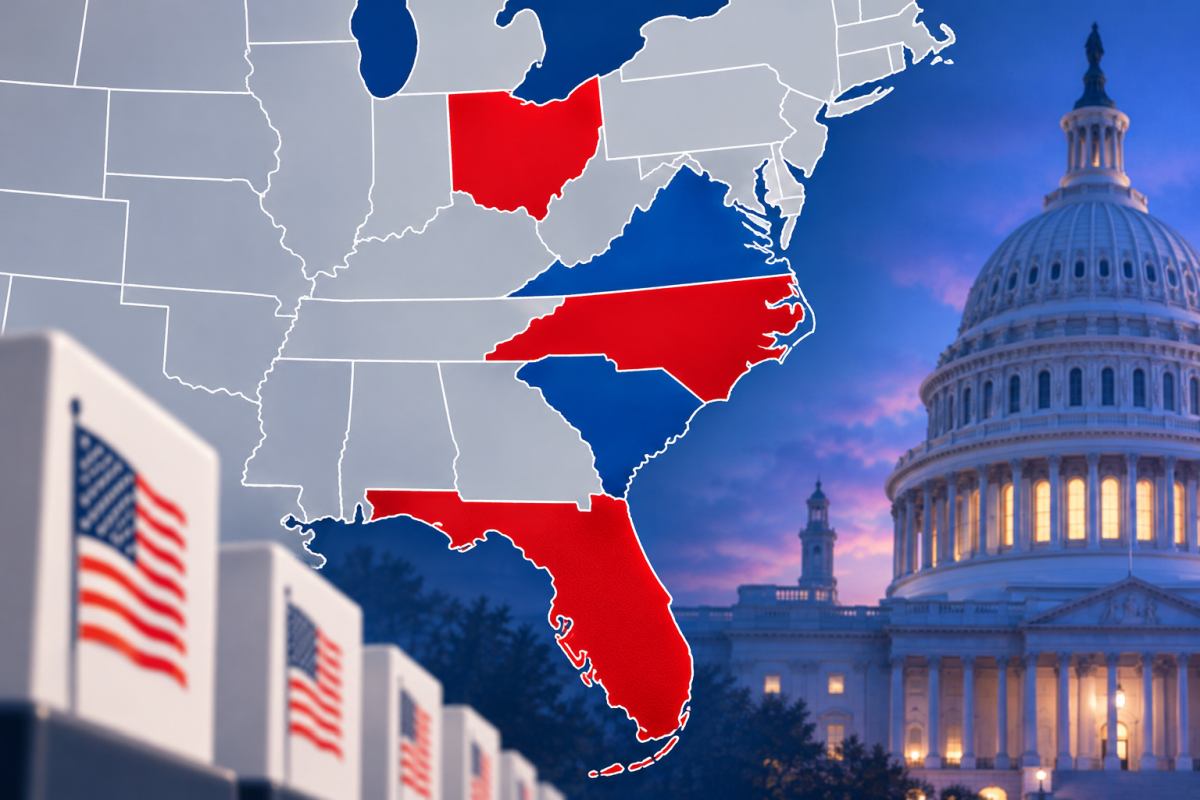
Election Day is Tuesday, Nov. 3, and while the voting is still a few days away, it is already possible to identify some of the first races worth watching once results begin arriving Tuesday night.
These are not necessarily the biggest races on the ballot, and no single contest will tell us who controls Congress. What makes them useful is timing. Because they begin reporting relatively early, their margins could provide the first clues about whether the final polls and forecasts are roughly right, whether Democrats are outperforming expectations, or whether Republicans are holding up better than many forecasters expect.
Virginia’s 2nd District Could Be an Early House Signal
Virginia polls close at 7 p.m. ET, putting the state near the front of the Election Night calendar. One of the first House races worth watching will be the rematch between Republican Rep. Jen Kiggans and Democrat Elaine Luria in Virginia’s 2nd Congressional District.
The district is closely divided politically, and major handicappers have treated the race as highly competitive. Axios highlighted it as one of the early contests that could help show whether strong Republican incumbents are surviving in swing districts or whether a broader Democratic House advantage is beginning to show up in actual returns.
The useful number may be the margin as much as the eventual winner. If Kiggans is running competitively in a district this balanced, Republicans may feel better about similar House seats elsewhere. If Luria opens a clear advantage, it would be an early sign that the House environment is moving in the direction many of the final forecasts expect.
South Carolina’s Senate Race Could Give Us Another Early Clue
South Carolina also closes at 7 p.m. ET, and the state generally reports results relatively quickly. Republican Darline Graham is facing Democrat Annie Andrews in a race that has received considerably more national attention than a South Carolina Senate contest normally would.
Again, the margin could matter almost as much as the result. South Carolina remains a Republican-leaning state, so a routine GOP advantage would not tell us much about the rest of the country. A noticeably tighter contest, however, could suggest that Democratic strength is extending into states Republicans would normally expect to carry comfortably.
That is why this is the kind of race worth checking early Tuesday even if it is not expected to be the contest that ultimately decides Senate control.
Ohio Could Be the First Major Statewide Test
Ohio polls close at 7:30 p.m. ET, and the state may provide the first major statewide test of the night. Republican Jon Husted is facing Democrat Sherrod Brown for U.S. Senate, while Republican Vivek Ramaswamy is running against Democrat Amy Acton for governor.
Late polling has shown Democrats competitive in both races. A Marist poll conducted Oct. 15-18 had Acton ahead of Ramaswamy 50% to 43% among likely voters, while several recent Senate surveys have also shown Brown narrowly ahead of Husted.
That makes Ohio especially useful as a benchmark. If the first large batches Tuesday night look roughly like the polling, the broader election may be unfolding close to expectations. If either party is clearly outperforming those late numbers, Ohio could provide one of the first indications that the national picture is shifting.
North Carolina Comes at the Same Time
North Carolina also closes at 7:30 p.m. ET, giving viewers another important statewide contest to watch almost immediately after Virginia and South Carolina. Former Democratic Gov. Roy Cooper is facing Republican Michael Whatley for the Senate seat being vacated by Thom Tillis.
North Carolina has produced a long run of extremely close statewide races, making it a useful place to judge whether either party is having an unusually strong night. Because large batches of early and absentee votes are often included in the initial reporting, the first returns can also give viewers a meaningful early look at the shape of the contest.
No one should treat the first batch as the final result, but the margin between Cooper and Whatley could still become an important early comparison point for the Senate map.
Florida Becomes Useful at 8 p.m.
Most Florida polls close at 7 p.m. ET, but statewide results are generally held until voting ends in the Central Time portion of the Panhandle at 8 p.m. ET. Florida also tends to report quickly, which makes it useful for anyone trying to understand the national environment early in the evening.
Axios specifically points to Florida’s 14th Congressional District as a race to watch. The district was redrawn from one Kamala Harris carried by about eight points into one Donald Trump carried by roughly 11, making it a useful test of how far any national Democratic movement is reaching.
Florida’s statewide governor and Senate margins will provide additional context. The state has moved substantially toward Republicans in recent elections, so any major deviation from recent GOP performance would be worth noting even before the later battleground states begin reporting.
Do Not Read Too Much From One Race
The important thing Tuesday night will be to look for patterns rather than declaring a national trend from one result. A House district can move because of a particularly strong candidate, a Senate race can behave differently because of local issues, and early vote batches can temporarily make a race look more dramatic than it really is.
But several early races pointing in the same direction can become meaningful. If Democrats are outperforming expectations in Virginia, South Carolina and Ohio at roughly the same time, that would be a notable signal. If Republicans are holding their ground or doing better than late polling suggested across those same states, that would tell us something different.
The goal is not to predict the entire night from the first hour. It is simply to know which results are worth paying attention to before the much larger 8 p.m. and 9 p.m. closing waves begin.
The Bigger Battlegrounds Come Later
By Tuesday’s 8 p.m. and 9 p.m. closing waves, many more of the races that could actually determine control of Congress will begin reporting. Pennsylvania, Michigan, Iowa, Arizona, Wisconsin and New York will all add major Senate, governor and House contests to the board.
Those later races will ultimately matter more than most of the early indicators. But if you want to know what kind of Election Night may be developing before the country reaches those later waves, Virginia, South Carolina, Ohio, North Carolina and Florida are good places to start.
See the full schedule in our 2026 poll closing times guide, and follow our 2026 Senate election guide and 2026 House elections guide for the latest battlegrounds.