
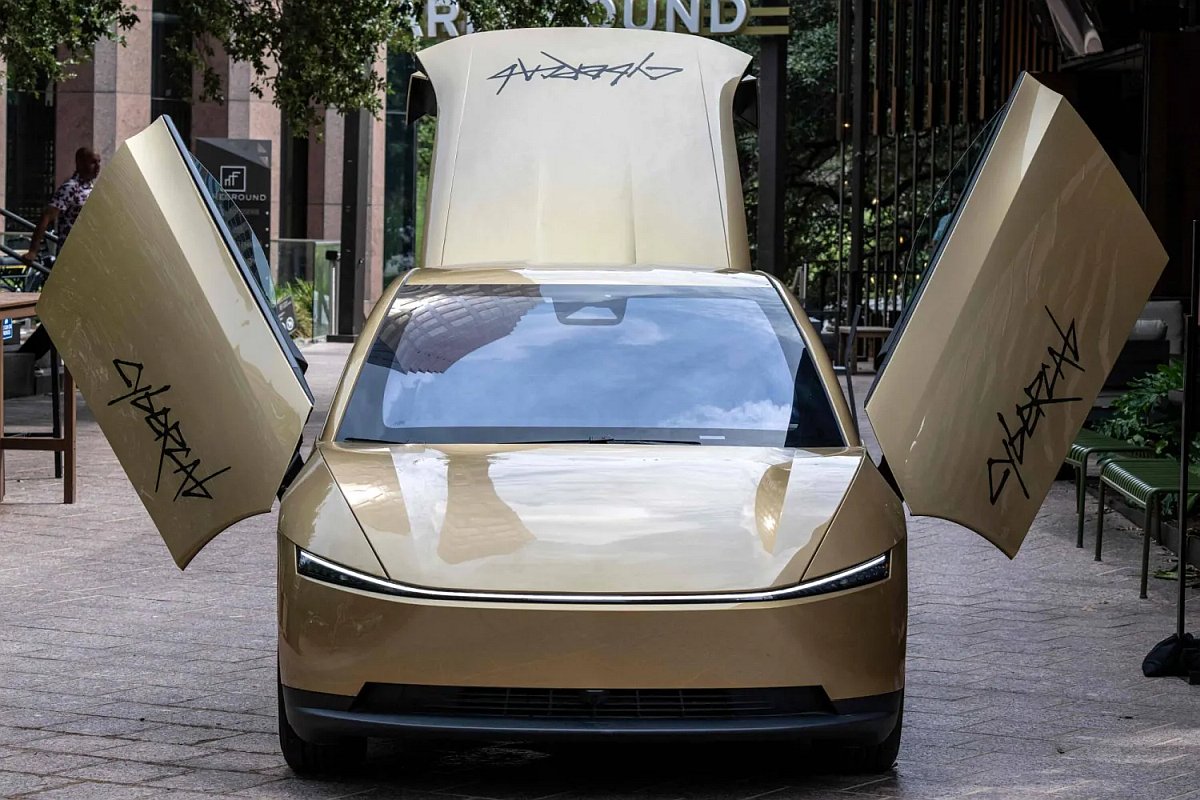
Elon Musk had himself a Thursday. In Austin, Tesla began offering rides in its new Cybercab, the purpose-built autonomous vehicle designed for the company’s Robotaxi service. It has two seats, no steering wheel and no pedals, and it looks considerably more like something from the future than the Uber that picked you up from the airport last week.
At roughly the same time, Musk was getting back into another business he knows pretty well: spending money to elect Republicans. America PAC, the political group Musk created during the 2024 election, has made its first major expenditures of the 2026 midterms, spending more than $800,000 across more than a dozen competitive House and Senate races.
The amount itself isn’t particularly enormous by modern campaign standards, especially for Musk. He spent more than a quarter-billion dollars helping elect Donald Trump in 2024, and America PAC reportedly could spend as much as $120 million before November. What’s much more interesting is where Musk has decided to put his first batch of money.
Ken Paxton Gets the Biggest Check
The largest expenditure went to a Republican we’ve been talking about quite a bit lately: Ken Paxton. America PAC spent roughly $248,000 supporting Paxton’s Texas Senate campaign, as the Republican tries to fend off Democrat James Talarico in a race that has become much more competitive than Republicans expected.
Paxton can certainly use the help. Talarico has badly outraised and outspent him, several recent polls have shown the Democrat with a narrow advantage, and outgoing Republican Sen. John Cornyn isn’t exactly rushing to rescue the man who knocked him out of the Republican primary. Cornyn recently called Paxton “lazy,” criticized his fundraising and said he plans to direct his own donor network toward Republican candidates in other states.
Apparently Paxton may not need Cornyn’s money if Elon Musk is willing to step in.
There is also an obvious reason Texas is particularly interesting when we’re following Musk’s political spending. Musk has built an enormous business presence in the state. Tesla is headquartered in Austin, Gigafactory Texas sits just outside the city, SpaceX moved its headquarters to Starbase in South Texas, and now Tesla is launching the Cybercab there too.
That doesn’t mean a roughly $248,000 expenditure for Paxton is some kind of corporate quid pro quo, and there is no evidence that it is. Musk has been an outspoken supporter of Republicans for years and has plenty of ideological reasons to prefer Paxton to Talarico. But when one of the world’s richest businessmen becomes one of the country’s biggest political donors, where he chooses to spend is worth watching.
Musk Is Shopping in the Senate Battlegrounds
Texas isn’t the only place America PAC is showing up. The group’s first expenditures look remarkably similar to a list of Senate races Republicans most need to survive if they want to keep control of the chamber.
- Texas: Roughly $248,000 supporting Ken Paxton.
- Maine: Roughly $170,000 supporting Sen. Susan Collins.
- Ohio: Roughly $106,000 supporting Sen. Jon Husted.
- New Hampshire: More than $90,000 opposing Democrat Chris Pappas.
- Alaska: Spending to support Sen. Dan Sullivan.
Those aren’t random names. Collins, Husted, Sullivan and Paxton are all running in races that could help determine control of the Senate. New Hampshire is an open Democratic-held seat where Republicans would love to go on offense, making spending against Pappas another potentially valuable investment.
America PAC is also putting money into competitive House contests, including support for Pennsylvania Republicans Scott Perry and Ryan Mackenzie and Virginia Republican Jennifer Kiggans. Those races matter for an obvious reason: Republicans don’t have many House seats to spare.
Politics Meets the Musk Empire
There is another layer to Musk’s spending map. SpaceX is a major federal contractor, Tesla operates in a heavily regulated industry, and Musk’s companies routinely deal with Washington on everything from defense and space launches to autonomous-vehicle rules. Some of the politicians getting America PAC’s help serve on committees involved with defense or federal spending.
That makes the geography and recipients worth following, but it doesn’t make the spending unusual or improper. Labor unions spend heavily to elect politicians who support union priorities. Energy companies back politicians whose policies affect energy. Trial lawyers, environmental groups, cryptocurrency companies and virtually every other major interest in American politics do the same thing. Musk is simply capable of doing it on a scale available to very few individuals.
Texas is the most obvious overlap between Musk’s politics and business interests, and perhaps the most interesting. Tesla, SpaceX and Musk himself have increasingly planted their flags there, while Texas Republicans have generally embraced the kind of lower-tax, lighter-regulation environment Musk prefers. Now his biggest initial Senate expenditure is going to the Republican trying to keep one of the state’s Senate seats red.
About That Cybercab
Politics aside, the machine Musk put on Austin’s streets this week is pretty remarkable. The Cybercab is a two-seat vehicle built specifically for autonomous operation, which is why Tesla dispensed with the steering wheel, brake pedal and accelerator altogether. You get in, tell Tesla’s Robotaxi service where you’re going and trust the computers to handle the rest.
That’s either incredibly cool or slightly terrifying depending on how much faith you have in computers navigating Austin traffic. Personally, I love my Tesla, so bring it on.
The rollout is still limited, and Musk has plenty left to prove. Federal safety regulators are evaluating the vehicle, and Tesla will have to demonstrate that it can safely scale from a relatively small Austin operation into the enormous autonomous network Musk has been promising for years.
But this isn’t another Musk presentation featuring a prototype and a promise about something coming someday. Cybercabs are now carrying passengers in an American city. Whatever ultimately happens with Tesla’s autonomous ambitions, that’s a milestone worth noticing and a sign of what’s next to come.
Musk Never Really Left Politics
The bigger political story is that Musk appears to be coming back after suggesting he wanted to spend less time and money on politics. His relationship with Trump went through a very public rupture after the opening months of Trump’s second term, and Musk said he intended to reduce his political spending and concentrate more heavily on his businesses.
That retreat apparently had limits. America PAC remained active, and the organization could reportedly spend as much as $120 million during the 2026 cycle. The roughly $800,000 disclosed so far may therefore be less a major investment than a preview of where Musk intends to deploy much larger sums.
That could matter enormously for Republicans because Musk’s 2024 political operation wasn’t merely about buying television advertisements. America PAC invested heavily in turnout and field operations aimed at lower-propensity voters, precisely the kind of voters Republicans worry may stay home when Trump himself isn’t on the ballot.
If Musk deploys that operation across competitive House and Senate races this fall, this week’s $800,000 will look like pocket change compared with what comes next.
Follow the Money From Here
For now, Musk’s initial choices tell us something. He’s helping Paxton in the state where much of his business empire now lives. He’s defending vulnerable Republican senators in Maine, Ohio and Alaska. He’s attacking a Democrat in New Hampshire, where Republicans have an opportunity to steal a Senate seat, and he’s putting resources behind House Republicans whose races could determine control of Congress.
Some of those choices intersect with Musk’s business interests. All of them line up with his broader political shift toward the Republican Party. The interesting question over the next two months will be where America PAC goes when the checks get substantially larger.
Musk spent much of the last year suggesting he wanted less politics and more time running his companies. This week, he managed to do both. His driverless Cybercabs hit the streets of Austin while his political money started landing in some of the most important Republican campaigns in America.
The Cybercab may not have a steering wheel, but Elon Musk apparently still wants a hand on the wheel in Washington.