
Millions of Americans hitting the road this Labor Day weekend are getting an unpleasant reminder at the gas station: cheap energy hasn’t exactly arrived. The national average for regular gasoline is running above $4 a gallon, nearly a dollar higher than it was a year ago, and Labor Day is on track to set a new nominal record at the pump.
AAA reported the national average at $4.14 heading into the holiday weekend, up from $3.19 a year ago. The previous Labor Day record was $3.82, set in 2012, and AAA says the national average has never before been above $4 on the holiday. Those aren’t inflation-adjusted records, an important distinction, but nobody standing beside a gas pump needs an economics lecture to know that $4 gasoline hurts.
It also presents a particularly uncomfortable problem for President Trump. He spent years promising Americans cheaper energy and arguing that aggressive domestic production would bring gasoline prices down. For a while, things were moving in exactly that direction. Then came the war with Iran.
$4 Gas Wasn’t Part of the Plan
The connection between the conflict and today’s energy prices isn’t particularly mysterious. AAA says continued volatility in the Strait of Hormuz has pushed crude oil back into the $90-per-barrel range, keeping gasoline unusually expensive at a time of year when prices would normally be falling as summer driving demand fades. The Strait is one of the most important oil chokepoints on Earth, and disruptions there can quickly ripple through global energy markets.
The U.S. Energy Information Administration has documented just how dramatic that disruption has been. EIA estimates that crude oil and petroleum liquids moving through the Strait of Hormuz averaged just 4.9 million barrels per day in the second quarter, down from 21.6 million barrels per day in the fourth quarter of 2025 before the conflict began. The agency says renewed tanker attacks and reduced shipments through the waterway have pushed crude prices higher and increased volatility.
That doesn’t mean every penny of the increase can be laid at Trump’s feet. Oil is traded globally, disruptions to Russian refineries are tightening supplies of refined products, inventories are under pressure and the American president does not wake up every morning and set the price displayed outside your local Shell station. But gasoline prices surged after Trump ordered the United States to begin bombing Iran in February, and the resulting conflict has become a significant part of the administration’s affordability problem.
Cheap Energy and Fewer Foreign Wars
Trump didn’t merely campaign on cheaper energy. One of the most important appeals of his America First foreign policy was the promise that the United States would stop stumbling into prolonged wars overseas that cost American lives, American money and American prosperity. Those two promises went together rather nicely: produce more energy at home, avoid unnecessary foreign conflicts and let Americans benefit from a more stable energy market.
Plenty of voters found that argument compelling. Now they’re getting a demonstration of what happens when those promises collide. The United States has been engaged militarily with Iran since late February, tens of thousands of American troops remain in the Middle East, and U.S. forces continue to carry out strikes while Iran retaliates and threatens commercial shipping.
Vice President JD Vance argued this week that the conflict shouldn’t be called a “war,” even as U.S. strikes continue and Iran responds against American interests and allies in the region. The administration points to the absence of a large American ground invasion and says its military actions are limited. Millions of Americans may be less interested in the terminology than in the consequences: the fighting continues, shipping through Hormuz remains disrupted, oil markets are reacting and drivers are paying more at the pump.
There Aren’t Many Easy Buttons Left
The administration isn’t ignoring the problem. Trump has criticized refiners and fuel retailers over high prices, Washington has moved to ease regulatory constraints on fuel transportation, and the White House has turned toward Venezuela in hopes that greater access to its enormous oil reserves can eventually increase supply. Those measures may help, particularly if they add meaningful barrels to the global market.
The trouble is that Americans filling their tanks this weekend aren’t buying gasoline several years from now. New oil development takes time, and there isn’t an obvious presidential lever capable of producing $3 gasoline next week. Even bringing more crude onto the market doesn’t instantly solve a shortage of refining capacity for the fuels Americans actually use.
Domestic refiners are already running about as hard as they reasonably can. EIA’s latest weekly data show U.S. refinery utilization reaching 98% for the week ending August 28, the highest level in years. Drilling matters, refining capacity matters, regulations matter and pipelines matter, but foreign policy matters too. A major conflict involving Iran can overwhelm gains made elsewhere in the energy system remarkably quickly.
Republicans Have Heard This Argument Before
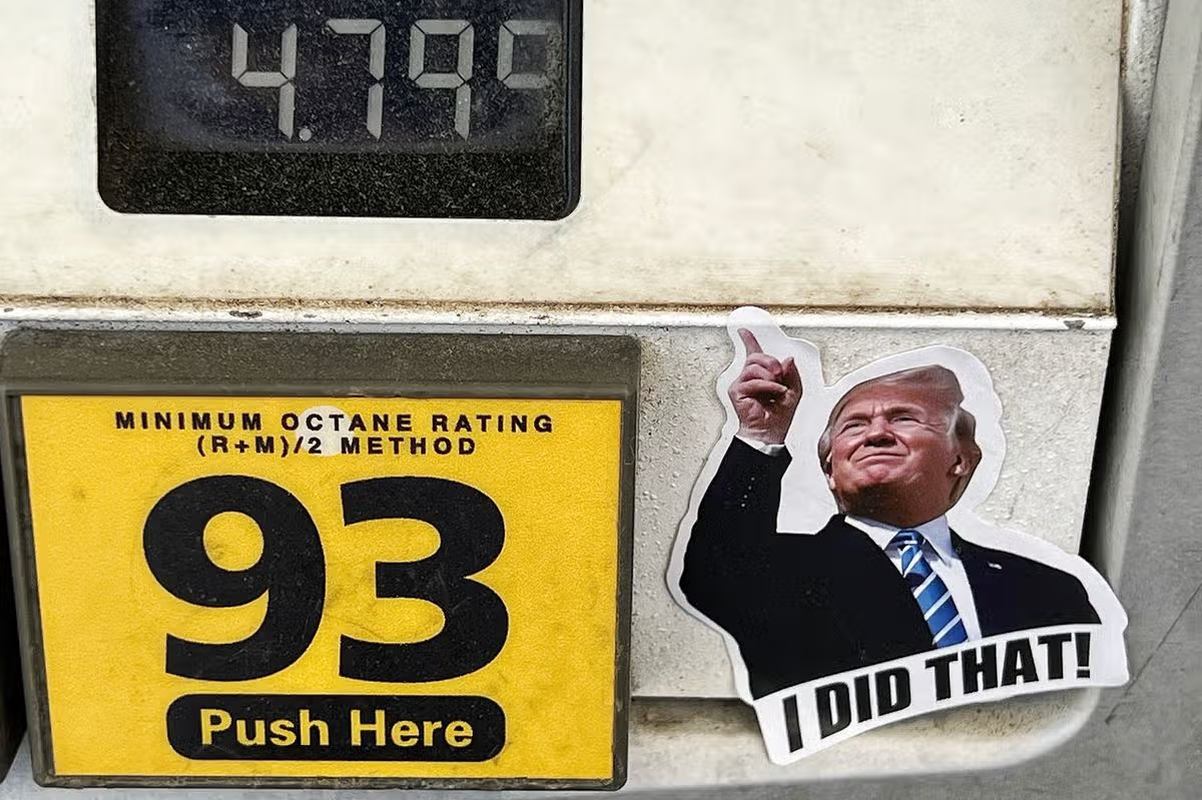
Republicans weren’t especially interested in hearing about the complexities of global oil markets when gasoline soared under Joe Biden. There were “I Did That” stickers with Biden’s face slapped on pumps across America, and Republicans relentlessly connected high gasoline prices to the man sitting in the White House. Democrats responded that presidents don’t control the global price of crude oil and that events overseas often matter more than whatever executive order was signed in Washington that week.
Republicans shouldn’t suddenly discover that argument only because our guy is president. The fair standard is the same in both directions. Trump doesn’t personally set gasoline prices, but presidential decisions on leases, pipelines, sanctions, regulations and foreign policy can affect them. Unlike many of the forces moving global energy markets, entering a military conflict with Iran was a policy choice made by this administration.
If the White House believes confronting Iran was important enough to justify the economic consequences, it can make that case. Perhaps voters will agree. But higher energy prices are part of the cost, and Americans are entitled to consider that cost when deciding whether the conflict has been worth it.
Americans Aren’t Sold on the Iran War
So far, the public has been deeply skeptical. Ipsos polling during the Iran conflict has found deep skepticism among Americans about whether U.S. military action has been worth the costs. In June, 25% said it had been worth it while 53% said it had not, and a July survey found 79% expected American military involvement to continue for an extended period.
The economic connection isn’t lost on voters either. In May, Ipsos found that 64% of Americans said rising gasoline prices had affected their household finances, while 86% said the Iran conflict bore at least a fair amount of responsibility for the increase. That doesn’t prove voters assign every dollar at the pump to Trump, but it does suggest they’re connecting what happens in the Strait of Hormuz with what happens to their household budgets.
Trump has argued that preventing Iran from obtaining a nuclear weapon is worth some economic sacrifice at home. That’s a case a president is entitled to make, and voters are entitled to decide whether they agree. The difficulty comes when that sacrifice collides with another highly visible promise: bringing energy prices down.
The Midterm Problem Isn’t MAGA Voting For Dems
Republicans need to be careful about reading Trump’s continued support within his base as a guarantee of November turnout. A Trump voter irritated by gasoline prices or the Iran conflict isn’t necessarily becoming a Democrat. Many still like Trump, dislike Democrats and would never seriously consider switching parties.
They don’t have to switch parties for Republicans to have a problem. Trump isn’t on the ballot this November, and Republicans need those voters to get excited enough about some House or Senate candidate to show up anyway. The president’s coalition includes plenty of voters who will enthusiastically turn out for Donald Trump but may feel considerably less attachment to the Republican Party itself.
A voter who showed up for Trump in 2024 because he wanted cheaper groceries, cheaper gasoline and fewer foreign wars may still like Trump in 2026. He may still think Democrats are far worse. But if $4 gasoline and another Middle Eastern conflict leave him discouraged enough to stay home, Democrats don’t have to persuade him to switch sides. They just have to make sure their own voters show up.
Democrats Have an Enthusiasm Advantage
There is evidence that isn’t merely a theoretical concern. An Ipsos poll conducted August 28-31 found the cost of living remains the single most important consideration for a plurality of registered voters heading into the midterms. The same survey found 71% of Americans disapprove of Trump’s handling of the cost of living, compared with just 22% who approve.
The political environment also contains warning signs for Republicans on voter motivation. Recent polling has generally shown Democrats more energized about the midterms, while Republicans face the familiar challenge of reproducing Trump’s presidential coalition when Trump himself isn’t on the ballot. That distinction could matter enormously in competitive House and Senate races decided by relatively small numbers of voters.
None of that guarantees a Democratic wave. Midterm electorates are difficult to predict, individual races matter, and Republicans still have advantages built into the congressional map that could help them survive a difficult national environment. Trump also remains enormously influential with Republican voters and can campaign aggressively for candidates who need help.
But the president’s party already faces the historical tendency to lose House seats in a midterm. Republicans don’t need another problem layered on top of that, particularly one that depresses enthusiasm among voters who reliably turn out for Trump but aren’t necessarily eager to vote for an obscure congressional Republican.
The Number on the Sign Is Hard to Ignore
Gasoline may be the most politically visible price in America. Nobody has to download a government inflation report to find out what it costs. The number is printed in enormous glowing digits beside virtually every major road in the country, and voters see it every time they drive past.
Diesel may be an even bigger economic concern. The Associated Press reported Friday that the national diesel average reached a record $5.85 a gallon, increasing costs for freight, agriculture and delivery networks that move much of what Americans buy. Higher diesel prices don’t stay at the truck stop forever. At least some of that cost eventually works its way onto store shelves.
That makes for an uncomfortable Labor Day picture. Families are paying record nominal prices for the holiday drive, diesel has reached a nominal high, and a Middle Eastern conflict continues without a clear endpoint. All of it is happening just as the midterm campaign enters its final two months.
Trump can push for more drilling, negotiate for Venezuelan oil, lean on refiners, waive regulations and try to keep shipping lanes open. Those policies may help, and blaming him personally for every movement in the global oil market would be every bit as simplistic as pretending Joe Biden personally set gasoline prices four years ago.
But Trump promised Americans cheap energy and fewer foreign wars, and those promises were connected. The Iran conflict is making the first one considerably harder to deliver. The political question this fall may not be whether Trump’s supporters abandon him over it, but whether enough of them become discouraged that, when November arrives and Trump isn’t on the ballot, they decide there isn’t much reason to show up at all.