
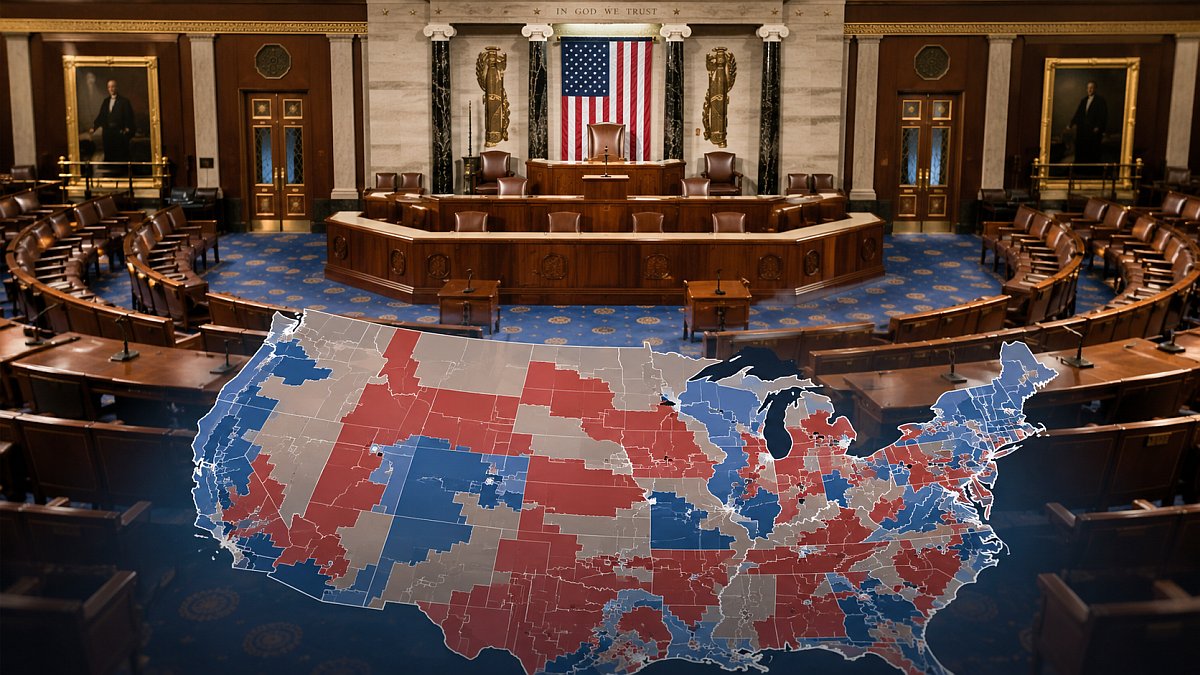
If Republicans were looking only at the national polls heading into the final two months of the midterm campaign, there would be plenty of reason to worry. Democrats have maintained a sizable advantage on the generic congressional ballot throughout the summer, President Trump remains unpopular nationally, and the president’s party is fighting the usual historical headwinds that come with a midterm election.
As of Wednesday, Silver Bulletin’s polling average had Democrats ahead by 6.6 points on the generic congressional ballot, almost exactly where the race stood at the beginning of August. RealClearPolitics has the Democratic advantage at 6.4 points. A July Pew Research Center survey found Democrats leading 43% to 37% among registered voters, while a CNN poll later that month put the advantage at eight points.
Those are not good numbers for Republicans. But there is a catch that could become one of the biggest stories of the 2026 midterms: Democrats can win the national vote by a healthy margin and still face a remarkably difficult path to the 218 seats needed to control the House.
A 6-Point Lead Is Nothing to Dismiss
Republicans shouldn’t comfort themselves by pretending the polls don’t matter. Generic ballot polling is imperfect, and plenty can change between Labor Day and Election Day, but a sustained Democratic advantage of six or seven points is a clear warning about the national political environment.
Silver Bulletin’s generic ballot average stood at D+6.6 on Sept. 2, virtually unchanged from D+6.5 at the beginning of August. Its likely-voter adjustment has recently produced an even larger Democratic advantage. Meanwhile, Pew Research Center found Democrats leading Republicans 43% to 37% among registered voters in July.
- Silver Bulletin: Democrats +6.6
- RealClearPolitics: Democrats +6.4
- Pew Research Center: Democrats +6
- CNN: Democrats +8 in its late-July poll
Pew also found something Republicans should find particularly concerning: Democratic voters appear more engaged. Seventy percent of Democrats and Democratic-leaning independents said it “really matters” which party controls Congress, compared with 60% of Republicans and Republican leaners. Democrats were also considerably more likely to say they had already given a lot of thought to the congressional elections.
None of that guarantees a Democratic wave. But if Republicans were drawing up their ideal political environment for defending a razor-thin House majority, this would not be it.
But This Isn’t 2018
Democrats have been here before. In Trump’s first midterm election in 2018, they won the national House popular vote by more than eight points and gained 41 seats, ending unified Republican control of Washington. Suburban districts that had traditionally elected Republicans collapsed toward Democrats, giving Nancy Pelosi a comfortable new majority.
The problem for Democrats in 2026 is that many of those districts no longer exist in the same political form. Eight years of polarization and another round of aggressive redistricting have produced a House map with far fewer seats sitting awkwardly between the presidential preferences of their voters and the party of their congressional representative.
That is where the national polling can become misleading. A six-point Democratic environment sounds like the beginning of a wave. But waves require seats that can actually be washed away.
Republicans Built Themselves a Firewall
The numbers behind the new House map are striking. According to an analysis reported by Axios, Democrats are defending 23 House seats in districts Trump carried in 2024. Republicans, by comparison, are defending only eight seats in districts Kamala Harris carried.
That is almost the reverse of what Democrats would want in a favorable national environment. Instead of Republicans sitting on dozens of seats whose voters preferred the Democratic presidential candidate, Democrats themselves have a substantial group of incumbents trying to survive in Trump territory.
Mid-decade redistricting made the imbalance worse. Trump pushed Republican states, beginning with Texas, to redraw congressional districts before the 2026 election rather than waiting for the next census, a shrewd political move long overdue. Democratic states responded where they could, most notably California, but Republicans appear to have emerged from the redistricting war with a meaningful structural advantage. The underlying reason is that Democratic states are already so gerrymandered that they were unable to bleed a stone.
Axios calculated in June that Democrats would need to outperform Harris’s 2024 district-level results by nearly five percentage points across the country to reach 218 seats under the new maps. Before the latest round of redistricting, the necessary improvement was closer to three points.
In other words, Republicans effectively made the hill Democrats have to climb steeper before voters even started casting ballots.
Look at the Actual House Map
The current race ratings show why Democrats remain in a strong position despite that Republican firewall. As of its Aug. 25 update, the Cook Political Report placed 205 seats in the Solid, Likely or Lean Democratic columns and 209 in the corresponding Republican columns, with 21 races rated Toss Up.
That puts Democrats just 13 seats short of a majority before assigning a single Toss Up. Republicans are nine seats short. More encouraging for Democrats, most of the Toss Ups are currently Republican-held, meaning Democrats have considerably more offensive opportunities among the most competitive races.
So Democrats absolutely can win the House. In fact, given the current national environment, Republicans would be foolish to deny that Democrats have a very real path to doing exactly that. The point is that a six-point national advantage doesn’t automatically deliver 218 seats anymore.
The Strange Geography of 2026
This helps explain why Democrats have recently started talking about districts that would have sounded absurdly ambitious only a few months ago. The Democratic Congressional Campaign Committee expanded its target list in August to include a dozen additional Republican-held or open seats, some in places Trump carried by double digits in 2024.
The list now stretches into districts Trump won by roughly 10, 15 and even 20 points. Democrats aren’t going to spend serious money in every one of them, and some are almost certainly more about forcing Republicans to defend territory than genuine expectations of victory. But expanding the map is what a party does when it believes the national environment is moving strongly in its direction.
There are already signs that a few normally safe Republican districts deserve attention. Cook recently moved Republican-held seats in Colorado and Ohio out of its Solid Republican category, while Michigan’s 10th District moved from Lean Republican to Toss Up. These aren’t predictions that Republicans will lose all of those races, but they are evidence that the battlefield is widening.
If Democrats start winning those kinds of seats in November, Republicans will have much bigger problems than their narrow majority. That would be evidence of an actual wave.
Democrats Have Their Own Problem
The Republican firewall works in both directions. Democrats aren’t merely trying to knock off vulnerable Republicans. They also have to protect incumbents representing voters who chose Trump two years ago, including some of the very Democrats we’ve identified as among the most vulnerable members of the House.
Marie Gluesenkamp Perez in Washington, Vicente Gonzalez in Texas, Jared Moskowitz in Florida and other Democrats in Republican-leaning territory cannot simply ride a national Democratic wave and assume it will carry them home. Their political brands, opponents and ability to separate themselves from the national Democratic Party will matter enormously.
That makes the House contest less like one national election and more like several dozen highly localized elections taking place underneath a national Democratic advantage. Democrats could have an excellent night nationally while losing one or two incumbents in Trump districts that partially cancel out their gains elsewhere.
This is also why the current Democratic fight over moderates such as Gluesenkamp Perez is politically dangerous. Democrats cannot simultaneously argue that they need to win Trump voters to capture the House and demand absolute party discipline from the members who actually represent Trump voters.
Six Points Is Good. It Isn’t 218 Seats.
There is still plenty of time for the national environment to change. Republican voters who haven’t paid much attention to the midterms could become more engaged after Labor Day, Trump’s planned campaign blitz could help motivate his coalition, and individual Democratic candidates will now face the kind of scrutiny that generic ballot questions cannot measure.
The opposite could happen too. If Trump’s numbers deteriorate further and Democrats push their national advantage from six points toward eight or nine, the Republican firewall may simply become overwhelmed. At some point, a national wave becomes large enough to reach districts that weren’t supposed to be competitive.
But Republicans have given themselves considerably more room for error than they had in Trump’s first midterm. The party has fewer members sitting in districts won by the other side’s presidential candidate, and redistricting has forced Democrats to fight on a map specifically designed to make converting national votes into House seats more difficult.
That’s the strange state of the 2026 midterms as the campaign enters its final stretch. Democrats are ahead nationally. They have the enthusiasm advantage. Most of the true Toss Up races give them opportunities to go on offense, and Republicans have every reason to be nervous about losing the House.
But Democrats don’t win the speaker’s gavel by winning a national poll. They win it by getting to 218. Republicans spent much of the last year making sure those last few seats would be as difficult for Democrats to find as possible.
A six-point Democratic lead should scare Republicans. Whether it is enough to defeat the map they built may be the question that decides who controls Congress in November.