
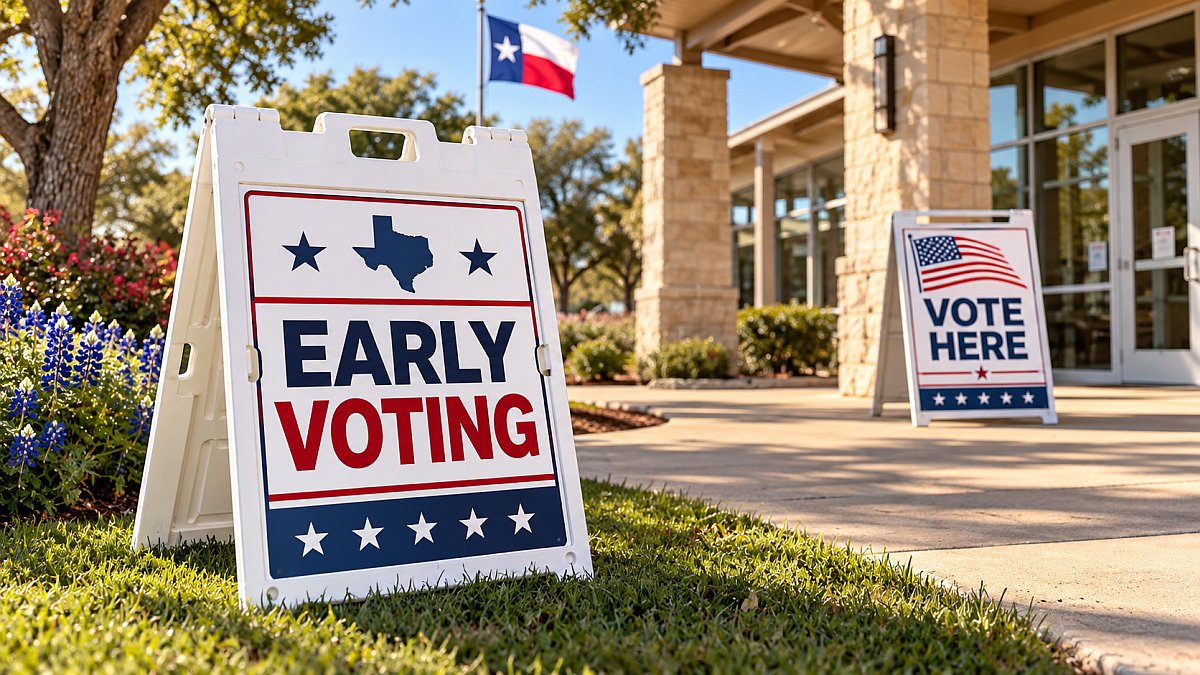
Texas voters are turning out early in huge numbers, and the surge is showing up in both Democratic strongholds and Republican territory.
The first day of early voting produced record or near-record participation across some of the state’s largest counties, including Harris, Dallas, Travis and Collin. That does not tell us who is winning the election, but it does suggest Texas voters are treating this midterm like something much bigger than a typical off-year congressional contest. The timing matters with Republican Ken Paxton and Democrat James Talarico locked in a close U.S. Senate race, several statewide contests tightening and a handful of congressional districts drawing far more attention than Republicans expected earlier in the year.
The First-Day Numbers Were Huge
Early voting began Monday, Oct. 19, and several counties immediately broke previous midterm records. The gains were not limited to blue counties, which is what makes the turnout picture more interesting.
- Harris County: Nearly 105,000 people voted on the first day, up from roughly 63,000 on the opening day of early voting in the 2018 midterms.
- Dallas County: More than 76,000 people voted on day one, compared with about 59,000 on the first day in 2018.
- Travis County: Nearly 41,000 people voted, the county’s highest first-day turnout for a midterm election this century.
- Collin County: The Republican-leaning suburban county also broke its previous opening-day midterm turnout record.
- Montgomery County: More than 13,000 people voted on the first day, about 21% more than in 2018.
- Randall County: First-day turnout in the heavily Republican Texas Panhandle county was up roughly 19% from 2018.
Harris, Dallas and Travis are critical Democratic vote centers, and Democrats need large margins there if they are going to win statewide. But Republicans are also seeing strong participation in places like Montgomery, Collin and the Panhandle, suggesting high motivation on both sides rather than a turnout surge concentrated in one political coalition.
The Houston Chronicle reported that Harris and Dallas both shattered their previous first-day midterm records, while Republican areas were also posting substantial gains.
Harris, Dallas and Travis Are Showing Serious Democratic Energy
Harris County produced one of the most striking numbers, with nearly 105,000 ballots cast on the first day of early voting compared with about 63,000 on the first day of the 2018 midterms. That works out to an increase of roughly 66%, and local election officials reported long lines at polling places across the county throughout the day.
Dallas County also posted a major increase, with more than 76,000 voters turning out Monday compared with roughly 59,000 in 2018. Travis County went even further, with nearly 41,000 voters casting ballots on the first day, representing about 4.3% of the county’s registered voters and surpassing every previous first-day midterm turnout total there this century.
Those are exactly the kinds of places Democrats would want to see energized. Harris, Dallas and Travis contain enormous numbers of Democratic voters, and strong participation there is necessary if Talarico and other Democratic candidates are going to seriously compete statewide.
Necessary, however, does not mean sufficient, especially when Republican counties are also reporting unusually strong turnout.
Republican Areas Are Turning Out Too
Collin County, which has moved somewhat toward Democrats over the past decade but still leans Republican, also broke its previous opening-day midterm record. Montgomery County, one of the most reliably Republican large counties in Texas, saw first-day turnout increase about 21% compared with 2018, while Randall County in the Panhandle was up roughly 19%.
That complicates any attempt to look at the huge urban turnout numbers and immediately conclude that Democrats have an advantage. Republicans do not need to match Harris or Dallas ballot for ballot because their statewide coalition depends on running up margins across a much larger number of suburban, exurban, rural and small-city counties while limiting Democratic gains in the major metros.
The first-day totals suggest both coalitions understand what is at stake. Democratic counties are showing strong enthusiasm, but Republican territory is not sitting this election out.
Texas Has More Than 19 Million Registered Voters
There is another reason the raw turnout numbers are going to look enormous this year: Texas itself has gotten bigger. The state now has more than 19 million registered voters, a record, so comparisons with 2018 or 2022 need to account for population growth as well as political enthusiasm.
Still, some of the percentage increases are large enough that population growth alone does not explain what is happening.
- More than 19 million: Registered Texas voters heading into the 2026 election.
- Oct. 19: First day of in-person early voting.
- Oct. 30: Final day of early voting.
- Nov. 3: Election Day.
The Houston Chronicle’s statewide early voting tracker is following turnout county by county as new totals are reported.
The Senate Race Is Giving Voters Plenty of Reason to Show Up
The biggest race on the ballot is the U.S. Senate contest between Paxton and Talarico. Texas has not elected a Democrat statewide in decades, but this race has consistently polled much closer than recent Texas Senate contests, forcing both parties to treat turnout as a genuine concern rather than assuming the state’s normal partisan patterns will settle the outcome.
Talarico needs enormous participation from Democratic areas such as Harris, Dallas, Travis and Bexar counties, while also performing well in faster-growing suburban counties including Fort Bend, Williamson and Hays. Paxton’s path depends on strong participation across rural Texas, the Panhandle, East Texas and Republican suburban and exurban areas such as Montgomery County, while holding enough support in the state’s major metropolitan areas.
That is why the early-voting numbers are so interesting. The blue counties are showing up, but so are many of the places Republicans rely on to offset those urban margins.
Early Voting Still Does Not Tell Us Who Is Ahead
There is an important warning before anyone tries to turn these numbers into election results. Texas does not register voters by political party, so an early ballot from Harris County is not automatically a Democratic vote, and a ballot from Montgomery County is not automatically Republican.
Voting habits have also changed significantly over the past several election cycles. Democrats have often been more likely to vote early, while Republicans have sometimes been more likely to wait until Election Day, but those patterns are not fixed and have shifted considerably since 2020.
That means early turnout is useful for measuring enthusiasm and comparing counties, but it is much less useful for declaring who is actually ahead. We can see where participation is running above previous elections, but we cannot look at 100,000 ballots from Harris County and know how many went to Talarico, Paxton or anyone else.
The Purple Counties May Tell Us More
The next places to watch may not be Harris or Montgomery County at all. Counties such as Fort Bend, Williamson, Hays, Tarrant, Denton and Collin sit somewhere between the deepest blue urban counties and the most Republican rural areas, and those fast-growing suburbs could tell us much more about the direction of the statewide races.
A few questions will be worth following as early voting continues:
- Does the massive turnout in Harris, Dallas and Travis remain elevated after the opening-day rush?
- Can Republican counties such as Montgomery and the rural Panhandle keep pace with their own strong turnout?
- What happens in Collin, Denton, Williamson, Fort Bend and Tarrant counties?
- Does South Texas continue the Republican movement seen in recent elections?
- Do turnout patterns begin looking more like a midterm year or a presidential election?
Those comparisons will become much more meaningful after several days of voting. One giant opening day can simply pull forward voters who would have cast ballots later anyway, while sustained high turnout would be stronger evidence that the electorate itself is expanding.
Texas Is Voting Like This Election Matters
Whatever these numbers eventually mean for Paxton, Talarico or the other candidates on the ballot, the first clear takeaway is that Texans are paying attention. Democratic counties are posting record numbers, Republican counties are turning out strongly too, and some of the state’s biggest races are much more competitive than Texas voters have become accustomed to seeing.
After one day, there is no reliable way to say which party is winning the turnout battle. There is plenty of evidence, however, that both sides have shown up for it.