
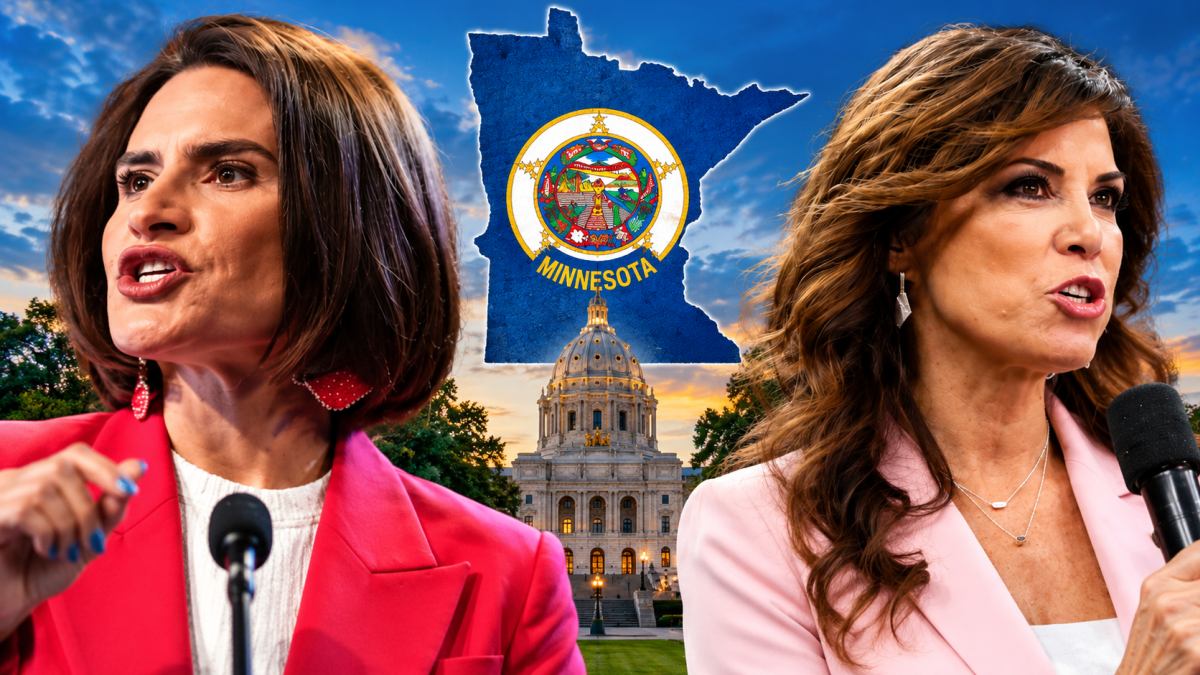
Republicans have been chasing Minnesota for years, usually with the same result.
Donald Trump came within about 1.5 points of winning the state in 2016, closer than any Republican presidential candidate in decades. Minnesota still voted Democratic. Trump tried again in 2020 and lost by more than seven points. Even in 2024, when Trump returned to the White House after making gains across much of the country, Kamala Harris carried Minnesota by a little more than four points.
There is plenty of reason, then, to be skeptical whenever Minnesota starts showing up on a Republican target list. But the latest Senate polling is at least giving the GOP something it hasn’t had very often in the state: a race that remains stubbornly close with Election Day less than a month away.
Take a Look at These Polls
Republican Michele Tafoya, the former NFL sideline reporter, is running against Democratic Lt. Gov. Peggy Flanagan for the open Senate seat being vacated by Sen. Tina Smith. The RealClearPolling average currently has Flanagan ahead by less than two points.
More interesting than the average may be the individual polls. The recent results have been remarkably consistent:
Big Data Poll (Sept. 29-30, 622 likely voters)
- Peggy Flanagan (D): 45.8%
- Michele Tafoya (R): 43.6%
- Flanagan +2.2
InsiderAdvantage (Sept. 28-29, 1,200 likely voters)
- Peggy Flanagan (D): 46%
- Michele Tafoya (R): 45%
- Flanagan +1
co/efficient (Sept. 14-15, 833 likely voters)
- Peggy Flanagan (D): 43%
- Michele Tafoya (R): 42%
- Flanagan +1
KSTP/SurveyUSA (Sept. 9-14, 654 likely voters)
- Peggy Flanagan (D): 42%
- Michele Tafoya (R): 42%
- Tie
Quantus Insights (Sept. 8-10, 720 likely voters)
- Peggy Flanagan (D): 48.9%
- Michele Tafoya (R): 45.4%
- Flanagan +3.5
The exact toplines vary slightly depending on whether leaners are included and how different polling aggregators report the results, but the larger pattern is hard to miss. Five September polls have produced a tie or a Flanagan advantage of less than four points. The two newest surveys put her ahead by roughly one and two points.
Big Data Poll’s full release provides an important caution, however. The same survey showing the close Senate contest found Democrats doing considerably better on the statewide generic congressional ballot. That raises the possibility that what we’re seeing has something to do with these two candidates, rather than Minnesota undergoing some broader Republican transformation.
Minnesota Has Teased Republicans Before
The state’s history is what makes all of this so interesting.
Republicans have not won a Minnesota U.S. Senate election since Norm Coleman in 2002. At the presidential level, Minnesota’s Democratic streak stretches all the way back to 1972. Trump nearly broke it in 2016, but Hillary Clinton held on by roughly 44,800 votes.
Four years later, Joe Biden won Minnesota by more than seven points. Harris then carried the state in 2024 with 50.9% to Trump’s 46.7%, even as Trump flipped several other states and won the election nationally. The official Minnesota election results show just how stubborn the state’s Democratic advantage has been.
The Senate result that year was even less encouraging for Republicans. Democrat Amy Klobuchar won reelection with 56.2% of the vote, beating Republican Royce White by nearly 16 points.
Two years later, Democrats are dealing with a very different race.
Flanagan Isn’t Klobuchar
Klobuchar had spent years building a political brand with broad statewide appeal. Flanagan arrives at the general election from a different place politically, after defeating Rep. Angie Craig by nearly 20 points in the Democratic primary.
Craig had represented a competitive suburban House district and made her ability to win swing voters part of her case. Flanagan won the nomination as the more progressive candidate and now has to assemble a statewide coalition in a much less predictable midterm environment.
Tafoya entered politics with something most first-time candidates don’t have: substantial name recognition. She spent years on national television covering the NFL before moving into conservative political commentary and eventually launching her Senate campaign.
There are also more than two names on the November ballot. Independent Marisa Simonetti and Libertarian Rebecca Whiting qualified for the Senate race, adding another wrinkle if the contest remains close. Axios recently looked at Minnesota’s third-party candidates and the role they could play in several close statewide races.
Real Race or Another Minnesota Tease?
There are still obvious reasons for Republicans to be cautious about what they’re seeing. Minnesota has repeatedly looked tempting without actually crossing the line, and Democrats continue to show strength elsewhere in the state’s polling.
There is also a difference between Republicans talking themselves into Minnesota and five September polls actually showing a close Senate race. Even the Washington Post recently included Minnesota among the Senate contests worth watching as the map has expanded in some unexpected directions.
Tafoya doesn’t need Minnesota to become a Republican state for the Senate contest to be close. The more immediate question is whether enough voters who normally lean Democratic are treating this particular race differently from the rest of the ballot.
We won’t know the answer until the votes are counted. For now, the notable part is that Democrats are having to pay attention to a Senate seat that has been out of Republican hands for nearly a quarter-century.
And in a midterm cycle where much of the surprising Senate news has been coming from traditionally Republican states, Minnesota is one of the places producing a very different kind of storyline.
Follow the latest numbers on our 2026 Senate polls page, and visit our 2026 Senate elections page for more races around the country.