
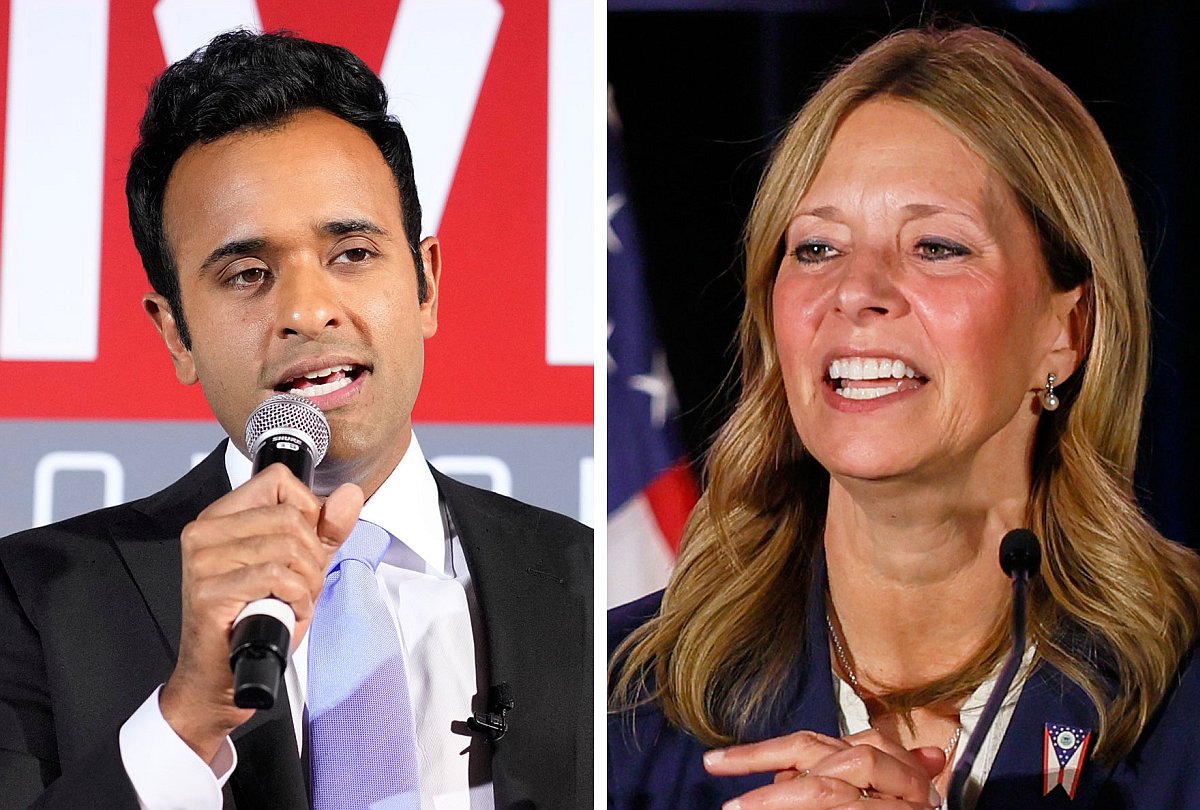
Vivek Ramaswamy wanted to put Amy Acton’s character and family history at the center of the Ohio governor race. He succeeded, but the attack has quickly become almost as much a story about Ramaswamy as it is about Acton.
A new Ramaswamy campaign ad features Acton’s estranged mother, Donna Arthur, calling her daughter a liar and urging Ohio voters not to elect her. Ramaswamy’s campaign has confirmed it produced the spot and says it plans to spend roughly $4 million airing it across the state, even as prominent Republicans argue that the ad goes too far.
The Ad Left Out a Big Part of the Story
Acton has spoken publicly for years about a difficult and unstable childhood, including allegations of abuse by her stepfather and periods when the family lacked stable housing. She says she has been estranged from her mother since she was 12, after she and her brother were removed from the home.
Those claims are not based only on Acton’s memory. FactCheck.org reviewed court records and contemporaneous reporting that corroborate important parts of her account, including that her stepfather was charged in 1978 in a rape case involving Acton when she was 12. The case never went to trial after he failed to appear in court, and Acton’s brother has also publicly backed her description of their childhood.
The ad itself does not mention that history. Instead, Arthur says Acton has lied about her past, including her account of living in a tent for a period of time, and argues that voters should not trust her.
But Is Acton’s Mother Actually Right?
That is the question underneath all the outrage. Whatever voters think about using an estranged parent in a campaign ad, the political attack only works if Arthur’s accusation is credible.
So far, the public record appears to support key parts of Acton’s version more than her mother’s. Court records support the existence of the 1978 case, while a police report cited by Acton’s campaign places her stepfather at the campground where Acton has said the family lived for a period. Her younger brother has also publicly supported her account.
That does not mean every detail of a childhood nearly five decades ago can be independently reconstructed with certainty. But the available documentation does not support Arthur’s broad claim that Acton simply invented the story.
Republicans Are Now Fighting Over the Ad
The controversy has moved well beyond normal partisan criticism. Ohio Gov. Mike DeWine, a Republican who endorsed Ramaswamy, called the ad “deeply, deeply troubling” and publicly urged him to take it down. Republican Senate candidate Jon Husted has also criticized the spot, while Ashley Hinson in Iowa called it “absolutely terrible” and said the campaign should stop running it.
President Trump has gone in the opposite direction. He publicly defended the ad Thursday and told Ramaswamy to keep running it, while Vice President JD Vance has also backed Ramaswamy and criticized Republicans complaining about the spot. That has turned the controversy into an intraparty fight during the final days of one of the country’s most closely watched governor races. Reuters reported on the split Thursday.
Ramaswamy Is Doubling Down
Ramaswamy has shown no sign of backing away. His campaign says the message tested well with persuadable voters and has announced plans to put roughly $4 million behind the ad.
That is a significant gamble because the Ohio governor race is already extremely competitive. The current RealClearPolling average has Acton ahead, and most recent public surveys have shown her with at least a narrow advantage.
- Fox News: Acton 50%, Ramaswamy 48%
- Marist: Acton 50%, Ramaswamy 43%
- Bowling Green/YouGov: Acton 50%, Ramaswamy 44%
- Verasight: Acton 46%, Ramaswamy 45%
The Marist poll was especially difficult for Ramaswamy among independents, where Acton led 53% to 34%. Those surveys were conducted before or during the early stages of the controversy, so they do not prove that the ad itself has hurt Ramaswamy.
The Ad Has Become the Story
The original purpose of the spot was straightforward: challenge Acton’s credibility in the closing days of the campaign by putting her own mother on television to accuse her of lying. Instead, much of the conversation has shifted to why Ramaswamy chose an estranged parent to deliver the attack when court records and other documentation support important parts of Acton’s account.
That does not mean voters will necessarily punish him for it. Ramaswamy and Trump clearly believe the ad can still work, and the campaign is spending heavily to make sure Ohio voters see it.
But the political risk is obvious. Instead of forcing Acton to spend the final days defending her past, the ad has forced Ramaswamy to defend the attack itself while Republicans publicly argue over whether he crossed a line.
With the race already close, that is not where any campaign wants the conversation to be less than two weeks before Election Day.