
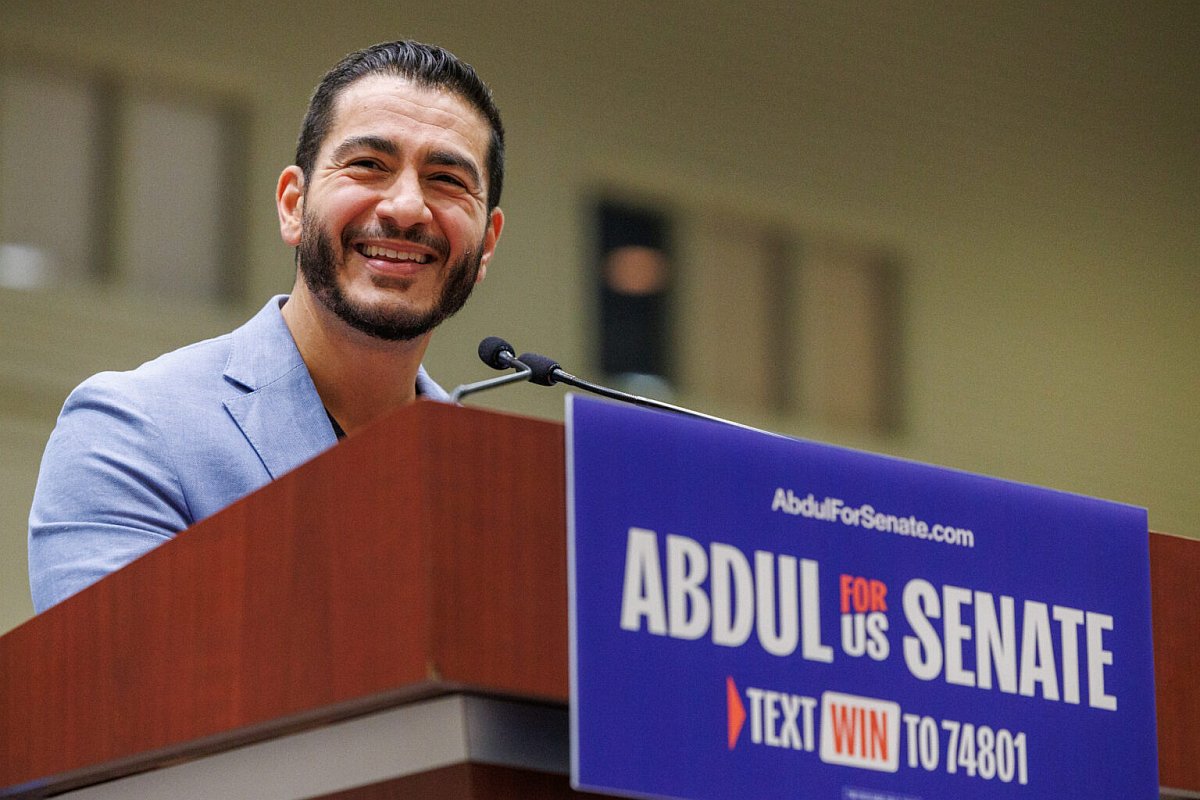
Michigan Democrat Abdul El-Sayed has built much of his Senate campaign around a populist economic message, arguing that government should work for ordinary people rather than wealthy and politically connected interests.
But while El-Sayed was campaigning for the Senate, his private consulting company was also collecting $9,000 monthly payments from Wayne County, where he had previously served as director of the Department of Health, Human and Veterans Services. The arrangement ultimately paid El-Sayed $72,000, according to his financial disclosure, and ended in December 2025.
A $300-an-Hour Consulting Deal
El-Sayed launched his Senate campaign in April 2025 after serving as Wayne County’s health director. Public records show the county subsequently retained his company, AME Higher LLC, to provide consulting services during the transition in leadership at the department.
The contract authorized payments of $9,000 per month for up to 30 hours of work, an effective rate of $300 an hour, with a maximum value of $72,000. The work included strategic advice, operational guidance, data strategy, executive support and communications assistance for the county and its health department.
El-Sayed’s latest financial disclosure reportedly lists $72,000 in consulting income from Wayne County, indicating he ultimately received the full amount authorized under the agreement. A Wayne County spokesman has said the consulting contract ended Dec. 23, 2025, meaning El-Sayed is no longer receiving the monthly payments.
The arrangement itself does not establish wrongdoing. Former government officials frequently perform consulting work, and the available records show El-Sayed was billing the county for specific services. But a $300-an-hour taxpayer-funded consulting arrangement running alongside a campaign built heavily around working-class economics creates an obvious political contrast.
What Did Wayne County Get for the Money?
Invoices obtained through public-records requests provide more detail about the work. They describe services including leadership and operational guidance, data and quality strategy, support for county executives, partner outreach and media and communications assistance.
El-Sayed’s campaign has defended the arrangement, saying he was helping Wayne County improve government services. His spokeswoman also turned the criticism back on Republican Senate nominee Mike Rogers, pointing to Rogers’ private-sector work after leaving Congress.
That defense addresses an important distinction: there is no evidence in the records reported so far that El-Sayed simply collected taxpayer money without performing work. The political problem is the size and timing of the payments, particularly given the economic message at the center of his Senate campaign.
El-Sayed has presented himself as a champion of working people and a critic of wealthy and politically connected interests. His campaign argues that life has become too expensive for Michigan families and promises a government that puts ordinary residents ahead of billionaires and powerful corporations.
He has campaigned on Medicare for All, lower costs and other policies associated with the Democratic Party’s progressive left. Republicans have also tried to associate El-Sayed with the socialist wing of the Democratic coalition, although El-Sayed is not a member of the Democratic Socialists of America and has avoided the socialist label.
The consulting disclosure nevertheless gives Republicans a straightforward contrast to use against his populist image. During the first year of his Senate campaign, El-Sayed’s own company was receiving $9,000 monthly payments from the government agency he had previously run.
And Michigan Is Already Tight
The story arrives at a particularly sensitive moment because Michigan’s open Senate race between El-Sayed and Rogers is already highly competitive.
Recent polling has shown a close contest, although the margins vary considerably by pollster. That leaves both campaigns with little room for unwelcome headlines during the final month before Election Day, particularly as affordability and the cost of living remain central issues across the midterm map.
El-Sayed’s consulting work does not by itself demonstrate misconduct, and the contract ended nearly a year ago. What it does create is an awkward political question for a candidate running heavily on economic populism: while asking Michigan voters to send him to Washington as an advocate for working families, El-Sayed was earning $300 an hour under a taxpayer-funded consulting contract.
Follow the latest numbers from Michigan and other competitive races on our 2026 Senate polls page.