
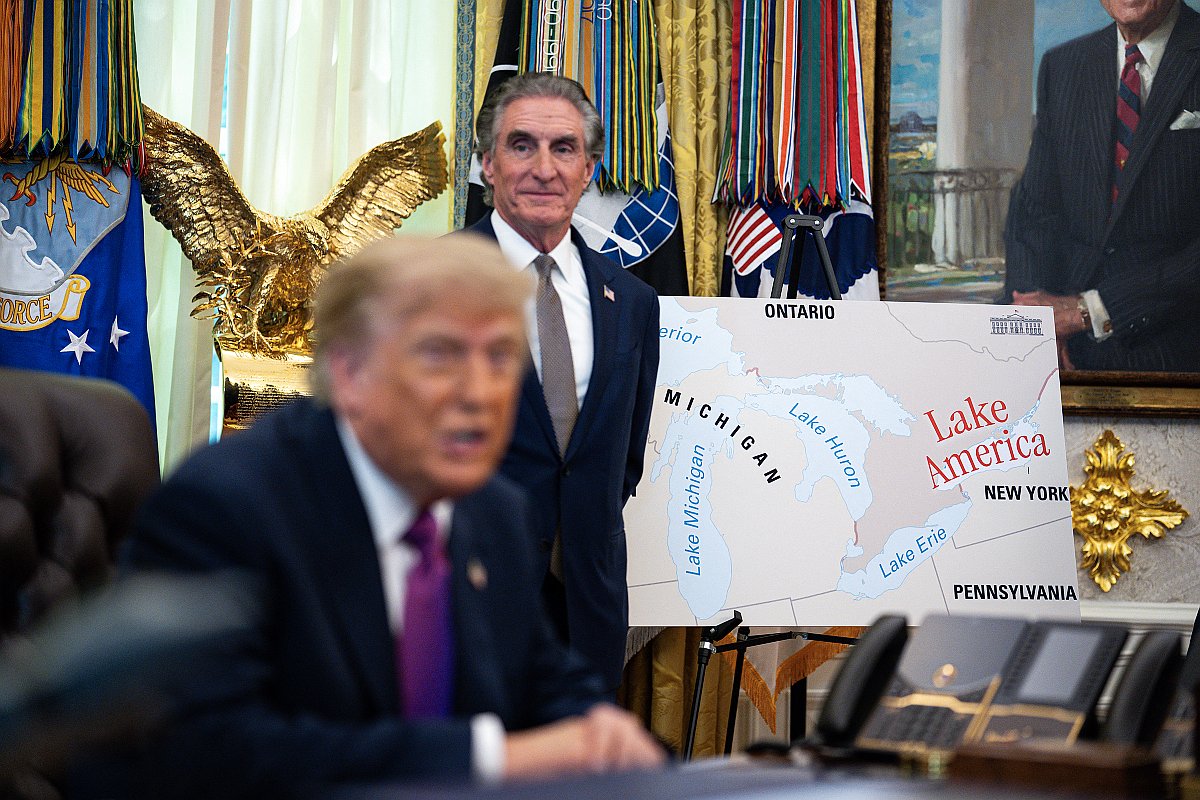
Donald Trump has built a political career around picking fights other Republicans were afraid to pick. Sometimes that instinct has served him very well. Immigration, trade with China and even his decision to rename the Gulf of Mexico as the Gulf of America all fit into the larger argument Trump has made for a decade: Washington spends too much time worrying about what other countries think and not enough time asserting American interests.
Lake Ontario is a little harder to explain. Trump signed an executive order last week directing the federal government to call it “Lake America,” and the change is already showing up for American users of Google Maps and Apple Maps. The White House has offered a rationale for the decision, and the increasingly ugly fight with Canada provides some political context, but judging by the reaction from voters, this may be one Trump fight that even many Republicans would rather skip.
Americans Aren’t Buying Lake America
A new Reuters/Ipsos poll released this week found overwhelming opposition to the name change. The numbers aren’t particularly close:
- 63% oppose renaming Lake Ontario as Lake America
- 14% support the change
- 43% of Republicans oppose the renaming
- 33% of Republicans support it
That last number is probably the most interesting one. Democratic opposition to almost anything Trump does is hardly surprising at this point, but even Republicans are more likely to oppose the Lake America name than support it. Nobody is going to decide how to vote in November because of what Google Maps calls a lake, but when your own voters look at an executive order and seem to be asking, “Why exactly are we doing this?” it is worth asking the same question.
There Is a Reason Trump Did It
The idea didn’t simply appear out of nowhere. In his executive order, Trump argued that the United States shoulders much of the burden of maintaining and protecting the Great Lakes. The White House notes that the U.S. Coast Guard operates nine of the 11 icebreaking vessels on the Great Lakes and says the United States has spent nearly $4 billion protecting the Great Lakes freshwater ecosystem over the past decade.
The administration also points to the lake’s importance to American trade, energy, manufacturing and national history. Trump argues that the United States has done enough to protect and develop this shared resource that its importance to America deserves greater recognition. Viewed strictly through Trump’s “America First” worldview, there is at least a logic to the argument.
There is also a much bigger fight going on in the background. Relations between Washington and Ottawa have deteriorated badly as the two countries battle over trade, tariffs and Trump’s repeated provocations toward Canada. Trade negotiations broke down in August, the United States imposed new tariffs on Canadian products, and Canada responded with retaliatory tariffs on roughly $20 billion worth of American goods.
Three days after Canada announced those retaliatory tariffs, Trump renamed Lake Ontario. Maybe the timing was coincidental, but it certainly doesn’t look like the administration was trying to lower the temperature. “Lake America” fits neatly with Trump’s broader approach toward Canada: remind Ottawa that the United States is the larger economic and military power and make clear that he isn’t especially interested in Canadian objections.
But What Does America Get Out of This Fight?
This is where Trump’s political instinct becomes harder to follow. Picking fights has worked for him when the fight reinforces something voters already care about. He promised to secure the border when Washington’s political class insisted the issue was exaggerated. He attacked China’s trade practices when politicians in both parties had spent decades accepting the status quo. Even Gulf of America was a relatively easy piece of patriotic branding because the United States has an enormous coastline on the Gulf and no neighboring country called Mexico owns the name.
Lake Ontario is different. Roughly half of the lake lies in Canada, and Ontario is the Canadian province that borders it. Trump’s executive order changes what the United States government calls the lake, but it obviously cannot force Canada to stop calling it Lake Ontario. American map users now see Lake America, Canadians continue seeing Lake Ontario, and the rest of the world is left watching two neighboring countries argue about what to call the same body of water.
Google adopted the new name for U.S. users over the weekend, and Apple Maps followed this week. That means this is no longer merely some obscure language buried in an executive order. Millions of Americans are going to open their phones and actually see “Lake America” staring back at them.
Maybe people eventually get used to it. Americans have already become much more accustomed to hearing Gulf of America than they were when Trump first announced that change. Presidents also have considerably more important decisions to make than what appears on a map, and it would be silly to pretend Lake America is going to determine control of Congress.
An Unforced Error Before the Midterms?
That is also what makes the whole thing feel like an unforced error. Republicans are entering the final two months of a difficult midterm campaign. Voters are worried about the cost of living, Republicans are defending a narrow congressional majority, and the party has competitive Senate races stretching from Texas and Iowa to Maine and North Carolina. There is no shortage of consequential fights for Trump to choose from.
The same Reuters/Ipsos poll makes that problem even clearer. While only 14% support renaming Lake Ontario, just 20% support Trump’s new tariffs on Canadian goods, compared with 57% who oppose them. Cost of living, meanwhile, remains the top concern for Americans heading toward the November elections.
That doesn’t mean Trump should abandon a trade policy simply because a poll says it is unpopular. Presidents are elected to make decisions, not conduct a national focus group before signing every order. If Trump believes Canada is taking advantage of American businesses or benefiting disproportionately from the United States, he should make that case and fight for better terms.
But renaming a lake doesn’t win a trade negotiation. It doesn’t lower prices, help American manufacturers compete or make it easier for Republicans to hold Congress. If anything, it gives Canada’s government an easy symbolic grievance while distracting from whatever substantive case Trump wants to make about the economic relationship.
Trump Usually Knows Why He’s Picking a Fight
One reason Trump has survived politically when so many people predicted his demise is that his fights are often more calculated than his critics acknowledge. His opponents see chaos; his supporters frequently see someone forcing issues onto the national agenda that establishment politicians preferred to avoid. Plenty of those fights have worked because Trump understood that voters were already frustrated and gave that frustration somewhere to go.
That is what feels missing here. There does not appear to be some great reservoir of Americans demanding that Lake Ontario receive a more patriotic name. The Reuters/Ipsos numbers suggest almost precisely the opposite. When just 14% of the country likes an idea and even Republican voters oppose it by a 10-point margin, the burden is on the administration to explain why the fight is worth having.
Maybe Trump sees Lake America as another small piece of his larger effort to make the United States more assertive toward Canada. Maybe it is intended to irritate Ottawa during a bitter trade dispute. Or maybe Trump simply likes the name. None of those explanations makes this a political catastrophe, but none makes the political payoff particularly obvious either.
Republicans don’t need to treat every Trump decision as some act of strategic genius, just as they don’t need to join Democrats in declaring every Trump controversy a five-alarm emergency. Sometimes an unforced error is just an unforced error. Lake America increasingly looks like one.
Trump has much bigger fights ahead of him, and Republicans have a Congress to defend in November. If nearly two-thirds of Americans oppose changing the name of Lake Ontario and even his own party isn’t sold on it, there is a pretty simple question the White House still hasn’t answered: What exactly are we getting out of this one?
Then again, if we’re renaming Lake Ontario to emphasize its American geography, wouldn’t Lake New York make more sense anyway?