
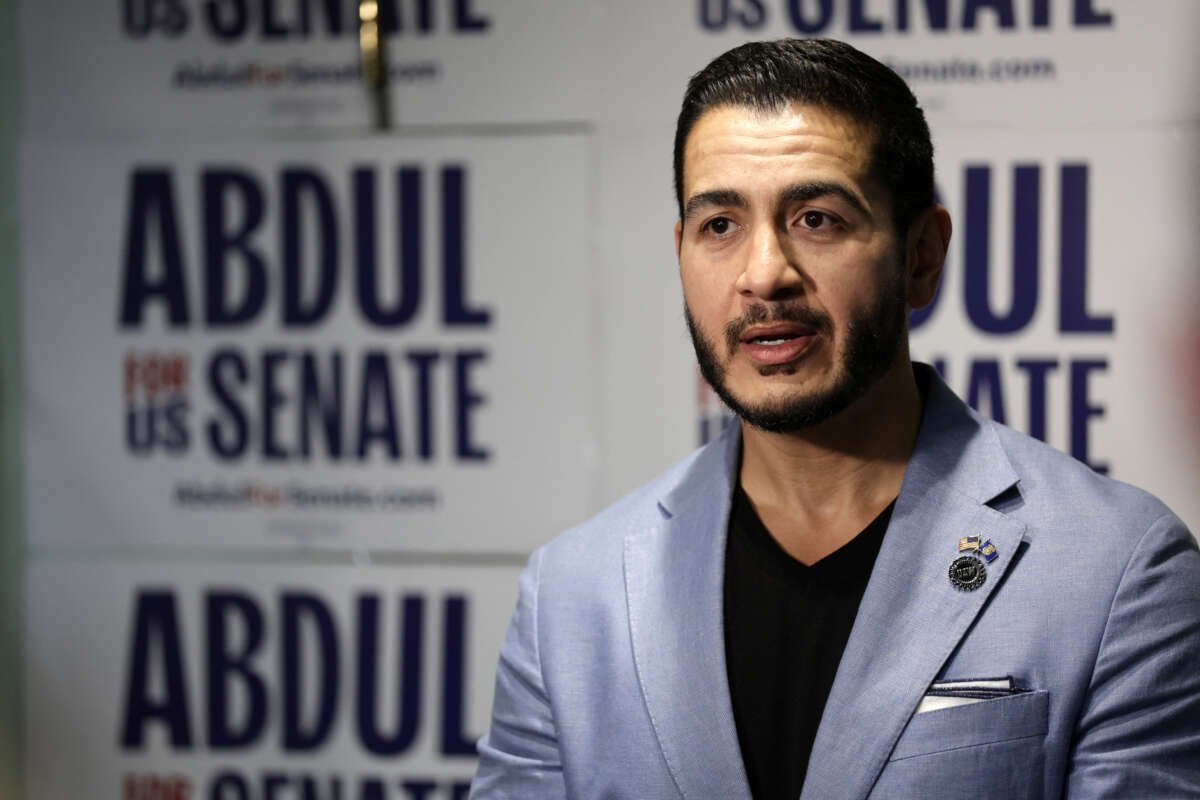
Democrats desperately need to hold Michigan if they want a realistic shot at taking back the Senate in November. Instead, they are entering the final stretch trying to smooth over another controversy involving Abdul El-Sayed, the democratic-socialist nominee who defeated much of the Democratic establishment in the August primary. El-Sayed apologized over the weekend for comments he made following a March attack on a Michigan synagogue, an episode that has become part of a larger question Democrats would probably rather not be answering right now: Did their primary voters nominate someone too far left to hold a must-win Senate seat?
That question will not be answered until November, and Republicans would be foolish to assume El-Sayed cannot win. Michigan remains closely divided, President Donald Trump carried it by less than two points in 2024, and the political environment gives Democrats plenty of reasons for optimism. But El-Sayed’s nomination has also created headaches that Democratic leaders plainly saw coming. Senate Minority Leader Chuck Schumer, Gov. Gretchen Whitmer and retiring Sen. Gary Peters all backed Rep. Haley Stevens in the primary, only to watch El-Sayed narrowly beat her despite being massively outspent.
The Comment El-Sayed Now Regrets
In March, a man rammed a vehicle into Temple Israel in West Bloomfield Township and opened fire, injuring a security guard before dying by suicide. Authorities identified the attacker as Ayman Mohammad Ghazali, a naturalized U.S. citizen from Lebanon whose relatives had reportedly been killed in an Israeli airstrike days earlier. El-Sayed condemned the synagogue attack, but in a subsequent video said that his experience as an epidemiologist had taught him that “hurt people hurt people” while discussing the broader cycle of violence. Critics saw that as an attempt to excuse targeted violence against a Jewish congregation.
El-Sayed now acknowledges that his response was a mistake. After addressing the Michigan Democratic Jewish Caucus on Saturday, he apologized to people hurt by the comments and said he had been trying to provide context for what happened. “It wasn’t the time for context,” El-Sayed conceded, according to the Associated Press. He similarly told Jewish voters that his original condemnation should have been the end of his response, rather than following it with an explanation of the attacker’s circumstances.
There is something to be said for a politician admitting he got something wrong rather than spending six weeks explaining why everyone else misunderstood him. El-Sayed’s apology appears to stem from political expediency, though some Jewish Democrats who heard him Saturday said they appreciated it. But politically, the problem is that Democrats are having this conversation at all, two months before an election that could determine control of the United States Senate.
Michigan Was Supposed to Be a Democratic Hold
Democratic Sen. Gary Peters’ retirement turned Michigan into an open-seat race at precisely the wrong time for his party. Democrats need a net gain of four Senate seats to reach 51, which means their most straightforward path to a majority starts by protecting every seat they already hold. Michigan was supposed to be part of that defensive foundation while Democrats spent their money and energy trying to knock off Republicans elsewhere.
Lose Michigan to Republican Mike Rogers and the math becomes considerably uglier. The Washington Post reported that a Michigan defeat would force Democrats to find a fifth Republican-held pickup elsewhere if their other seats hold. Considering that several of the GOP seats Democrats are targeting are in states Trump won comfortably, giving away Michigan would be an expensive mistake.
Democratic leaders understood the danger during the primary. Schumer backed Stevens because he believed she had the better chance of winning the general election, while Whitmer and Peters also lined up behind her. El-Sayed had Bernie Sanders and other prominent progressives in his corner and ran as an insurgent against big donors, corporate power and the Democratic establishment itself. The establishment had the endorsements and an enormous financial advantage, but El-Sayed had the voters.
According to The Washington Post’s post-primary analysis, advertising supporting Stevens totaled roughly $64.7 million compared with about $7.4 million for El-Sayed. El-Sayed turned that disparity into one of his strongest arguments, portraying the flood of outside money as proof of exactly what was wrong with Democratic politics. It worked. He narrowly won the nomination and left some of the most powerful Democrats in Michigan and Washington with no choice but to get behind him.
Some Democrats Still Aren’t Comfortable
Publicly, the party has mostly fallen into line. Schumer endorsed El-Sayed after the primary, Whitmer backed him, Stevens endorsed him, and national Democrats have begun spending to protect the seat. That is what political parties do after ugly primaries, especially when control of the Senate may depend on the winner.
Privately, and sometimes not so privately, the discomfort remains. The Washington Post reported that three Democratic donors in Michigan hosted a fundraiser for Rogers after El-Sayed won the nomination. One of those donors said El-Sayed’s response to the Temple Israel attack made it impossible for him to support the Democratic nominee. That does not mean Michigan Democrats are defecting en masse, but in a state where statewide elections can be decided on the margins, even a small fracture matters.
Michigan Attorney General Dana Nessel has also spoken openly about the unease among Jewish Democrats. Nessel, the state’s highest-ranking Jewish elected official, recently told The Atlantic about the alienation some Jewish voters feel amid rising antisemitism and the controversy surrounding El-Sayed. His weekend apology was clearly intended, at least in part, to begin repairing that relationship.
Then There Is Hasan Piker
The other recurring headache for El-Sayed is Hasan Piker, the enormously popular left-wing streamer who supported him during the primary. Piker has a long history of inflammatory commentary, including remarks about Israel and American Jews that have drawn condemnation from prominent Democrats. El-Sayed has emphasized that Piker does not speak for his campaign, but he has resisted demands to make the kind of dramatic public break some Democrats would prefer.
Beyond that, Piker has repeatedly said that he “hates America” and “hates cops,” comments he has defended rather than disavowed. Whatever their appeal to his online audience, they are hardly the kind of associations a Democratic Senate candidate wants to explain to swing voters in Michigan.
The controversy has already affected relationships inside the Michigan delegation. The Washington Post reported last week that Rep. Hillary Scholten had refused to campaign with El-Sayed because of his association with Piker. El-Sayed’s position is essentially that voters care far more about health care, groceries and affordability than they do about what an internet personality in California says on a livestream. He may well be right about that, but Republicans have no reason to help him change the subject.
El-Sayed has increasingly tried to steer the campaign back toward his economic message. He talks about health care, corporate power, wages and the cost of living, issues that helped propel him through the Democratic primary despite the avalanche of money spent against him. The Guardian reported that he has repeatedly tried to redirect questions about Piker and other controversies toward affordability. It is probably his best path to winning, because every day spent litigating the activist left’s latest controversy is a day Mike Rogers gets to fight the election on terrain Republicans prefer.
Rahm Emanuel Says Democrats Are Going Too Far
The argument playing out in Michigan happens to arrive in the middle of a much larger fight over the Democratic Party’s leftward flank. Former Obama White House chief of staff Rahm Emanuel made his own position unmistakable Sunday, saying he does not consider democratic socialists part of the Democratic Party. “Run as a separate party,” Emanuel said, challenging them to put their agenda before general-election voters.
Emanuel’s comments were not directed specifically at El-Sayed, but it’s not difficult to see the overlap. El-Sayed rejects the socialist label and calls himself a capitalist, though much of his agenda reads like a wish list from the Bernie Sanders wing of the Democratic Party. He supports Medicare for All, has called for abolishing ICE and has taken a much harder line against U.S. support for Israel than establishment Democrats. Sanders and Alexandria Ocasio-Cortez backed him, while Schumer, Whitmer and Peters backed his opponent.
That distinction actually makes Michigan more interesting. The argument is not about whether El-Sayed carries a DSA membership card. It is about whether the politics represented by the party’s insurgent left can travel beyond Democratic primaries and win the suburbanites, independents and occasional ticket-splitters who decide elections in a state like Michigan.
Emanuel has been making the case that Democrats do not build national majorities by making safe blue districts even bluer. They have to win voters in competitive territory, and Michigan is about as competitive as it gets. El-Sayed’s supporters have an answer to that argument: establishment Democrats tried to bury their candidate beneath tens of millions of dollars, and Democratic primary voters chose him anyway.
The Establishment Bet Against El-Sayed and Lost
That last point should keep Republicans from getting overconfident. El-Sayed has already survived a political assault that would have buried plenty of candidates. He was outspent by more than eight to one on advertising, faced opposition from much of his party’s state and national leadership, and still found enough voters to win. His attacks on big money in politics became more persuasive every time another outside group bought millions of dollars in advertisements telling Democrats not to vote for him.
His coalition also has real energy behind it. El-Sayed has built support among younger and highly educated voters, attracted progressive activists and turned his campaign into a broader argument against an establishment many Democratic voters no longer trust. A center-right analysis of this race should not confuse disagreement with his politics for evidence that those politics have no constituency. Clearly, they do, just look at Zohran Mamdani in New York City.
The question is whether that constituency is enough in November. The Democratic primary electorate is not the Michigan electorate, and Rogers is not Haley Stevens. Rogers came within roughly 19,000 votes of winning Michigan’s other Senate seat in 2024, when he lost narrowly to Elissa Slotkin even as Trump carried the state. Republicans have every reason to believe he can compete again.
November Is Not a Democratic Primary
The early general-election polling reinforces that point. A Fox News poll conducted after the primary found Rogers leading El-Sayed 51 percent to 47 percent among registered voters, although that advantage was within the survey’s margin of error. Interestingly, El-Sayed led among voters who said they would definitely cast a ballot, reflecting the enthusiasm Democrats hope will carry them through the midterms. In other words, there is evidence for optimism on both sides and not much evidence that either candidate can relax.
That is what makes the synagogue apology more than another campaign controversy. El-Sayed has already won his fight with the Democratic establishment. Now he has to keep skeptical Democrats in the coalition, persuade enough independents that his economic populism matters more than his ideological baggage, and survive a Republican campaign designed to make every uncomfortable association part of the conversation.
Democrats would have preferred to spend September talking about vulnerable Republicans in North Carolina, Maine, Ohio, Iowa and Texas. Instead, they are also spending time reassuring voters about the nominee defending a Democratic-held seat they cannot afford to lose. The same progressive movement that shocked the establishment in August now has the opportunity to prove it can do something considerably harder: hold a must-win race for Democrats in November, or go down in socialist flames while helping the GOP hold its Senate majority.
El-Sayed beat Schumer’s candidate, beat an enormous spending disadvantage and beat the Democratic establishment at its own game. If he beats Rogers too, progressives will have every right to remind the party’s moderates that they said he couldn’t do it. If Democrats lose a Senate seat they desperately needed to hold, Rahm Emanuel and the rest of the party’s center-left will have plenty to say as well.