
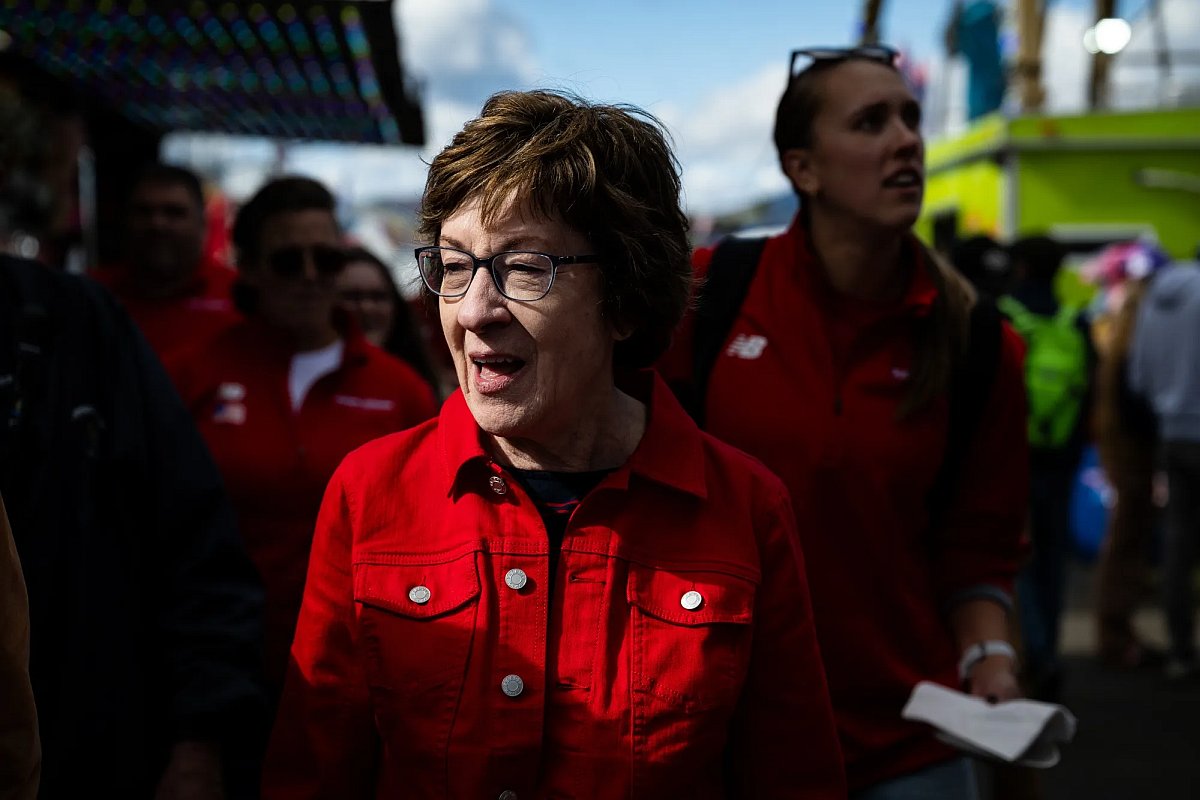
Susan Collins is trailing again in Maine, but anyone looking at the current polling should remember what happened the last time she was seeking reelection. Democrat Troy Jackson currently leads Collins by 1.3 points in the Election Central Senate polling average, and several recent surveys have shown the Republican incumbent behind by two to four points.
That is enough to make Maine one of the most important toss-up races on the 2026 Senate map, but Collins has been in a much worse polling position before. In 2020, she entered the final stretch of the campaign with public surveys repeatedly showing Democrat Sara Gideon ahead. Collins ended up winning by 8.6 points.
The 2020 Polls Had Collins Losing
The closing weeks of the 2020 Maine Senate race looked brutal for Collins. An Emerson College poll taken just before Election Day had Gideon ahead 48% to 42%, a six-point lead. Colby College had Gideon ahead by four, Pan Atlantic had her ahead by seven, and a Boston Globe/Suffolk University poll showed Gideon up five. Earlier in the fall, Quinnipiac had produced an even more dramatic result, putting Gideon ahead by 12 points.
The full 2020 Maine polling history is still remarkable to look at today. Collins spent much of the final months of the race behind, often by margins that would normally suggest an incumbent was in serious trouble. Democrats treated Maine as one of their best pickup opportunities in the country, and Gideon raised enormous amounts of money trying to finish the job.
Then came Election Day. Collins won 51.0% of the vote to Gideon’s 42.4%, according to the certified results, a margin of 8.6 points. She also cleared 50% outright, avoiding additional rounds under Maine’s ranked-choice voting system.
The scale of the polling miss was enormous. Emerson’s final poll showed Collins losing by six points, but she actually won by nearly nine. That is almost a 15-point difference between the poll margin and the final result, and several other late surveys missed the race by similarly large amounts.
The Current Numbers Are Actually Better for Collins
That history matters because Collins is trailing again, but the current numbers are nowhere near as bad as they were six years ago. The latest RealClearPolling average has Jackson at 48.6% and Collins at 47.3%, a 1.3-point Democratic lead. Suffolk and Rasmussen each show Jackson ahead by two, while the Washington Post and Marist have recently put him ahead by four.
There have also been ties and small Collins leads mixed into the polling. CBS News and Trafalgar both showed the race even, Co/efficient had Collins ahead by two, and New York Times/Siena put her up three in September. The broader picture still favors Jackson slightly, but this is not a race where Collins has been buried in the polling.
That distinction is important. In 2020, Collins was repeatedly down four, five, six or seven points and still won comfortably. Today, Jackson’s advantage is much smaller, which does not mean Collins is secretly ahead, but it does mean that a narrow Democratic lead deserves more context than it would in an ordinary Senate race.
Why Collins Has Been So Difficult to Poll
Collins has spent decades building a political identity that does not always line up neatly with the national Republican brand. Her appeal has traditionally included independents, moderates and some Democrats who may vote differently in federal races depending on the candidate.
That was especially obvious in 2020. Joe Biden carried Maine comfortably in the presidential race, while Collins won another Senate term by nearly nine points. A significant number of voters clearly split their tickets, supporting Biden for president and Collins for Senate.
That kind of crossover voting can make a race harder to model. Pollsters have to estimate not just partisan turnout, but how many voters are willing to break from their preferred party in one race while sticking with it in another.
Collins has also benefited from a long record of constituent service and her ability to bring federal money back to Maine. Even in the latest Washington Post-Schar School poll, which had Jackson ahead 50% to 46%, Collins still held advantages on bipartisanship and delivering federal funding to the state, while Jackson performed better on abortion, health care and the cost of living.
But 2026 Is Not 2020
There are also good reasons not to assume history will simply repeat itself. Collins is now seeking a sixth term, the political environment is different, and Jackson is a different kind of challenger than Gideon. He has spent years in the Maine legislature and has built his own following, particularly in the northern part of the state.
President Trump is also a bigger factor in the race than Collins would probably prefer. She has spent much of her career trying to maintain some distance from the national Republican Party, and the latest debates have again highlighted differences between Collins and Trump on Iran, tariffs and other issues. At the same time, Democrats are trying to tie her more closely to Republican positions on abortion, health care and the economy.
Collins and Jackson have already met several times this month, including a sharp Oct. 8 debate over abortion, energy costs, Trump and the war in Iran. You can watch the full Collins-Jackson debate here.
2014 Tells a Different Part of the Story
Collins also dramatically outperformed her Democratic opposition in 2014, although that race is not nearly as useful as 2020 for comparing polling misses. She defeated Democrat Shenna Bellows 68.5% to 31.5%, a 37-point margin, and was never in serious danger of losing.
The significance of 2014 is not that pollsters missed the winner. It is that Collins was still able to produce the kind of landslide that would be almost impossible for a generic Republican running statewide in Maine. By 2020, those margins had narrowed sharply, but she still demonstrated an ability to attract voters well beyond the normal Republican base.
That is the broader question hanging over the 2026 race. Does Collins still have enough of that crossover support to outperform the public polling again, or has Maine finally become too polarized for her old coalition to hold together?
Maine Could Help Decide the Senate
The stakes go well beyond Collins’ own political future. Maine remains one of the handful of races that could help determine control of the Senate, and Democrats have every reason to feel encouraged by the current numbers. Jackson leads the polling average, Collins is facing a difficult national environment for Republicans, and the race remains a toss-up.
We looked at Maine recently as part of our broader analysis of why Democrats still have a difficult path to Senate control. Collins is one of the biggest reasons the state remains so hard to evaluate.
The lesson from 2020 is not that polls in Maine should be ignored, and it is not that Collins is guaranteed to outperform them again. Polling methods have changed, the electorate has changed, and Collins may not have the same crossover strength she once did.
But the historical comparison is still impossible to dismiss. Six years ago, Collins spent the final stretch of the campaign trailing in survey after survey, including several that had her down by four, five, six or seven points. She won by 8.6.
Today, she trails Jackson by just 1.3 points in the polling average. That does not tell us where the race will end, but it should be enough to make anyone cautious about writing Susan Collins off too early.