
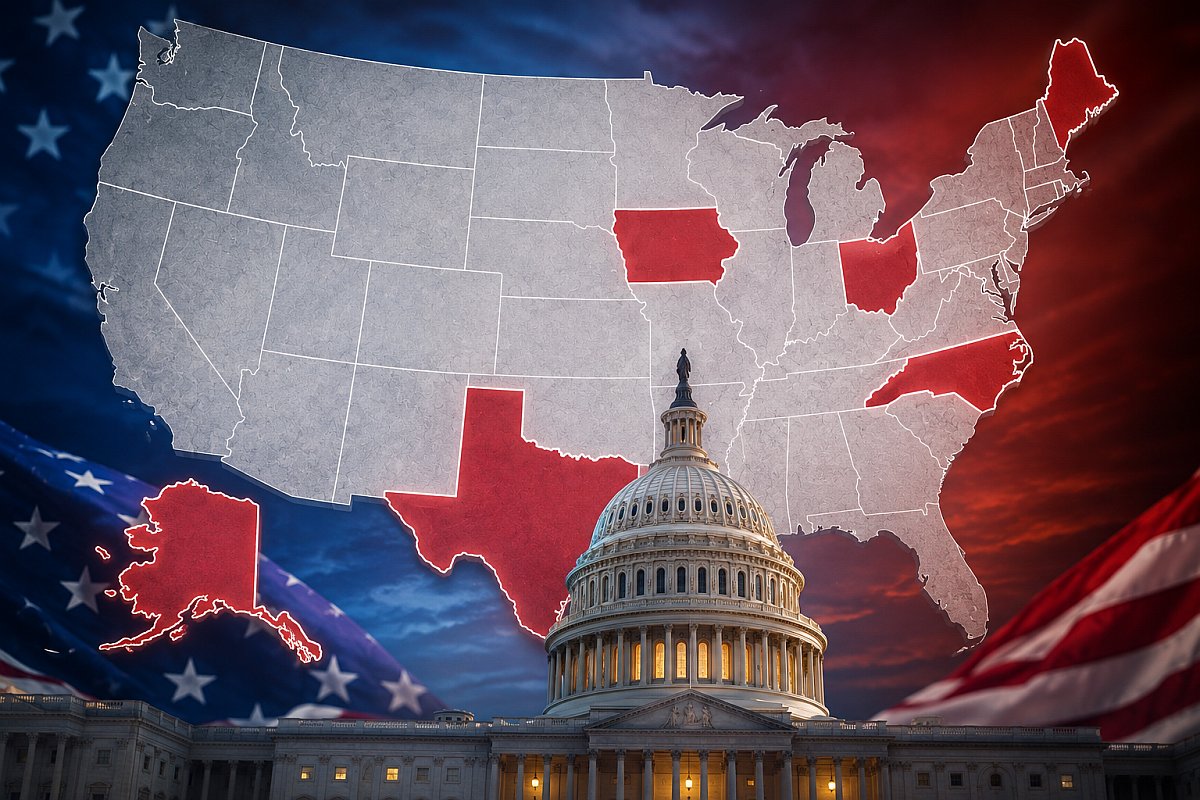
Republicans have a 53-47 Senate majority, but their margin for error is getting smaller. Democrats need a net gain of four seats to take control of the chamber in 2027, and while that remains a difficult task, the Republican side of the map has become considerably less comfortable as the midterms approach. The Cook Political Report’s latest Senate ratings put five Republican-held seats in the Toss Up column: Alaska, Iowa, Maine, Ohio and Texas, while North Carolina, an open Republican-held seat, is rated Lean Democratic.
For a list limited to five, that leaves one genuine battleground on the cutting-room floor. Alaska is very much worth watching after Democrat Mary Peltola finished ahead of Republican Sen. Dan Sullivan in the state’s August primary, but the five races below currently present the clearest combination of Democratic opportunity, candidate strength and danger to the GOP majority. Here are the five Republican-held Senate seats most at risk in 2026.
5. Texas
Seat status: Open Republican-held seat
Outgoing senator: Sen. John Cornyn (R)
Republican nominee: Ken Paxton
Democratic nominee: James Talarico
Cook rating: Toss Up
Texas is not supposed to be one of the states Republicans have to sweat in a midterm election. Donald Trump carried it by more than 13 points in 2024, and Democrats have not won a U.S. Senate race there since 1988. Yet the race has become competitive enough that Cook moved it from Lean Republican to Toss Up on Aug. 20, citing public and private polling that showed a much closer contest than the state’s recent partisan history would suggest. Cook moved Texas and Iowa into the Toss Up column in the same ratings update.
Attorney General Ken Paxton emerged as the Republican nominee after defeating longtime Sen. John Cornyn, while Democrats nominated state Rep. James Talarico. Paxton brings strong support from the Republican base, but he also enters the general election with years of political controversy behind him. Talarico, meanwhile, has become a formidable fundraiser and is trying to keep the race centered on economic issues. Republicans still have the advantage of running in a state that has consistently favored them statewide, but when Texas becomes a Toss Up, the national environment is clearly creating problems for the party.
4. Iowa
Seat status: Open Republican-held seat
Outgoing senator: Sen. Joni Ernst (R), retiring
Republican nominee: Rep. Ashley Hinson
Democratic nominee: State Rep. Josh Turek
Cook rating: Toss Up
Iowa has moved sharply toward Republicans over the past decade. Trump carried the state by more than 13 points in 2024, and Democrats have not won an Iowa Senate race since Tom Harkin’s final reelection in 2008. But Joni Ernst’s retirement removed the advantage of incumbency and turned the contest into an open-seat race. Republicans nominated Rep. Ashley Hinson, one of the party’s stronger recruits, while Democrats nominated state Rep. Josh Turek, a Paralympic gold medalist who has won legislative races in politically difficult territory.
Cook initially viewed the race as favoring Republicans, but the picture changed as polling tightened. On Aug. 20, Cook moved Iowa from Lean Republican to Toss Up, saying the political environment and polling made it increasingly difficult to maintain a Republican advantage. Hinson may still be exactly the kind of candidate Republicans want in a difficult year, but Democrats do not need Iowa to become a blue state again. They only need Turek to win one election in a favorable midterm environment.
3. Ohio
Seat status: Republican incumbent seeking election
Incumbent: Sen. Jon Husted (R), appointed in 2025
Republican nominee: Jon Husted
Democratic nominee: Former Sen. Sherrod Brown
Cook rating: Toss Up
Ohio has become increasingly Republican in presidential elections, but Democrats have one major reason to believe this race can break differently: Sherrod Brown. Brown represented Ohio in the Senate for three terms before losing narrowly to Bernie Moreno in 2024, and he is now trying to return by defeating Republican Sen. Jon Husted, who was appointed to fill the vacancy created when JD Vance became vice president. Brown won the Democratic primary in May, while Husted advanced on the Republican side. The Associated Press described the race as one of the marquee Senate contests of the cycle.
The fundamental question is whether Brown can once again outperform the Democratic ticket with working-class voters who have increasingly moved toward Republicans. Trump won Ohio by double digits in 2024, so the state’s underlying partisan trend still favors the GOP. Brown’s personal brand, however, makes this a much different race than a generic Republican-versus-Democrat matchup. Cook rates it a Toss Up, and Republicans cannot assume Ohio’s recent red shift will be enough to carry Husted across the finish line.
2. Maine
Seat status: Republican incumbent seeking reelection
Incumbent: Sen. Susan Collins (R)
Republican nominee: Susan Collins
Democratic nominee: Troy Jackson
Cook rating: Toss Up
Susan Collins has been called vulnerable before, and she has repeatedly survived. That is an important warning for anyone tempted to treat Maine as an easy Democratic pickup. Collins won reelection in 2020 despite widespread expectations of a much closer result, relying on a long-established reputation for independence and an ability to attract voters who do not normally support Republicans. This year’s Democratic challenge has taken an unusual path, with Maine Democrats selecting former state Senate President Troy Jackson after the party’s original nominee left the race. Jackson was formally chosen as the Democratic nominee in July.
Jackson is a fifth-generation logger with deep roots in northern Maine and a populist profile Democrats hope can compete outside the state’s more liberal population centers. Collins, however, has a major financial advantage and decades of experience winning difficult statewide races. That makes Maine one of the most fascinating contests on the map: Democrats have the state’s presidential lean working in their favor, while Republicans have Susan Collins, who has spent a career proving that national partisan trends do not always dictate what Maine voters do.
1. North Carolina
Seat status: Open Republican-held seat
Outgoing senator: Sen. Thom Tillis (R), not seeking reelection
Republican nominee: Michael Whatley
Democratic nominee: Former Gov. Roy Cooper
Cook rating: Lean Democratic
The most vulnerable Republican-held Senate seat is also the only one on this list that Cook currently places on the Democratic side of Toss Up. Thom Tillis’ decision not to seek reelection created an open seat in one of the most closely divided states in the country. Republicans nominated former Republican National Committee Chairman Michael Whatley, while Democrats nominated former Gov. Roy Cooper. Both won their March primaries, setting up a general-election contest that had effectively been taking shape for months.
Cooper is a particularly difficult opponent for Republicans because North Carolina voters already know him. He won two terms as governor even while the state backed Trump for president, and before that he served four terms as state attorney general. Whatley has Trump’s backing and the benefit of running in a state Republicans have continued to carry at the presidential level, so North Carolina is not suddenly a Democratic state. But Cooper’s statewide record gives Democrats something they do not have everywhere else on the map: a proven candidate who has repeatedly won the same electorate he is asking to support him again. Cook currently rates the race Lean Democratic, making North Carolina the clearest Republican-held pickup opportunity for Democrats heading into the final stretch.
The Senate Majority Is Still Republicans’ to Lose
Democrats have a path to the majority, but it remains narrow. They need a net gain of four seats, and they are simultaneously defending competitive Democratic-held seats in Michigan, Georgia and New Hampshire. A Republican pickup in any of those states would force Democrats to compensate somewhere else, which is why the expanding Republican defensive map matters so much. North Carolina currently leans toward Democrats, while Maine, Ohio, Iowa and Texas are Toss Ups.
Alaska is another Republican-held Toss Up that narrowly misses this five-seat ranking, and its August primary gave Republicans another reason to pay attention after former Democratic Rep. Mary Peltola finished ahead of incumbent Sen. Dan Sullivan in the open primary. Both advanced toward Alaska’s ranked-choice general election. Republicans still begin with the most important advantage because they already hold the majority, but a 53-seat majority does not leave much room for a wave election. If Democrats can protect their own battlegrounds and convert four Republican-held seats, control of the Senate changes hands.
Five months ago, a race like Texas or Iowa might have looked more like an expensive Democratic reach than a true path to 51. Heading into Labor Day, both are Toss Ups, and that is the warning sign for Republicans. Their Senate majority remains intact, but the number of places they have to defend it keeps growing.
Will Texas really turn blue in November? Democrats keep pushing, and spending piles of money, to make it happen. But for all the talk about Texas finally flipping, the Lone Star State has always come home to the GOP when the votes are counted.