
Republicans may have a difficult House map in front of them, but the Senate is a different story.
Republicans currently hold a 53-47 Senate majority, counting the two independents who caucus with Democrats on the Democratic side. That gives the GOP a three-seat cushion above the 50-seat mark and leaves Democrats needing a net gain of four seats to reach 51 and take the majority. Inside Elections currently puts the Senate math at exactly that: Republicans 53, Democrats 47, with Democrats needing four pickups.
That makes every Democratic seat Republicans can flip especially valuable. A GOP victory in Michigan, for example, would not just add another Republican senator. It would force Democrats to pick up five Republican-held seats elsewhere just to reach 51, assuming no other Democratic losses. Win Michigan and Georgia, and the Democratic path gets harder still.
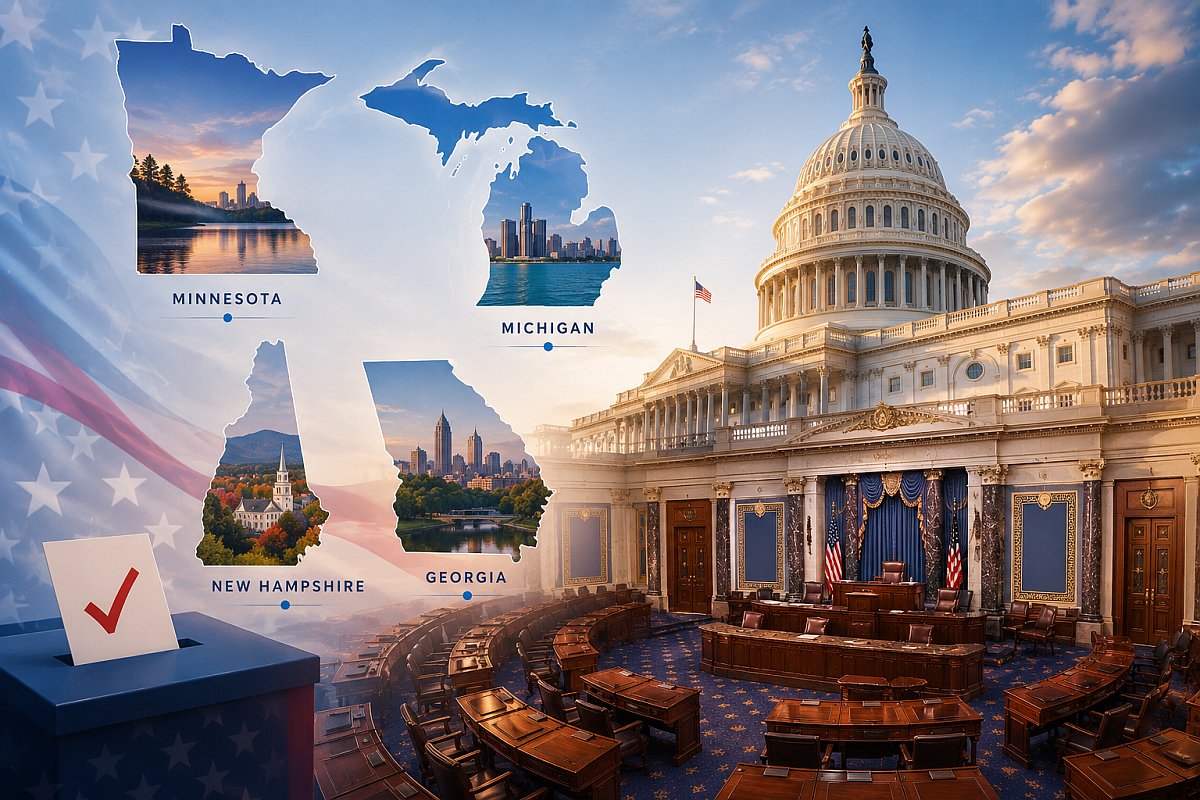
The Cook Political Report’s latest Senate ratings show that Republicans have plenty of defensive problems of their own, but Democrats have vulnerabilities too. Michigan is currently the clearest Republican pickup opportunity, while Georgia, New Hampshire and Minnesota give the GOP additional places to play offense.
Republicans do not need to win all four. Taking even one could dramatically change the Senate math on election night. Here are the four Democratic-held seats Republicans have the best chance to flip.
4. Minnesota
Democratic nominee: Peggy Flanagan
Republican nominee: Michele Tafoya
Cook Rating: Likely Democratic
Minnesota is the longest shot on this list, but Republicans finally have the matchup they wanted to see before deciding whether it deserves serious investment.
Lt. Gov. Peggy Flanagan defeated Rep. Angie Craig in the Aug. 11 Democratic primary, winning about 59 percent of the vote. Former television sports reporter Michele Tafoya won the Republican nomination the same night. The two are competing for the open seat being vacated by retiring Democratic Sen. Tina Smith.
Flanagan’s victory continued a notable trend in Democratic primaries this summer. Progressive candidates have beaten more centrist alternatives in several important races, including Michigan’s Senate contest. Republicans will try to make that ideological shift part of their argument in November.
Still, Minnesota is Minnesota. Republicans have not elected a U.S. senator there since Norm Coleman in 2002, and Cook currently rates the race Likely Democratic. Tafoya gives Republicans a recognizable candidate who can make the race interesting. Calling her the favorite would be a stretch. If the national environment improves for Republicans, however, Minnesota is the next Democratic seat worth watching.
3. New Hampshire
Seat: Open
Cook Rating: Lean Democratic
New Hampshire is the one race on this list where the November matchup is not yet settled, which matters when assessing it in late August.
Democratic Sen. Jeanne Shaheen’s retirement created an open seat in a state that has remained competitive even as Democrats have performed well there in recent federal elections. Cook currently rates the race Lean Democratic, putting it one step outside the Toss Up column.
The Republican opportunity is obvious. Open seats remove the personal advantage of incumbency, and New Hampshire voters have repeatedly shown a willingness to split their tickets. Republican Kelly Ayotte won the governorship in 2024 even as Kamala Harris carried the state at the presidential level.
But this race also comes with a warning for Republicans: unlike Michigan, Georgia and Minnesota, the primary isn’t finished yet. We should not pretend there is a settled general-election matchup before voters actually choose one.
For now, New Hampshire belongs on the Republican target list. Whether it moves higher will depend heavily on who emerges from the primary and how quickly the party can consolidate behind that candidate.
2. Georgia
Democratic incumbent: Sen. Jon Ossoff
Republican nominee: Rep. Mike Collins
Cook Rating: Lean Democratic
If Republicans are looking for the most obvious Democratic incumbent to target, Jon Ossoff is it.
Ossoff is the only Democratic senator seeking reelection this year in a state Donald Trump carried in 2024. Republicans nominated Rep. Mike Collins after Collins won the June runoff against Derek Dooley. Trump endorsed Collins, while Gov. Brian Kemp backed Dooley.
There is a reason Georgia is not No. 1, though. Ossoff enters the general election with an enormous financial advantage and has spent years building a statewide political operation. Reuters reported after the Republican runoff that Ossoff had raised about $60 million compared with roughly $4.9 million for Collins. Cook currently rates the race Lean Democratic rather than Toss Up.
Republicans nevertheless have something here that they do not have in Minnesota or New Hampshire: recent evidence that the state’s electorate can break their way at the presidential level.
Trump won Georgia in 2024. Collins’ job is to convince enough of those voters to come back to the polls in a midterm and vote Republican again.
Ossoff has money, incumbency and what is currently a favorable national environment for Democrats. Collins has the state’s underlying competitiveness and a straightforward argument that Georgia should not be represented by a Democrat in a Republican-controlled Senate.
This will be expensive, ugly and close enough that neither party can ignore it.
1. Michigan
Seat: Open
Democratic nominee: Abdul El-Sayed
Republican nominee: Mike Rogers
Cook Rating: Toss Up
Michigan is the biggest Republican opportunity on the Democratic side of the Senate map, and the Aug. 4 primary gave the GOP another reason to believe it can win.
Progressive former health official Abdul El-Sayed narrowly defeated Rep. Haley Stevens for the Democratic nomination despite Stevens entering the race as the establishment-backed alternative. El-Sayed finished with about 48.5 percent to Stevens’ 47.6 percent. He now faces Republican Mike Rogers, the former congressman who came within roughly 19,000 votes of winning Michigan’s other Senate seat in 2024.
Republicans immediately saw an opening. El-Sayed gives them a nominee they can try to define by his progressive record rather than allowing the election to become solely a referendum on Trump. Cook noted after the primary that Republicans now have an opportunity to make the contest about El-Sayed’s views rather than simply the president or the economy.
That does not make Rogers the favorite. The political environment has been difficult for Republicans, and Michigan voters have moved back and forth between the parties enough times to make predictions dangerous.
But Rogers has been here before. He nearly won statewide two years ago, and this time he faces a Democratic nominee who emerged from a bruising ideological primary by less than one percentage point.
The contest is already producing some unusual strategic maneuvering. Axios reported that Rogers’ allies asked AIPAC not to publicly support his campaign, despite Rogers’ strong pro-Israel record, out of concern that the group’s involvement could become politically counterproductive.
Cook rates Michigan as a Toss Up. It is the only Democratic-held Senate seat currently in that category.
If Republicans flip one Democratic Senate seat in November, Michigan is the best bet today.
Republicans Don’t Need a Sweep
There is no point pretending Republicans currently have a long list of easy Democratic targets. They don’t. New Mexico, Virginia, New Jersey, Colorado and the other Democratic-held seats up this year are all rated Solid Democratic by Cook. Minnesota remains Likely Democratic. Even Georgia and New Hampshire currently lean toward the Democrats.
But Republicans also don’t need a Democratic collapse. They already hold the Senate majority. Every Democratic seat the GOP flips makes the opposition’s job harder somewhere else. A Republican win in Michigan could cancel out a Democratic pickup in Maine, Ohio or another GOP-held battleground. A surprise in Georgia would force Democrats to find yet another Republican seat to compensate.
And Michigan is a real opportunity, not a theoretical one. Rogers nearly won statewide in 2024, the seat is open, Democrats just nominated the more progressive candidate in a razor-thin primary, and Cook has the race sitting squarely in Toss Up territory.
Georgia is harder, but Trump carried the state two years ago. New Hampshire remains an open-seat opportunity. Minnesota is the reach.
Republicans have plenty of Senate seats of their own to worry about this fall. Cook’s Aug. 20 ratings changes moved both Texas and Iowa into Toss Up territory, making the Republican defensive challenge impossible to ignore.
But defense is only half the map. If Republicans can protect most of what they already have and steal one of these four, Democrats could have a very difficult time finding a path back to the majority.