
President Trump has boiled his closing argument for the midterm elections down to something remarkably simple: If Republicans win the House and Senate, every adult American gets $5,000.
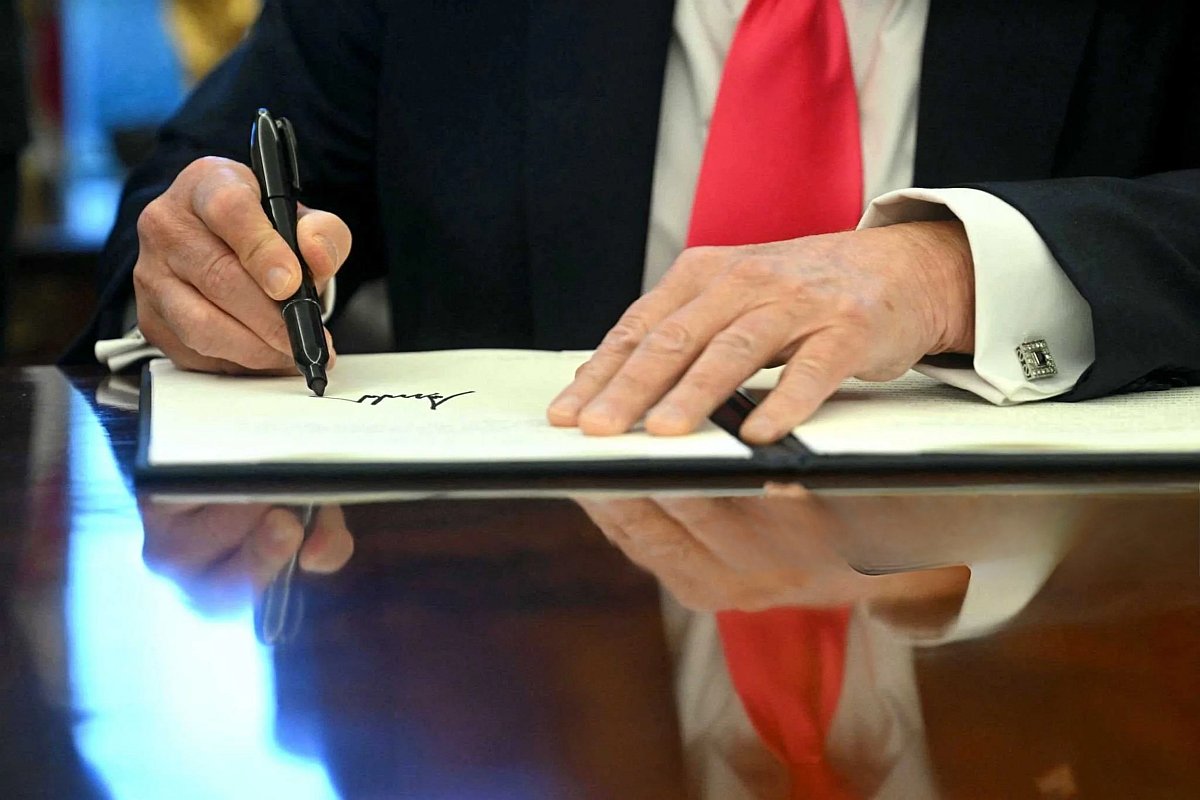
Trump repeated the promise Monday in a social media post, telling Americans that Republicans can afford the payments because of tariff revenue and what he described as record economic investment. He put the estimated price of his “Trump dividend” at roughly $1 trillion and ended with another promise: “I look forward to signing those checks.”
It is difficult to imagine a more direct election-year pitch. Republicans win, voters get a check. Critics have already compared the proposal to vote-buying, while Trump and his supporters describe it as returning some of the country’s economic gains directly to Americans. Whatever label gets attached to it, the latest version of the promise raises some fairly obvious questions.
If Republicans Control Washington Now, Why Wait Until After the Election?
This may be the simplest question surrounding the proposal. Republicans already control the House and Senate, and Trump is already president. If the federal government can afford to distribute roughly $1 trillion to American adults, Trump has not explained why those payments need to depend on the results of the Nov. 3 election.
The proposal also isn’t something that appeared for the first time this week. Trump initially announced the $5,000 dividend at the Republican midterm convention in Dallas in September, meaning Republicans have known about the idea for weeks. At the time, Ohio Sen. Bernie Moreno said he would prepare legislation to get the dividend passed after the election, while several other Republicans immediately questioned whether Congress should spend that much money.
There is nothing preventing Congress from debating such legislation before an election simply because an election is approaching. But Congress would have to authorize the money, and there has been no enacted $5,000 dividend program for Trump to sign.
Where Does $1 Trillion Come From?
Trump’s answer is tariffs and economic growth. In his latest pitch, he said Republicans can make the payments because the government is collecting “massive amounts of money through tariffs” while trillions of dollars are being invested in the United States.
The arithmetic is considerably more complicated. There are roughly 245 million adult U.S. citizens, according to an analysis by FactCheck.org. Giving each of them $5,000 would cost roughly $1.2 trillion, before accounting for any additional borrowing costs or administrative expenses.
Tariffs are producing substantial federal revenue, but nowhere near $1.2 trillion in a single year. FactCheck.org found that the government collected $264 billion in net tariff revenue in 2025. Net tariff revenue through July of this year was far lower after accounting for refunds required following the Supreme Court’s ruling against some of Trump’s tariffs.
There is also an important distinction between government revenue and private investment. Trump cited roughly $21 trillion in investment commitments while explaining why the dividend would be affordable, but a company investing money in an American factory or data center does not put that same amount of money into the U.S. Treasury where Congress can use it to finance checks.
What Would $5,000 Checks Do to Inflation?
This is where the proposal creates an unusual political problem for Republicans. For years, Republicans blamed excessive federal spending under former President Joe Biden for helping fuel the inflation surge that followed the pandemic. Biden’s 2021 American Rescue Plan cost roughly $1.9 trillion and included direct payments of up to $1,400 to eligible Americans.
Economists continue to debate exactly how much that legislation contributed to the inflation that followed, particularly because supply disruptions, energy prices, monetary policy and earlier pandemic spending were also involved. But the basic Republican argument was straightforward: Putting enormous amounts of borrowed federal money into an economy with limited supply can push prices higher.
Now some Republicans are making essentially the same argument about Trump’s proposal. Reuters reported that several GOP lawmakers raised concerns that injecting roughly $1.2 trillion into the economy could increase inflation and worsen the federal government’s fiscal position.
Rep. David Schweikert of Arizona warned that the proposal could hurt working-class Americans through higher inflation and interest rates. Rep. Chip Roy of Texas separately estimated the cost at about $1.2 trillion and questioned whether the money would be better used for tax relief, while several Republican senators have said they want to know how the payments would be financed before supporting them.
The economic circumstances are not identical to 2021. But that makes the question more interesting, not less. If Republicans believe large stimulus payments helped cause the inflation they spent years campaigning against, they now have to explain why a much larger $5,000 payment would produce a different result.
Voters Aren’t Exactly Convinced
The $5,000 promise certainly gets attention, but the limited polling we have suggests Americans are skeptical of both the proposal and the chances that the checks ever arrive.
An Economist/YouGov poll conducted Sept. 11-14 found likely voters narrowly opposed the $5,000 dividend, with 45% opposed and 43% in favor. More striking was what voters thought would actually happen: only 22% of likely voters said Trump would deliver the checks, while 61% said he would not, according to Axios.
The broader Economist/YouGov results found similar skepticism among Americans overall. Just 21% said Trump definitely or probably would issue the promised dividend if Republicans kept control of Congress, while 57% said he would not. Even among Republicans, fewer than half said they expected the checks to materialize.
That skepticism may explain why Trump is returning to the promise now. Instead of a line delivered once during a convention speech, the president has put the offer directly in front of voters again during the final month of the campaign and attached an unmistakable condition to it: Republicans must win both chambers.
Is It Really $5,000 for Everyone?
Trump’s latest statement says “all Adult Citizens in the United States of America” would receive $5,000. It does not mention an income cutoff, tax liability requirement, application process or phaseout for wealthy Americans.
There has already been some movement in the details, however. When Trump first announced the dividend in September, he said recipients would have to spend the money in the United States. He did not explain how such a restriction would work, and that condition is absent from his latest social media pitch.
There is also no legislation establishing exactly who qualifies, how payments would be distributed, whether they would be taxable or how the government would pay for them. Senate Majority Leader John Thune acknowledged in September that there was not yet a specific proposal, while Sen. John Kennedy said he would want to see the “pay-fors” before supporting anything that required another $1.2 trillion in borrowing.
A Very Expensive Midterm Promise
Trump isn’t hiding the political condition attached to the idea. Quite the opposite. His latest message explicitly tells Americans that Democrats cannot provide the payments and that the $5,000 checks depend on Republicans winning the House and Senate.
Supporters can reasonably argue that elections are always filled with promises involving voters’ wallets. Candidates campaign on tax cuts, tax credits, student loan policies, Social Security benefits and government spending all the time. Trump is also arguing that these payments would represent a dividend from an economy and tariff system that he says Republicans created, rather than a traditional stimulus program.
Critics see something more troubling in making a specific cash payment explicitly contingent on one party winning an election. That criticism is likely to grow as Trump continues repeating the promise during his final campaign swing, particularly because Republicans already control Washington and Congress has yet to approve the money.
The biggest question may ultimately be the one voters themselves appear to be asking. Forget for a moment whether a $5,000 check sounds appealing. Is there actually a trillion-dollar plan behind it that Congress is prepared to pass, or is the Trump dividend going to remain an election-year promise?
With less than a month until Election Day, Trump is making the offer increasingly difficult to miss. Republicans win the House and Senate, he says, and the checks are coming. Now Republicans have to explain how they intend to make the math work.
Follow the latest races and developments on our 2026 midterm elections page and track the latest numbers on our 2026 Senate polls page.