
Donald Trump is kicking off his final month of midterm campaigning Thursday night in Oklahoma. On Friday, he heads to Alabama. That is a strange place for a Republican president to begin an all-out push to save his party’s congressional majorities.
Trump won Oklahoma by more than 30 points in 2024 and Alabama by more than 30 points. Sending a Republican president into those states a month before a midterm is a little like sending Barack Obama to New York and Vermont to shore up Democrats.
There are explanations for the itinerary. Republican officials say the locations were chosen partly because they reach multiple media markets and can help turn out Trump voters in nearby competitive races. Durant, Oklahoma, sits just across the border from North Texas, where Republicans suddenly have a serious Senate race on their hands.
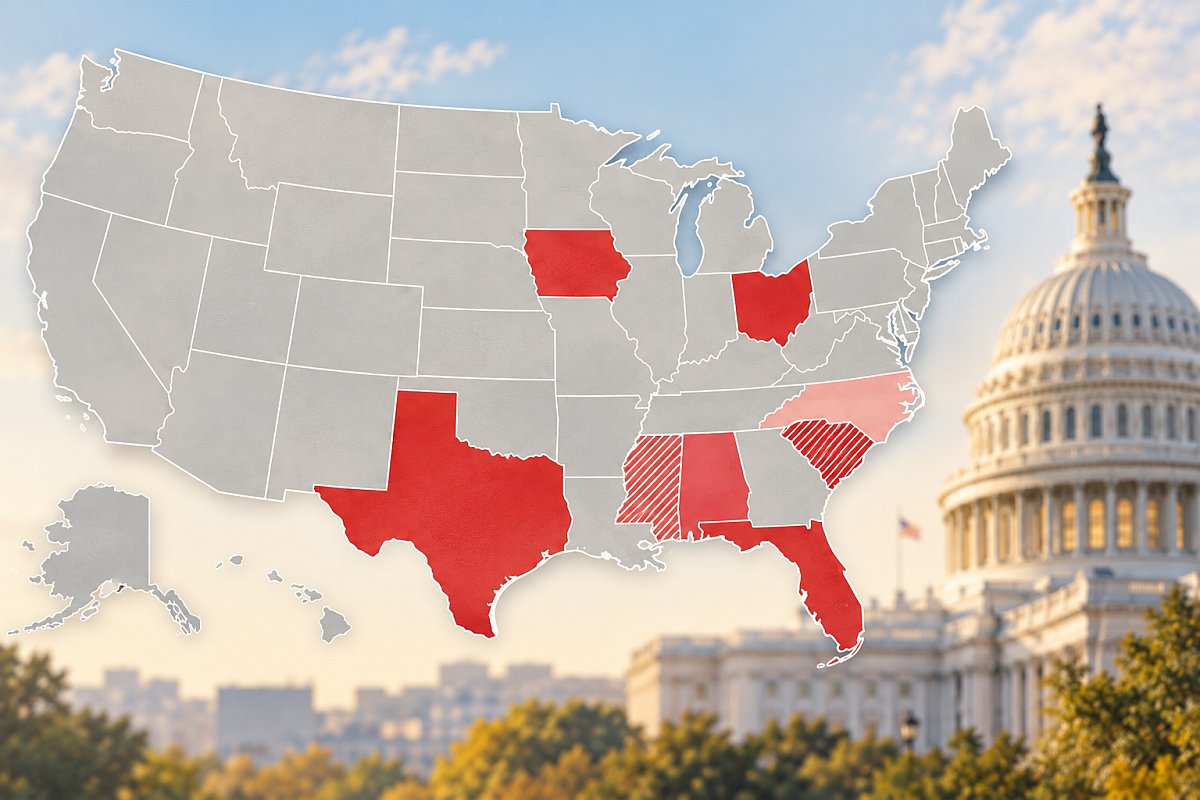
But Oklahoma and Alabama are also part of a much bigger picture. Republicans are playing defense in places they never expected to be worrying about this late in the election.
The Republican Map Keeps Getting Bigger
Start with Texas. Republican Senate nominee Ken Paxton is locked in a close race with Democrat James Talarico, something that would have sounded far-fetched after Trump carried the state comfortably two years ago. Making matters more awkward, Paxton was caught on leaked audio this week saying Republican poll numbers dropped after Trump’s recent convention in Dallas.
Then there is Iowa. What initially looked like one surprising poll showing Democrat Josh Turek ahead of Republican Ashley Hinson has turned into a string of surveys showing a genuinely competitive Senate race. South Carolina has joined the list, with recent polls showing Republican Darline Graham Nordone and Democrat Annie Andrews separated by only a few points in a state where Democrats haven’t won a statewide election in two decades.
Ohio is competitive enough that Trump will head directly from Alabama to Vandalia on Saturday to campaign with Republican Sen. Jon Husted, who is facing former Democratic Sen. Sherrod Brown. Even Florida is absorbing Republican money. Reuters reported Thursday that a super PAC backed by billionaire Ken Griffin has spent nearly $5 million supporting Republican Sen. Ashley Moody against Democrat Angie Nixon. Major election forecasters still rate the race as favoring Republicans, but spending that kind of money in Florida illustrates how much territory the party is now defending.
Democrats are even taking another look at Mississippi, where the party hasn’t won a U.S. Senate election since 1982. That doesn’t suddenly make Mississippi a toss-up, and several of these races still favor Republicans. Democrats also have their own resource problems, and a close poll in October isn’t the same thing as an election result.
Still, when Republicans are spending serious money in Florida, worrying about Senate races in Iowa and South Carolina, fighting for Texas and sending Trump through Oklahoma and Alabama, something has clearly changed.
The Economy Is Becoming the Common Thread
The simplest explanation may be the one voters keep giving pollsters: things are too expensive. A new AP-NORC poll released Thursday found just 26% of Americans approve of Trump’s handling of the economy. On the cost of living, his approval falls to just 17%.
More troubling for Republicans, roughly six in ten Republicans disapprove of Trump’s handling of living costs, while about 65% of Americans say his policies deserve at least some responsibility for unusually high prices.
That is a particularly difficult problem for Republicans because affordability helped put Trump back in the White House in 2024. Voters who were angry about inflation under Joe Biden were promised lower prices, cheaper energy and a stronger economy. Less than two years later, Republicans are again heading into an election dominated by complaints about gas, groceries and household bills.
Republicans Are Saying It Themselves
This isn’t just Democratic campaign spin or nervous speculation from election analysts. Republican senators are openly talking about the problem. “If you’re not worried, you’re living in a cave,” Republican Sen. Jim Justice of West Virginia told Semafor as senators left Washington to campaign.
Sen. Lisa Murkowski of Alaska made essentially the same point from another direction. If Republicans had already done enough on affordability, she said, voters wouldn’t still be raising it as the dominant issue of the campaign.
There is plenty for voters to notice. Consumer confidence fell in September to its lowest level since 2014, while elevated fuel prices continue to hit consumers and businesses. Diesel has become such a problem that Texas Gov. Greg Abbott declared a 30-day statewide disaster and temporarily relaxed transportation and fuel regulations in an effort to increase supplies.
That matters enormously in farm states such as Iowa, where expensive diesel and fertilizer land directly on farmers’ balance sheets. Republican lawmakers from those states have been pressing Washington for relief, and some have called for Congress to return before the election to address fuel costs. The White House has also been looking for ways to bring diesel prices down, including discussions with European allies about drawing from emergency inventories.
Trump Is Trying to Get His Voters Back to the Polls
The other problem is enthusiasm. Trump can still draw crowds, and Republican candidates continue to seek his endorsement and support. But a midterm electorate is different from a presidential electorate, and Republicans need millions of people who turned out for Trump in 2024 to come back and vote when his own name isn’t on the ballot.
That helps explain Oklahoma and Alabama. Republican officials say the two rally locations can reach voters across multiple states and media markets, while the administration plans to send Trump into more conventional battlegrounds during October, including states with competitive Senate races.
The strategy makes sense, but the geography is still revealing. Trump isn’t beginning October with a victory lap through states Republicans are trying to flip. He is beginning it by trying to energize voters in some of the reddest territory in America while Republican campaigns spend money defending states they once assumed would take care of themselves.
There Is Still a Month to Go
Republicans have important advantages. They have significant financial resources, incumbency in many of the races now drawing attention and a Senate map that still gives them opportunities. Some of the eye-catching Democratic performances are coming from individual polls, and several races now being described as competitive still lean Republican.
Trump and the White House also argue that the economy is stronger than voters give them credit for. Republicans point to their tax legislation, private-sector investment and manufacturing announcements while arguing that some of today’s inflation and energy problems were inherited or have been aggravated by the war with Iran.
Trump himself acknowledged Wednesday that the administration has struggled to sell its economic record, saying he had done a poor job explaining how well he believes the country is doing. The problem for Republicans is that voters don’t cast ballots on economic statistics alone. They also vote on what they see at the gas station, the grocery store and in their monthly bills.
Right now, those voters are forcing Republicans to defend an extraordinary amount of territory: Texas, Iowa, South Carolina, Ohio and Florida, with even Mississippi getting attention. At the same time, the president is starting his October campaign blitz in Oklahoma and Alabama.
None of that tells us what will happen on Election Day. It does tell us something important about the election Republicans are fighting right now: the battlefield is much larger than they expected.
Follow our 2026 midterm election coverage for the latest polls, campaign developments and key races heading into November.