
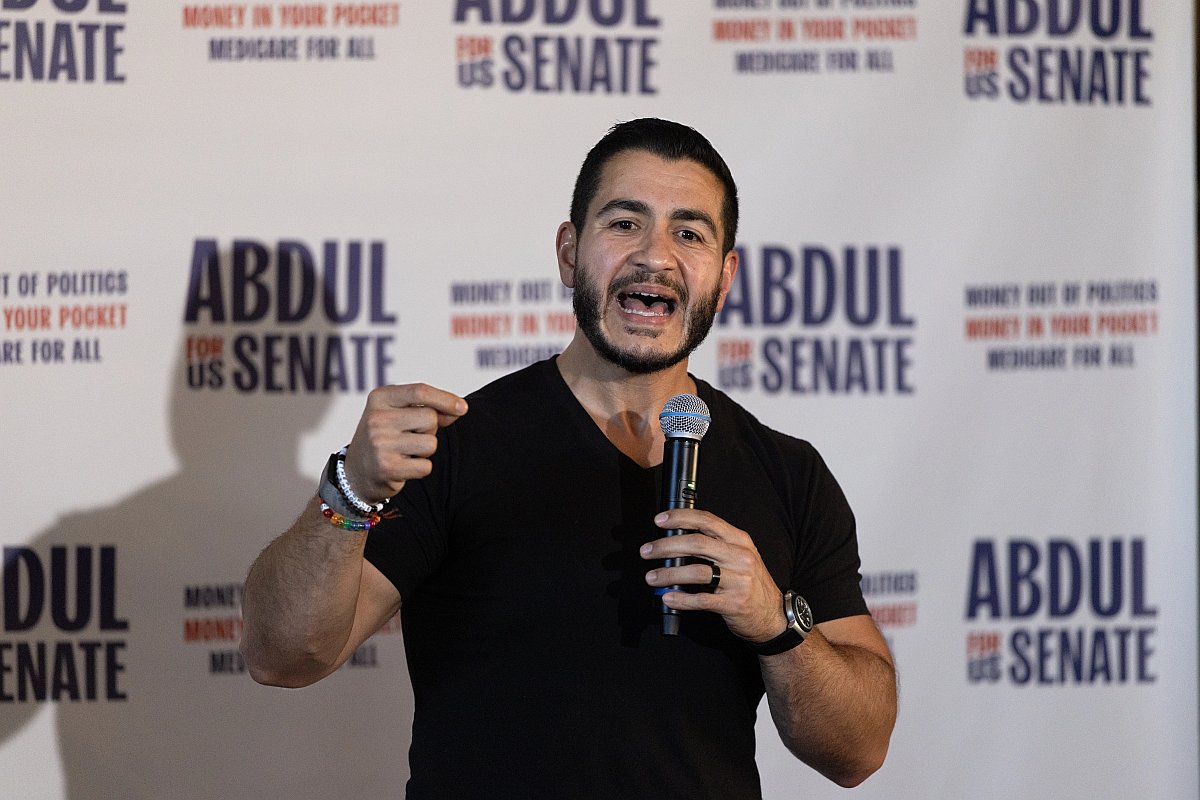
Abdul El-Sayed has spent much of the fall trying to unite Michigan Democrats behind his Senate campaign, but a new conversation with Jewish voters in Oakland County shows that one part of the Democratic coalition remains deeply uneasy with its nominee.
MS NOW contributor Elise Jordan recently sat down with Jewish Democrats who supported Rep. Haley Stevens in the Democratic primary and asked how they were approaching the November race between El-Sayed and Republican Mike Rogers. The answers ranged from reluctant support for El-Sayed to uncertainty about voting for either candidate, with Israel and antisemitism dominating the discussion.
In many ways, their answers reveal the tension between voting for Rogers, a relatively moderate Republican on some issues, and supporting a candidate whose views on Israel they see as hostile to a core part of their identity. Only Democrats could make it this hard.
One voter described the choice as being “like Sophie’s Choice,” a comparison that feels more than a little overwrought. In the novel and film, Sophie is forced by a Nazi officer to choose which of her children will live and which will die. Deciding between two Senate candidates may be politically agonizing for these voters, but it is not remotely comparable to that kind of horror.
Another said the biggest obstacle to supporting El-Sayed “just comes down to this whole thing with Israel,” while another said she wanted to hear the Democratic nominee make a simple declaration that he supports Israel, something El-Sayed has declined to do.
The conflict was particularly confusing for one voter who said he is both Jewish and the father of a transgender daughter. He described Israel as deeply important to him, but said he also believes voting for Rogers would threaten his daughter’s (son’s?) rights, something he was never asked to clearly define or elaborate on. Another participant said her daughter, currently attending law school, feels she has to hide being Jewish.
The segment is only a focus group and should not be treated as representative polling of Michigan’s Jewish population, but these are the conversations happening and it’s why Mike Rogers remains within striking distance.
El-Sayed Hasn’t Backed Away From His Israel Position
El-Sayed has been one of the Democratic Party’s most outspoken critics of Israel during the campaign. He has accused the Israeli government of committing genocide in Gaza, called for ending U.S. military assistance and said during a CNN interview in April that both Hamas and the Israeli government were “evil.”
“Hamas: evil. Israeli government: evil. We can say both,” El-Sayed said when pressed on the comparison. He has also rejected the idea that criticism of Israel or Zionism should automatically be treated as antisemitic. The Forward reported earlier this year that El-Sayed was actively courting Jewish voters while refusing to soften those positions.
His response to a March attack on Temple Israel in West Bloomfield also became a major issue in the campaign. El-Sayed condemned the attack, although comments he made afterward about cycles of violence drew criticism from Jewish leaders and Republicans. PolitiFact later found that claims he had refused to condemn the attack were inaccurate, noting that El-Sayed explicitly said, “I condemn what he did.”
The controversy has not prevented prominent Democrats from lining up behind him. Michigan Sen. Elissa Slotkin recently appeared alongside El-Sayed and argued that seeing a Jewish senator and a Muslim Senate candidate work together was important for the state. Former President Barack Obama is also expected to campaign with El-Sayed as Democrats try to consolidate support heading into November.
The Race Is Still Very Close
Whatever problems El-Sayed may have with parts of the Democratic coalition, recent statewide polling has generally shown him ahead of Rogers. The current RealClearPolling average has El-Sayed at 48.1% and Rogers at 44.7%, a Democratic advantage of 3.4 points.
Recent polls have ranged from a one-point El-Sayed lead in Fox News and YouGov surveys to a seven-point advantage in a Marist poll. A Mitchell Research survey conducted Oct. 1 had El-Sayed ahead 46% to 41%. None of those margins is large enough to make Michigan anything other than a closely watched Senate contest.
The MS NOW discussion also showed why the race cannot simply be reduced to dissatisfaction with El-Sayed. Several participants who expressed serious reservations about him were equally clear that those concerns did not automatically translate into support for Rogers.
One woman said she might ultimately leave the Senate race blank. Others described themselves as caught between their concerns about El-Sayed’s Israel positions and their disagreements with Republicans on other issues.
That may be the central challenge for El-Sayed over the final weeks. He does not necessarily need every skeptical Democrat to suddenly agree with him on Israel, but in a close Senate race he does need enough of them to decide that their disagreements are not enough to keep them home or send them to Rogers.
For at least some Jewish Democrats in Oakland County, and elsewhere in the state, that decision clearly has not been made yet.
Follow the latest numbers on our 2026 Senate polls page and visit our 2026 Senate elections guide for more races around the country.