
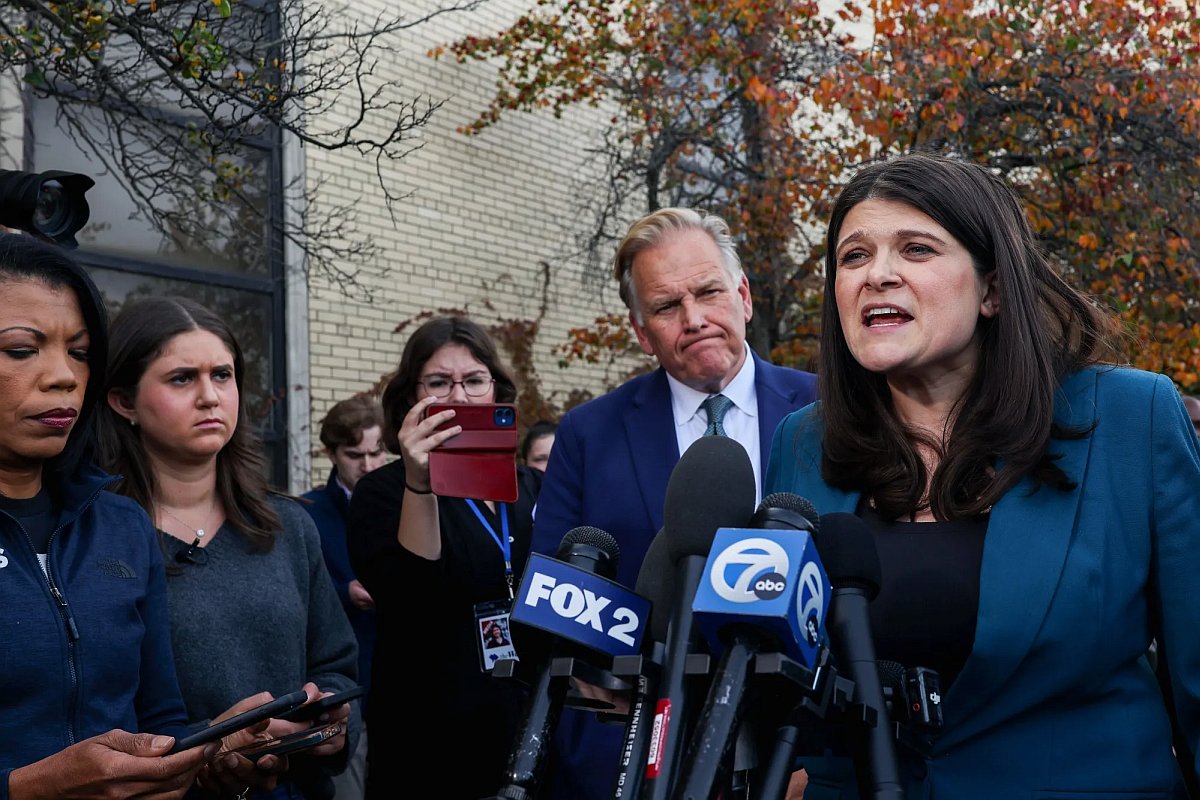
Michigan Democrats were supposed to spend the final weekend before Election Day trying to prove they had finally moved past one of the nastiest Senate primaries of the year.
Instead, former Democratic Senate candidate Haley Stevens showed up at church with Republican Mike Rogers and endorsed him over her own party’s nominee, Abdul El-Sayed. The stunning reversal came less than 48 hours before Election Day and capped several days of increasingly public infighting inside the Democratic coalition.
This Feud Started in the Democratic Primary
El-Sayed defeated Stevens in the Aug. 4 Democratic primary by roughly one point, 48.5% to 47.5%, after a bitter and expensive campaign that exposed deep divisions over Israel, the direction of the Democratic Party and the role of outside money in the race. The Associated Press has a useful rundown of how that primary feud carried into the general election.
Stevens had heavy support from establishment Democrats and pro-Israel groups, while El-Sayed ran as the more progressive candidate and was sharply critical of U.S. support for Israel. The primary became increasingly personal, but after losing, Stevens publicly said it was time to move on and support the Democratic ticket.
Two days after the primary, Stevens and El-Sayed appeared together at a unity breakfast. Stevens later said their differences had been aired out and that “the unity deal” was done. But the two barely appeared together after that, and the tension never really disappeared.
Then Stevens’ Fiancé Said He Was Voting for Rogers
The divisions burst back into public view last week when Jason Turkish, Stevens’ fiancé and a prominent Jewish Democrat in Michigan, said he planned to vote for Rogers instead of El-Sayed.
Turkish told The Detroit News that he believed El-Sayed’s rhetoric regarding Israel and Jewish political groups had become increasingly troubling. Stevens initially distanced herself from that decision, appearing on CNN hours later to reaffirm that she still supported El-Sayed while urging him to do more to reassure voters who had backed her in the primary.
At that point, Democrats still appeared determined to get the two former rivals together publicly before Election Day.
The Big Unity Event Was Supposed to Happen Sunday
Democratic leaders organized a church appearance in Detroit for Sunday that was supposed to put an end to the drama. El-Sayed and Stevens were expected to attend together alongside prominent Democrats including Rep. Jim Clyburn, giving the party a highly visible show of unity just two days before the election.
The event mattered because Stevens had performed particularly well with Black and Jewish voters in Wayne and Oakland counties during the primary, two constituencies Democrats badly want engaged in the general election. The planned appearance was supposed to signal that whatever happened in August was over.
Instead, everything unraveled.
A Fight Over Israel Blew Up the Truce
On Friday, Stevens publicly called on El-Sayed to condemn an advertisement from an outside progressive group that linked U.S. support for Israel to higher costs at home. El-Sayed responded that the ad was not produced by his campaign and said he disagreed with it, but he also accused Stevens of trying to relitigate a primary that had ended months earlier.
By Saturday, the planned unity appearance had become a distraction rather than a reconciliation. Rep. Debbie Dingell, who helped organize the event, said she ultimately asked Stevens not to attend because the dispute had become too disruptive in the final hours of the campaign.
Stevens later characterized the situation more bluntly, saying El-Sayed’s side had made clear she was no longer welcome around the campaign.
Then Stevens Showed Up With Mike Rogers
Sunday morning produced one of the strangest scenes of the entire 2026 campaign. Instead of attending church with El-Sayed and Democratic leaders, Stevens appeared alongside Republican Mike Rogers at Perfecting Church in Detroit. Fox News reported on the church appearance and the collapse of the planned Democratic unity event.
She then formally endorsed him.
Stevens said she was not abandoning the Democratic Party broadly, describing the decision as being about “this one vote.” Rogers said he was honored to have her support, while Republicans immediately seized on the endorsement as evidence that even prominent Democrats had reservations about El-Sayed.
The reaction inside Stevens’ own political operation was brutal. Her longtime chief of staff resigned, other staff departures followed or were expected, and Michigan Democratic Party chair Curtis Hertel said Stevens was no longer a member of the state Democratic Party. Senate Democratic Leader Chuck Schumer called the endorsement a “despicable betrayal.”
El-Sayed Says None of This Matters
El-Sayed tried to brush off the endorsement Sunday, telling reporters he was more interested in the issues facing Michigan voters than in Stevens’ decision. He argued that the campaign should remain focused on the cost of living and other economic issues rather than internal Democratic drama.
His campaign also appears to have turned the controversy into a fundraising moment. Reuters reported Monday that El-Sayed’s campaign said it raised more than $1 million in the hours after Stevens endorsed Rogers.
And the Race Was Already Close Enough to Matter
The timing makes the whole episode more consequential because Michigan is one of the Senate races that could help determine control of the chamber. El-Sayed is running for the seat being vacated by retiring Democratic Sen. Gary Peters, while Rogers is attempting to flip it for Republicans.
Late polling has generally shown El-Sayed ahead, although the size of that lead varies. The current RealClearPolling average has El-Sayed ahead by roughly four points, while individual late surveys have ranged from a narrow Democratic advantage to substantially larger leads.
That means the Stevens endorsement does not suddenly erase the polling picture, and there is no way to know how many voters will actually follow her lead. But endorsements this dramatic are rare enough on their own, and almost unheard of when they come from the losing primary candidate just two days before a close general election.
So What Is This Election-Even Chaos?
Michigan Democrats spent months trying to stitch together the coalition that fractured during the primary. Stevens said she supported El-Sayed, El-Sayed accepted that support, and party leaders repeatedly tried to move everyone toward the general election.
But the underlying dispute over Israel, political rhetoric and the direction of the party never really went away. Stevens’ fiancé publicly defected first, the planned unity event collapsed next, and then Stevens herself crossed party lines and endorsed Rogers.
By Monday morning, the day before Election Day, the Michigan Senate race was no longer just about El-Sayed versus Rogers. It had also become a last-minute Democratic civil war playing out in public with Election Day only one day away.
Follow the latest polling and battlegrounds in our 2026 Senate election guide.