
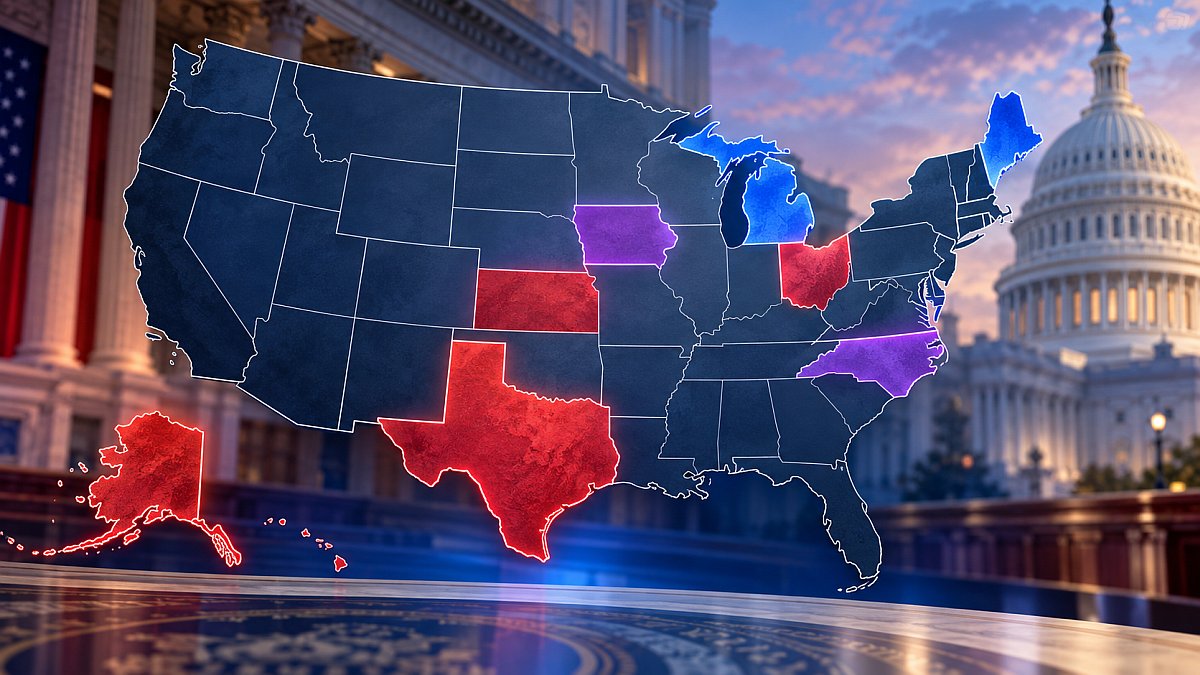
Democrats have spent much of the fall expanding the Senate battlefield into places Republicans never expected to seriously defend. Alaska is competitive, Kansas is a toss-up, Sherrod Brown is threatening Republicans in Ohio, Texas is close, and North Carolina has moved sharply toward Democrats.
Put all of that together and a Democratic Senate majority can start to look close. But there is another way to look at the map, and it begins with two races that have received less attention lately: Maine and Iowa. If Republican Sen. Susan Collins survives in Maine and Ashley Hinson holds Iowa, Democrats could still win the Senate, but they would have to do it by winning several states Donald Trump carried comfortably two years ago.
Democrats Need Four Seats
Republicans entered this election with a 53-47 Senate majority, counting the two independents who caucus with Democrats on the Democratic side. That means Democrats need a net gain of four seats to reach 51, assuming there is no change in how the independents caucus.
The good news for Democrats is that the battlefield has become remarkably large. The Cook Political Report currently lists seven Senate races as Toss Ups:
- Alaska: Dan Sullivan (R) vs. Mary Peltola (D)
- Iowa: Ashley Hinson (R) vs. Josh Turek (D)
- Kansas: Roger Marshall (R) vs. Adam Hamilton (D)
- Maine: Susan Collins (R) vs. Troy Jackson (D)
- Michigan: Mike Rogers (R) vs. Abdul El-Sayed (D)
- Ohio: Jon Husted (R) vs. Sherrod Brown (D)
- Texas: Ken Paxton (R) vs. James Talarico (D)
Six of those seven seats are currently held by Republicans. Michigan is the exception, with Democrats trying to defend the open seat being vacated by Sen. Gary Peters. North Carolina has moved even further toward Democrats, with Cook now rating Democrat Roy Cooper’s race against Republican Michael Whatley as Likely Democratic despite the seat currently being held by Republicans.
Now Give Democrats North Carolina
Start by assuming Democrats successfully defend every Senate seat they already hold, including Michigan, Georgia, Minnesota and New Hampshire. Then give them North Carolina.
- Starting Democratic-aligned seats: 47
- Flip North Carolina: 48
- Seats needed for control: 51
- Additional Republican seats Democrats still need: 3
That is where Maine and Iowa become so important. If Democrats win either one, the road gets easier. Win both and Democrats would need only one more Republican seat after North Carolina.
But flip the scenario around. If Collins wins Maine and Hinson wins Iowa, Democrats are still sitting at 48 and still need three more Republican-held seats, which likely means some combination of Alaska, Kansas, Ohio and Texas.
That Means Winning Three Trump States
This is the part of the Senate map that can get obscured when you look at seven Toss Ups on a chart. The races may all be competitive, but the states themselves are not politically interchangeable.
Trump won Iowa by 13.2 points in 2024 and also carried Alaska, Kansas, Ohio and Texas. If Maine and Iowa both stay Republican, Democrats would likely need to win three Senate races in states Trump carried just two years ago.
That is certainly possible given the polling we are seeing this year, but it is a very different proposition from simply saying Democrats have seven Toss Ups from which to find four seats. Expanding the battlefield is one thing. Actually converting enough of those races to reach 51 is another.
Maine Was Supposed to Be the Obvious Pickup
Maine has long looked like the cleanest Democratic opportunity because Collins is the only Republican senator seeking reelection in a state Kamala Harris carried in 2024. Yet with less than two weeks remaining, Collins is still very much alive.
The latest RealClearPolling average has Democrat Troy Jackson ahead by just 1.4 points, 48.8% to 47.4%. A new Fox News poll released Friday has the race dead even at 49% each.
That is particularly notable because Collins has been here before. In 2020, multiple late polls showed Democrat Sara Gideon leading Collins, in some cases by substantial margins, before Collins won the election by nearly nine points.
We recently looked at that history in The Last Time Susan Collins Trailed Like This in Maine, She Won by 9 Points. None of that means Collins will repeat the trick in 2026, but it does make assuming Maine is already a Democratic pickup particularly risky. If Collins survives, one of the most straightforward pieces of the Democratic Senate strategy disappears.
Iowa Has Quietly Become Just as Important
Iowa presents a different problem for Democrats because the state itself has moved substantially toward Republicans over the past decade. Trump carried it three elections in a row and won it by 13.2 points in 2024, while Republicans have also built a significant voter-registration advantage.
Yet Democrat Josh Turek has turned the open Senate contest against Ashley Hinson into a genuine toss-up. The current RealClearPolling average has Hinson ahead by just 0.4 points, 46.0% to 45.6%, with individual surveys still bouncing back and forth between the two candidates.
The basic tension has not changed. Turek is running dramatically better than Democrats did in Iowa in 2024, but Hinson is competing on political terrain that has become increasingly Republican. If she holds the seat, another relatively direct Democratic path disappears.
Then Democrats Need Alaska, Kansas, Ohio or Texas
Take North Carolina as a Democratic pickup, let Collins and Hinson hold Maine and Iowa, and assume Democrats successfully defend Michigan. Democrats would still need three additional Republican seats.
- Alaska: Mary Peltola is running competitively against Republican Sen. Dan Sullivan
- Kansas: Democrat Adam Hamilton has turned what once looked like a safe Republican seat into a Toss Up against Sen. Roger Marshall
- Ohio: Former Democratic Sen. Sherrod Brown is attempting a comeback against Republican Sen. Jon Husted
- Texas: Democrat James Talarico and Republican Ken Paxton are locked in a race that several recent polls have shown within a few points
Democrats would not necessarily have to win those exact three because another Republican-held race could still move late. South Carolina, for example, has tightened considerably and is currently rated Lean Republican by Cook.
But the basic math remains the same. Without Maine and Iowa, Democrats need several things to go right in territory that normally leans Republican, and they need those things to happen at the same time.
And Michigan Is the Complication Nobody Can Ignore
All of this math assumes Democrats hold Michigan, which is far from guaranteed. Cook still rates the open Senate race between Abdul El-Sayed and Republican Mike Rogers as a Toss Up, while recent polling has generally shown a close contest.
A Marist poll released this week had El-Sayed ahead 50% to 48%, and other recent surveys have also placed the race within a few points. That leaves Republicans with one of their few realistic opportunities to take a Democratic-held Senate seat while defending their own much larger battlefield.
If Republicans were to win Michigan, the entire Democratic calculation changes. A Michigan loss would cancel out one Democratic pickup somewhere else, meaning Democrats would need five Republican seats instead of four to produce the same net gain.
Combine a Republican Michigan win with Collins holding Maine and Hinson holding Iowa, and the path gets considerably narrower. Democrats would then be asking for something close to a sweep across several of the remaining Republican-held battlegrounds.
A Big Battlefield Is Not the Same Thing as 51 Seats
There is no question that Democrats have dramatically improved their Senate position during 2026. Cook’s own range has Democrats gaining between two and six seats, which puts the four-seat majority threshold right in the middle of the plausible outcomes it is tracking.
That is a remarkable position considering how Republican the Senate map looked earlier in the cycle. North Carolina has moved toward Democrats, while Alaska, Kansas, Iowa, Ohio and Texas are all competitive enough to force Republicans to spend money and defend territory they would normally expect to hold.
But Democrats still have to assemble 51 actual seats, and that is where Maine and Iowa matter so much. If Jackson defeats Collins and Turek wins Iowa, the Democratic path becomes much easier to see. If Collins survives again and Hinson keeps Iowa in Republican hands, the same national environment could produce a very different Senate result.
Democrats have created opportunities almost everywhere they could reasonably hope to create them. The remaining question is whether they can convert enough of those opportunities at the same time, which is why the Senate can look close to flipping on a national map while still being several difficult wins away from actually changing hands.
Follow the latest numbers on our 2026 Senate polls page and visit our 2026 Senate elections guide for the latest races around the country.