

For the past several weeks, the Senate map has started to look almost unreal for Democrats.
Democratic candidates are leading or running essentially even in Texas, Kansas, Nebraska, Iowa, Ohio, Alaska and Maine. Republicans are moving money into states they never expected to defend, President Trump is crisscrossing the country for candidates who were supposed to have easier races, and national polling continues to point toward a strongly Democratic midterm environment. The Washington Post reported this week that Democrats are leading national congressional preference by roughly eight points.
It certainly looks like the ingredients for a blue wave. But there is another possibility worth considering: What if the wave is real, but the Senate polling is showing it traveling a little farther into Republican territory than it actually will?
That question has become increasingly relevant as Republican pollsters raise concerns about the same problem that has perplexed election polling throughout the Trump era. Rural and lower-propensity Republican voters are difficult to reach, less likely to answer surveys and, in several recent elections, have shown up in greater numbers than polling models expected.
The Washington Post reported this week that Republican pollsters are openly questioning whether current surveys are again understating GOP support, particularly among rural and lower-response voters. Republican pollster Patrick Ruffini noted that polling at this point in the cycle overstated Democratic Senate support by an average of 6.2 points across Iowa, Michigan and Ohio from 2018 through 2024. Rich Lowry raised the same broader concern Wednesday during an appearance with Megyn Kelly, pointing in particular to Susan Collins’ history of outperforming her polls.
That does not mean the polls are wrong. Pollsters have made significant methodological changes since 2016, 2020 and 2024, including greater use of voter files, past-vote weighting and other techniques designed specifically to find Republicans who were missed before. The Atlantic noted this week that midterm electorates can also be easier to model than presidential electorates.
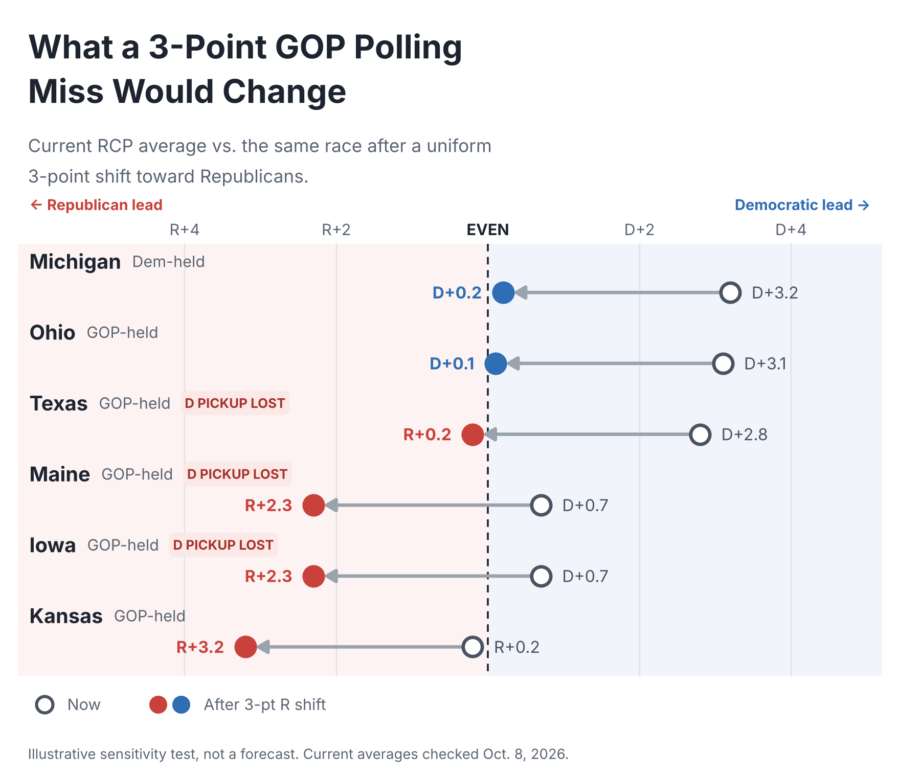
But a polling error does not have to be enormous to matter. A Republican improvement of only two or three points across several Senate battlegrounds would dramatically change a map that currently looks unusually favorable to Democrats.
Democrats Need Four Seats, Not Just a Good Night
Republicans currently hold a 53-47 Senate majority, including the two independents who caucus with Democrats on the Democratic side of the ledger. Democrats therefore need a net gain of four seats to reach 51. Getting to 50 would not be enough because Vice President JD Vance could break Senate ties for Republicans.
That makes the Senate very different from the House. Democrats can perform well nationally, win a large number of competitive districts and still fall short in the Senate if a handful of Republican states revert toward their normal partisan voting patterns.
North Carolina currently gives Democrats their clearest opening. Former Democratic Gov. Roy Cooper leads Republican Michael Whatley 49.8% to 41.0% in the RealClearPolling average, an 8.8-point advantage, and Republican groups have pulled millions of dollars from the state to reinforce races elsewhere.
Suppose Democrats pick up North Carolina. They are still only one-quarter of the way there.
To reach 51 while protecting every seat they already hold, Democrats would then need three more Republican-held seats from a collection that includes Maine, Ohio, Texas, Iowa, Alaska, Kansas and potentially Nebraska.
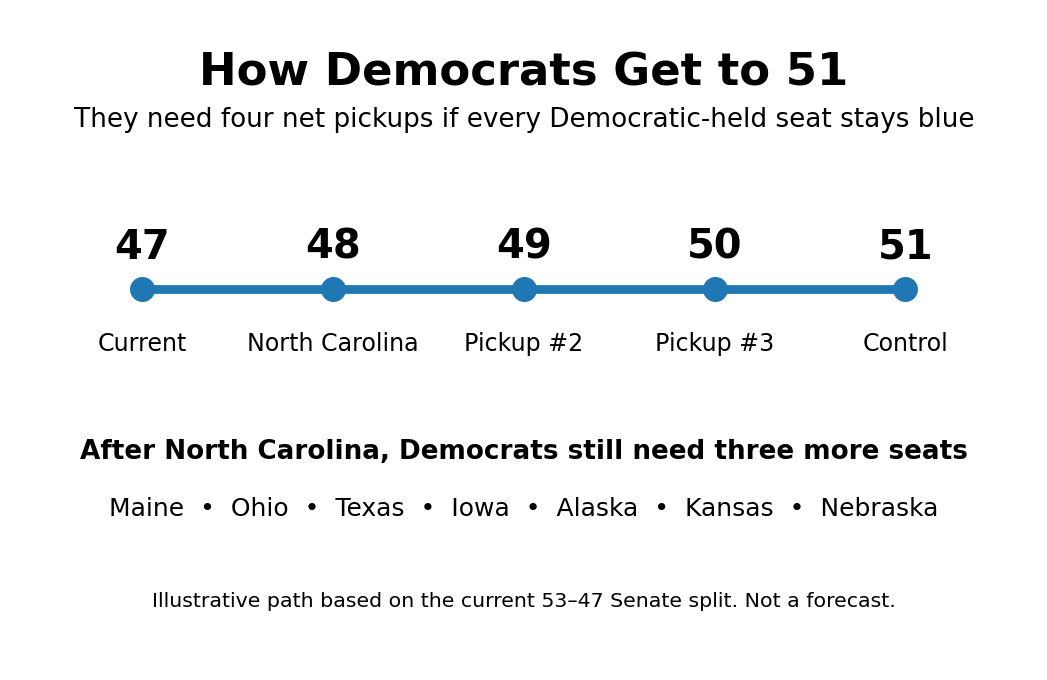
That is possible according to today’s polling. It is also a lot of individual races that all have to cooperate.
Susan Collins Has Seen This Movie Before
Maine may be the best reason for caution.
Democrat Troy Jackson currently leads Republican Sen. Susan Collins by just 0.7 points in the RealClearPolling average, 48.1% to 47.4%. Marist recently found Jackson ahead by four, while CBS News and Trafalgar both found a tie. Other recent polls have Collins ahead by one, two or three points.
For Democrats, those numbers look encouraging in a state Kamala Harris carried in 2024. Collins, however, has a rather dramatic piece of history on her side.
In 2020, virtually every major late public poll showed Collins losing to Democrat Sara Gideon. Emerson had Gideon ahead by six points. Colby College had her ahead by four. Pan Atlantic had Gideon ahead by seven, while an earlier Quinnipiac poll had put the Democrat ahead by 12.
Then Maine voted, and Collins won 51.0% to 42.4%, an 8.6-point victory. The final Emerson poll had missed the margin by nearly 15 points. The 2020 polling history is striking to look at now because the basic picture looked considerably worse for Collins than it does today.
That does not mean the same thing will happen again. Six years have passed, the political environment is different and Jackson is not Gideon. But anyone looking at a one-point Maine race and assuming Collins is finished has very recent evidence suggesting caution.
Then There Are the Red States
The stranger part of the current map is how many states that Trump won comfortably in 2024 are now showing competitive Senate races.
In Kansas, Republican Sen. Roger Marshall leads Democrat Adam Hamilton by just 0.2 points in the current RCP average, 45.6% to 45.4%. YouGov actually has Hamilton ahead by three, while New York Times/Siena has Marshall ahead by one.
That is remarkable because Trump carried Kansas by 16.2 points in 2024, and Kansas has not elected a Democratic U.S. senator since George McGill won in 1932. Republicans are taking the threat seriously enough that the Senate Leadership Fund has now poured fresh money into the state after pulling back in North Carolina. Axios reported Thursday that the group recently added another $14 million in normally deep-red Kansas.
Nebraska presents a similar problem. Trump won the state by 20.4 points in 2024, yet Pete Ricketts has found himself in a competitive race with independent Dan Osborn. The three most recent public polls range from Ricketts ahead by five to Osborn ahead by four, and RealClearPolling currently rates the contest a toss-up.
Both races may represent genuine dissatisfaction with Republicans. But they also illustrate exactly what GOP pollsters are talking about. If rural Republican voters who are difficult to reach eventually vote the way they have in recent elections, Kansas and Nebraska do not have to move very far before their current toss-up polling begins to look much more conventional.
Texas Is the Biggest Test of All
Texas is harder to dismiss because James Talarico’s polling against Ken Paxton has been unusually consistent.
Talarico currently leads Paxton 48.1% to 45.3% in the RCP average, a Democratic advantage of 2.8 points. Recent polls have shown Talarico anywhere from tied to six points ahead, and the pattern is very different from Beto O’Rourke’s 2018 campaign, when Ted Cruz led every poll in RealClearPolling’s main series.
Still, Texas provides its own warning about treating a close October poll as an election result.
In 2024, Cruz’s final RCP average had him beating Colin Allred by 4.4 points, 49.2% to 44.8%. Cruz ultimately won by 8.5 points, meaning the polling average understated his margin by about four points. Several October polls that year had Cruz ahead by only one or two points.
Four years earlier, the polling miss went in the opposite direction. The final 2018 average had Cruz beating O’Rourke by 6.8 points, but Cruz won by only 2.6. The lesson is not that Texas polls always underestimate Republicans. It is that an error of three or four points is entirely possible, and a race currently showing Talarico ahead by fewer than three points could look very different if that happens.
Iowa and Ohio Have the Same Problem
Iowa may be the purest example of why a small polling error matters so much.
Democrat Josh Turek leads Republican Ashley Hinson by only 0.7 points in the current RCP average, 45.9% to 45.2%. Recent polls have been scattered in both directions, from Turek ahead by four to Hinson ahead by five.
Trump carried Iowa by 13.2 points in 2024. If the current polls are accurately capturing a major political shift, Democrats have a genuine opportunity. If the surveys are missing even a modest number of rural Republican voters, Hinson does not need much movement at all to erase Turek’s current average lead.
Ohio tells a similar story. Former Democratic Sen. Sherrod Brown leads Republican Jon Husted by 3.1 points in the RCP average, 47.3% to 44.2%, despite Trump carrying Ohio by 11.2 points two years ago. But the newest co/efficient poll actually has Husted ahead by one.
A three-point polling miss would not necessarily decide Ohio, but it would turn a modest Brown advantage into essentially an even race.
Alaska Adds Another Complication
Mary Peltola also leads Republican Sen. Dan Sullivan in the current Alaska polling average, 48.5% to 47.3%. But individual surveys have ranged from Peltola ahead by seven to Sullivan ahead by three.
Alaska’s ranked-choice system adds another layer of uncertainty. The first-round polling has also shown a close contest, with Peltola and Sullivan both hovering in the mid-to-upper 40s while additional Republican candidates remain on the ballot.
That does not tell us exactly where those voters ultimately go, but it is another reminder that a one- or two-point Democratic lead is not the same thing as having a seat in hand.
Michigan Is Suddenly Harder to Ignore
All of this Senate pickup math assumes Democrats lose nothing.
Michigan makes that assumption less comfortable than Democrats would like. Abdul El-Sayed currently leads Republican Mike Rogers 48.1% to 44.9% in the RCP average, but the two newest public polls have El-Sayed ahead by only one point.
That was already enough to make Michigan worth watching before Thursday night’s first Senate debate. The debate did little to make the Democratic position feel more secure.
Rogers came into the event aggressively and spent much of the night putting El-Sayed on defense over Israel, Iran, controversial associations and his record. The Associated Press described the debate as a night of aggressive exchanges and persistent interruptions that continued through commercial breaks. Republican commentators quickly argued that Rogers had delivered one of his stronger performances of the campaign, while El-Sayed drew criticism from some viewers for appearing defensive, combative and overly self-assured at several points.
None of that proves the debate moved the race. It does reinforce the larger problem for Democrats, however. Michigan is not a pickup opportunity. It is a seat they already hold, and Rogers only lost Michigan’s other Senate race in 2024 by about a third of a point.
El-Sayed also continues trying to consolidate Democrats after a bruising primary. His positions on Israel remain a source of unease among some Jewish Democrats, while Rogers is trying to peel away enough suburban and independent voters to keep the race close.
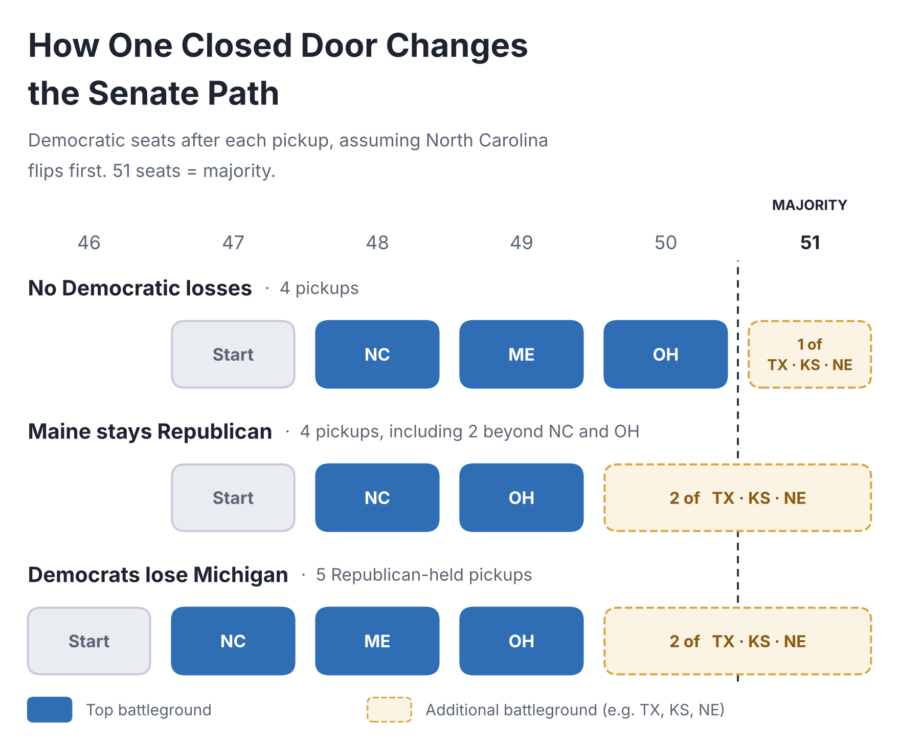
If Democrats lose Michigan, the entire Senate equation changes. Instead of needing four Republican-held pickups to reach 51, they would need five.
New Hampshire is another Democratic-held seat worth watching, although Democrats currently have more breathing room there. Chris Pappas leads former Republican Sen. John Sununu 49.0% to 43.1% in the RCP average, a 5.9-point advantage. Republicans nevertheless recruited one of their strongest-known names in the state specifically to make Democrats spend resources defending territory of their own.
The Polls Could Also Be Right
There is an important counterargument to all of this: Maybe Republicans really are having an election this bad.
The warning signs are not limited to public polls. Republican outside groups are moving enormous amounts of money into Texas, Kansas, Iowa, Alaska and Ohio. They have pulled money out of North Carolina while trying to reinforce races in states that were never expected to become major battlegrounds. Trump himself has embarked on an unusually aggressive rally schedule through states such as Nebraska, Texas and Ohio.
Axios reported Thursday that Republican groups are pouring well over $100 million into Texas alone while shifting millions more toward other vulnerable Senate seats. That is real campaign behavior involving real money, and it suggests Republican strategists are not simply assuming the public polling will snap back on its own.
Democrats also have a genuine national advantage. Trump’s approval ratings are deeply underwater, cost-of-living concerns remain widespread, and the generic congressional ballot has consistently shown Democrats ahead. The fact that races in Kansas, Nebraska and Texas are competitive at all is evidence of a difficult Republican environment, regardless of where the final margins land.
A Blue Wave Can Still Stop Short of 51
That may be the most important distinction heading into the final weeks of the campaign. Democrats do not need every optimistic poll to be exactly right to have an excellent midterm election. They could gain House seats, win governorships and make major advances in states Trump carried comfortably just two years ago.
But the Senate demands something more specific.
Democrats need four net Republican seats. North Carolina currently gives them a significant head start, but after that the path runs through a collection of incumbents, red states and unusual candidates where many polling margins are only one, two or three points.
If Susan Collins once again outruns her polling, one door closes. If Texas returns to its recent statewide Republican pattern, another closes. If Kansas and Nebraska ultimately vote more like Kansas and Nebraska, two more possibilities disappear. Iowa, Ohio and Alaska then become increasingly important, while any Democratic loss in Michigan or New Hampshire raises the number of Republican seats they must capture.
Michigan is especially important because Democrats cannot afford to think only about pickups. A party trying to gain four seats while simultaneously defending a toss-up open seat has much less room for error. Thursday night’s debate was another reminder that Rogers is still very much in the race and that El-Sayed has vulnerabilities Republicans intend to keep pressing.
That is why the Senate map can simultaneously look extraordinary for Democrats and remain fragile. They do not need a literal straight flush, but they do need several cards to break their way at once.
The polling could be capturing exactly that kind of election. It could also be overstating how far a national Democratic wave will penetrate into deeply Republican territory. A two- or three-point error would barely register in some House districts. Spread across Texas, Kansas, Iowa, Nebraska or Maine, it could determine control of the United States Senate.
With less than a month remaining, that may be the question hanging over the entire map: Is the blue wave really reaching this far, or are Democrats looking at its high-water mark before some of these red states come home?
Follow the latest numbers on our 2026 Senate polls page and visit our 2026 Senate elections guide for continuing coverage of the battle for Senate control.