
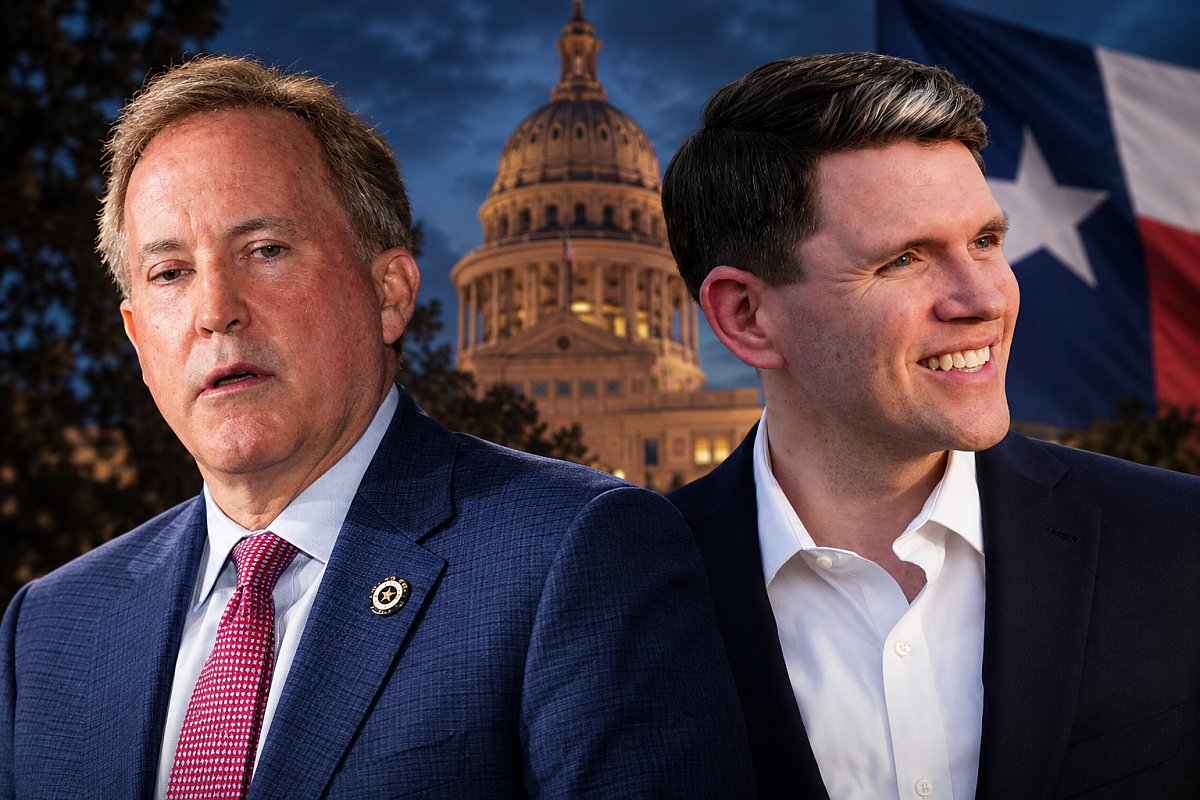
Texas Democrats have been here before. Beto O’Rourke came within a few points of Ted Cruz in 2018, setting off years of speculation that the state’s long-promised political transformation had finally arrived. Six years later, Colin Allred raised another mountain of money and briefly made the 2024 Senate race look competitive before Cruz ultimately won by more than eight points.
That history is reason enough to be skeptical whenever another Texas race starts generating national attention. Democrats have not won a statewide election in Texas since 1994, Donald Trump carried the state by 13.6 points just two years ago, and Republicans have controlled both U.S. Senate seats for decades.
But the polling in the 2026 Senate race between Republican Ken Paxton and Democrat James Talarico is becoming increasingly difficult to dismiss as another round of Texas hype. The difference is not one spectacular poll or one friendly pollster. It is the consistency of the numbers.
As of October 5, the Texas Politics Project’s post-primary polling tracker contains 18 nonpartisan public polls of the race. Talarico leads in 13 of them, Paxton leads in three and two are tied. More strikingly, Talarico has led each of the last nine polls on the tracker.
The Latest Texas Senate Polls
The recent polling isn’t coming from a single organization or methodology. The nine-poll streak includes surveys from Fox News, The New York Times/Siena, NPR/Marist, Emerson College, YouGov, Mason-Dixon and several other polling organizations, with Talarico’s margins ranging from one to six points.
Fox News (Sept. 24-28, 881 likely voters, ±3.0%)
- James Talarico (D): 51%
- Ken Paxton (R): 49%
New York Times/Siena (Sept. 21-30, 615 likely voters, ±4.0%)
- James Talarico (D): 49%
- Ken Paxton (R): 43%
NPR/Marist (Sept. 17-20, 1,139 registered voters, ±4.4%)
- James Talarico (D): 50%
- Ken Paxton (R): 44%
TSU/YouGov (Sept. 15-19, 1,800 likely voters, ±2.31%)
- James Talarico (D): 47%
- Ken Paxton (R): 46%
Emerson College/Nexstar (Sept. 12-14, 1,000 likely voters, ±3.0%)
- James Talarico (D): 47%
- Ken Paxton (R): 46%
Recon MR (Sept. 8-11, 614 likely voters, ±4.3%)
- James Talarico (D): 49%
- Ken Paxton (R): 43%
NBC News/Mason-Dixon (Sept. 8-10, 625 likely voters, ±4.0%)
- James Talarico (D): 46%
- Ken Paxton (R): 43%
Those numbers have pushed Talarico ahead in the RealClearPolling average. As of Monday morning, RCP has Talarico at 48.2 percent and Paxton at 45.4 percent, a Democratic advantage of 2.8 points.
That does not tell us what will happen on Election Day. Polling averages have missed the final margin in Texas before, sometimes substantially. What makes the current situation interesting is how different the polling pattern looks from the two recent Texas Senate races that generated similar national attention.
Beto Came Close, but He Never Led the RCP Polling
The obvious comparison is 2018. O’Rourke became a national political celebrity, raised enormous amounts of money and eventually came closer to winning statewide in Texas than any Democrat had in years. Yet the public polling never showed him in the position Talarico occupies today.
RealClearPolling’s 2018 series contains 22 polls beginning in April and running through Election Day. Cruz led every one of them. The closest was an August Emerson survey showing Cruz ahead 39 to 38, but by early October the Republican’s advantages were considerably larger.
An Emerson poll conducted Oct. 1-5 had Cruz ahead by five. CBS News/YouGov had him ahead by six, Quinnipiac by nine and The New York Times/Siena by eight. The final RCP average put Cruz ahead 51.3 to 44.5, a 6.8-point advantage.
Then O’Rourke dramatically outperformed those numbers. Cruz won 50.9 to 48.3, a margin of just 2.6 points, according to the final Texas results. In other words, the polling average underestimated O’Rourke’s final margin by roughly four points.
That election is a useful reminder of why nobody should treat a polling average as an Election Day result. It also highlights what is unusual about 2026. O’Rourke nearly defeated Cruz without ever leading a single poll in RCP’s main series. Talarico has now led nine consecutive surveys tracked by the Texas Politics Project.
Then 2024 Went the Other Way
The Colin Allred race provides an equally important warning, because the polling error went in the opposite direction. Allred briefly led Cruz 45 to 44 in a Morning Consult survey in September 2024, but the broader polling picture continued to favor Cruz as Election Day approached.
The final RealClearPolling average had Cruz ahead 49.2 to 44.8, a 4.4-point margin. Cruz ultimately won 53.1 to 44.6, an 8.5-point victory.
So the polling miss was again roughly four points, except this time it underestimated the Republican rather than the Democrat. Put 2018 and 2024 together and there is a fairly obvious lesson: recent Texas Senate polls have not consistently erred in one party’s direction.
Here’s What Makes 2026 Different
The simplest way to see the difference is to put the three races next to each other. The final RCP average had Cruz ahead by 6.8 points in 2018 and 4.4 points in 2024. The current 2026 RCP average has Talarico ahead by 2.8.
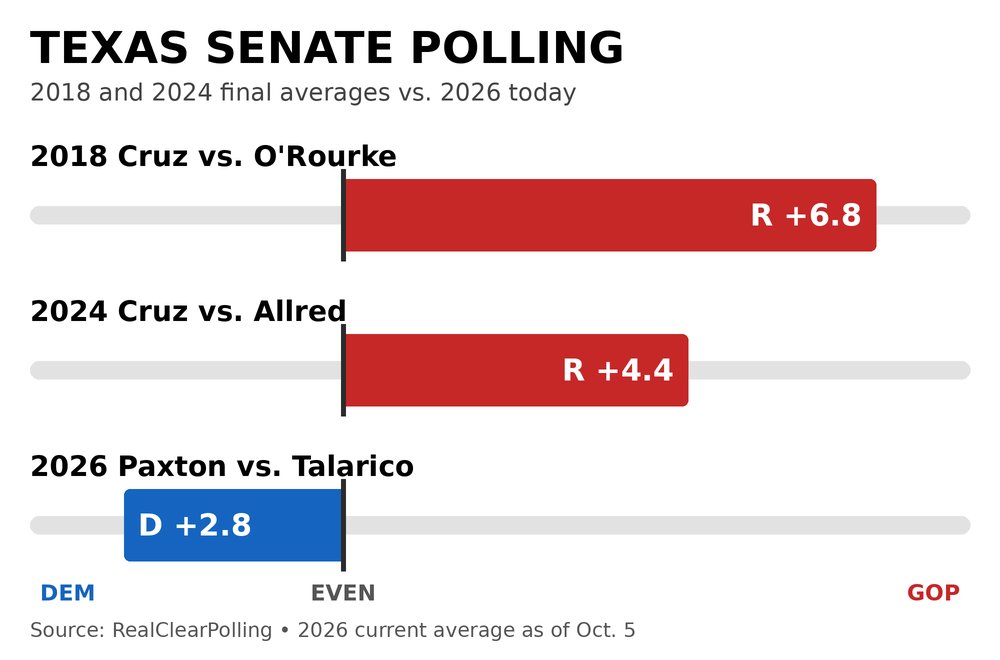
There is an important caveat to that comparison. The 2018 and 2024 numbers above are final polling averages, while the 2026 number is a snapshot taken about four weeks before Election Day. The Texas Politics Project tracker and RCP also use different inclusion criteria, so the exact number of polls should not be treated as a perfect apples-to-apples statistical comparison.
Still, the broader pattern is difficult to miss. In 2018, Cruz consistently led even as O’Rourke ultimately came close. In 2024, Cruz generally led Allred and then won comfortably. In 2026, Paxton has not led a public poll on the Texas Politics Project tracker since an Emerson survey conducted Aug. 9-10.
One Number in the Fox Poll Is Especially Interesting
The latest Fox News survey adds another wrinkle because its Senate result does not perfectly match what Texas voters told the pollster about control of the chamber. Fox found Talarico ahead of Paxton 51 to 49 among likely voters, a difference within the survey’s margin of error. The same voters preferred Republican control of the U.S. Senate by 50 to 49.
That is a small difference, but it raises a larger question hanging over the Texas race. Is the polling showing a broader change in the Texas electorate, or is some of what we’re seeing specific to Paxton and Talarico?
There is evidence for the latter explanation. Fox found Paxton with a 40 percent favorable rating and a 58 percent unfavorable rating, while Talarico stood at 52 percent favorable and 44 percent unfavorable. Paxton has also emerged from a bruising Republican primary and carries years of political controversy into the general election.
We’ve been watching the Paxton problem in Texas for weeks, but the race took another strange turn when leaked audio captured Paxton discussing the effect Trump’s Dallas convention had on Republican polling.
“When we did that convention, it dropped our numbers. Everybody’s numbers dropped,” Paxton said in the recording. When he was asked during the same conversation whether Trump was currently a drag on his campaign, Paxton responded, “Right now, yeah.”
We covered the Paxton audio and its polling implications here. Trump has continued supporting Paxton, and the two are currently scheduled to appear together at a midterm rally Wednesday in San Antonio.
Texas Has Fooled Democrats Before
There are plenty of reasons not to get carried away by four weeks of polling. Trump won Texas by 13.6 points in 2024, Republicans have not lost a statewide Texas election since 1994, and a significant number of voters remain undecided in several of the current surveys. A two or three-point polling advantage is also small enough that an ordinary polling error could erase it.
The history of the last two Senate elections reinforces that caution. O’Rourke did about four points better than the final polling margin in 2018, while Cruz did about four points better than the polling margin in 2024. If nothing else, those two elections demonstrate why a Texas polling lead in early October should not be confused with a result in November.
But skepticism about Texas becoming a Democratic state shouldn’t obscure what the numbers are actually showing. Democrats have come close before, and national attention has descended on Texas races before, but the public polling did not look like this during O’Rourke’s near miss or Allred’s 2024 campaign.
This time, the Democrat isn’t trying to close a persistent polling deficit. Talarico has led the last nine nonpartisan public polls listed by the Texas Politics Project, has reached 50 percent or better in multiple recent surveys and currently leads the RCP average. Whether that survives the final month is the question that will make Texas one of the races worth watching through Election Day.
Follow our 2026 Senate polls for the latest polling averages around the country, and visit the 2026 Senate elections guide for the broader battle for control of the chamber.