
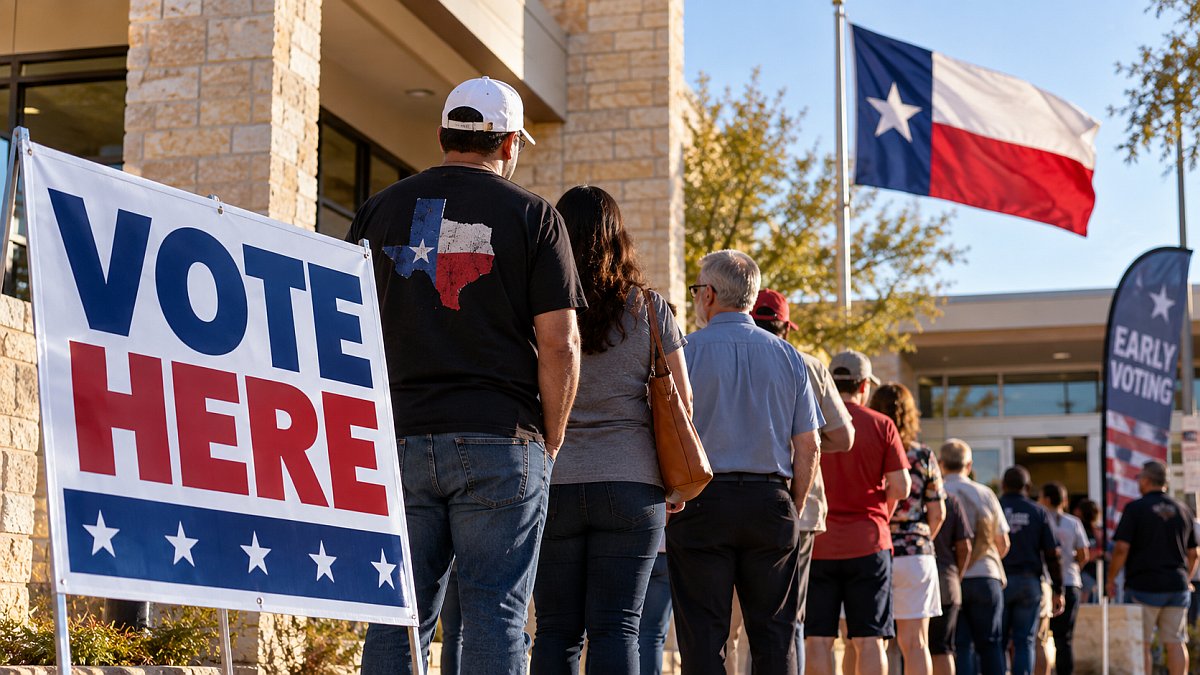
Something unusual is happening in the Texas early vote.
Through the first five days, voters with a history of participating in Democratic primaries made up 36% of ballots cast, slightly ahead of the 35% coming from voters with Republican-primary history. Texas Republican data analyst Derek Ryan told the Texas Tribune that he could not remember another recent general election where Democratic-primary voters were ahead at this point.
That is real evidence of Democratic enthusiasm. But there is also a very large catch: more than 2.1 million Texans who voted in at least one of the last four Republican primaries had not yet voted as of the latest analysis.
Democrats Really Are Showing Up
The numbers are different from what Texas saw in the last two major general elections. Ryan noted that Republican-primary voters were already making up the larger share of the early electorate at this stage in both 2022 and 2024.
- Democratic-primary history: 36% of early voters
- Republican-primary history: 35%
- No recent primary or general-election-only history: about 25%
- Mixed primary history: about 4%
There are other encouraging signs for Democrats. Hispanic voters accounted for about 18% of the early electorate through Friday, up from 16% in 2024 and 15% in 2022, while turnout from the state’s large urban counties has also been running closer to the benchmarks Democratic strategists have said they want.
None of that tells us how those voters actually cast their ballots. Texas does not register voters by party, so analysts are using past primary participation as a proxy rather than looking at actual Democratic and Republican registration.
But Millions of Republican Voters Are Still Out There
The biggest reason not to get carried away is the size of the Republican vote that has not yet appeared. Ryan identified more than 2.1 million Texans who participated in at least one of the last four Republican primaries but had not cast a ballot in the general election as of the latest count.
Republicans do not need every one of those voters to show up, but even a substantial portion would change the composition of the electorate quickly. Ryan expects the final three days of early voting to be especially heavy and said the picture should become much clearer by Thursday or Friday.
That makes the next few days more important than the first week alone. A strong late Republican surge would make the current Democratic edge in primary-history voters look less significant, while another few days of unusually strong Democratic participation would be harder to dismiss as simply front-loaded enthusiasm.
Texas Has Seen Huge Democratic Enthusiasm Before
The obvious comparison is 2018, when Beto O’Rourke came closer to winning statewide than any Texas Democrat had in years. Early voting was enormous, Democratic enthusiasm was unmistakable, and turnout eventually reached 53% of registered voters.
O’Rourke still lost to Ted Cruz by about 2.6 points, 50.9% to 48.3%, according to official Texas election results. The lesson is not that early Democratic enthusiasm does not matter. It is that Texas Republicans have historically had enough voters elsewhere in the state to overcome very strong Democratic turnout in the largest cities and suburbs.
The statewide pace also has not yet surpassed 2018. Nearly 4.5 million Texans had voted through the first seven days this year, equal to about 23.4% of registered voters. At the same point in 2018, turnout was slightly higher at 24.3%.
So What Does the Early Vote Actually Tell Us?
It tells us Democrats have genuine reason to be encouraged. Their voters appear highly motivated, the partisan-history mix looks better for them than in recent elections, and several demographic and geographic turnout measures are moving in the direction Democratic strategists want.
It does not tell us that Democrats are winning Texas. The state still has a huge pool of Republican-propensity voters who have not voted, nearly three in ten early voters do not fit neatly into either party’s primary history, and several days of early voting remain.
That is what makes the numbers so interesting. Something really is different about the Texas early vote this year, but we probably will not know exactly how different until the rest of the electorate shows up.
Follow the latest numbers on our 2026 Senate polls page and visit our 2026 Senate elections guide for the latest races around the country.