
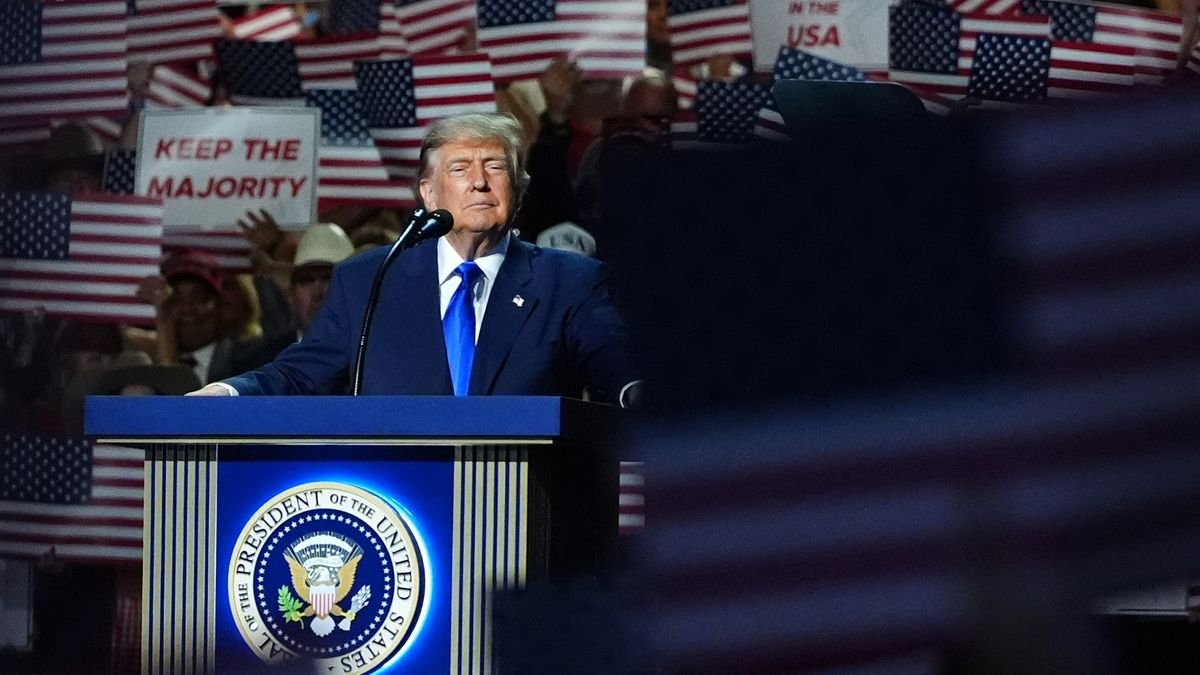
President Trump dropped one of the biggest promises of the 2026 midterm campaign Wednesday night: $5,000 checks for American adults if Republicans retain control of Congress in November.
Trump called the proposed payment a “Trump Dividend” during his keynote address at the Republican Midterm Convention in Dallas. He said every adult U.S. citizen would receive $5,000, with the condition that the money be spent in the United States. What he did not provide was a detailed explanation of how the government would pay for it, how eligibility would work or how quickly the checks could actually be sent.
Those details matter because the price tag would be enormous. Estimates put the cost of a broadly distributed $5,000 payment at more than $1 trillion, with Reuters calculating a potential cost of roughly $1.35 trillion. And despite the simplicity of the campaign promise, a president cannot simply order the Treasury to send more than a trillion dollars to Americans without dealing with Congress.
What Trump Actually Promised
Trump unveiled the idea near the end of his lengthy Wednesday night address in Dallas, tying the payments directly to Republicans retaining both chambers of Congress in the November 3 midterm elections. He described the payment as a dividend from America’s economic success rather than as another pandemic-style stimulus check.
The proposal, as Trump presented it, was remarkably broad: $5,000 for every adult American citizen. Trump said the money would have to be spent in the United States, although he did not explain how such a requirement would be administered or enforced.
You can watch Trump’s full Republican Midterm Convention speech and the complete Night 1 replay here.
The $1 Trillion-Plus Problem
Multiplying $5,000 by the enormous number of potentially eligible adults quickly turns an appealing campaign promise into one of the largest federal cash-distribution proposals in American history. Reuters estimates Trump’s proposal could cost about $1.35 trillion if implemented broadly. The Associated Press similarly estimates that the price tag would exceed $1 trillion.
That would be particularly significant because the federal government is already running a large annual budget deficit. There is no pool of more than $1 trillion sitting in an account waiting to be distributed as a dividend, meaning Congress would have to determine where the money comes from and authorize the spending.
Trump did not present that legislation Wednesday night. At this point, the $5,000 dividend is a political proposal conditioned on Republicans winning Congress, not an approved federal payment program.
Vance Is Already Suggesting the Checks Could Be Smaller in Scope
There is also an early indication that Trump’s description may not be the final version of the proposal. Vice President JD Vance suggested Thursday that wealthier Americans could be excluded, potentially reducing the number of people receiving checks.
Vance also pointed to tariff revenue as a possible source of money for the payments. But current tariff collections would not come close to covering a $1 trillion-plus program on the scale Trump described Wednesday. Narrowing eligibility could reduce the cost substantially, but it would also mean the eventual proposal would differ from Trump’s promise of $5,000 for every adult citizen.
We’ve Heard About Trump Dividend Checks Before
This is not the first time Trump has raised the possibility of sending Americans a large government “dividend.” In February 2025, Trump embraced the idea of using savings generated by the Department of Government Efficiency, then associated with Elon Musk, to send money back to taxpayers.
The proposal became known as the “DOGE dividend.” One version envisioned $5,000 checks for tax-paying households, financed by returning 20 percent of an assumed $2 trillion in DOGE savings to taxpayers. Trump publicly said he liked the concept and was considering using another 20 percent of the savings to reduce the national debt.
The $5,000 DOGE checks never materialized. The proposal depended on DOGE producing savings on a scale that was never realized, and no legislation authorizing the payments became law.
Trump later proposed another kind of dividend, this time using tariff revenue. In 2025 he floated payments of at least $2,000 to many Americans from money collected through tariffs. Administration officials acknowledged that legislation would be needed, and that broad $2,000 payment also did not become a nationwide check program.
Would $5,000 Checks Push Inflation Higher?
There is another complication: putting more than $1 trillion into consumers’ hands could increase inflationary pressure, depending on how the program was financed and the economic conditions when the money was distributed. Sending cash to households generally increases their ability to spend, which can push demand higher. If production of goods and services cannot rise enough to meet that demand, some of the adjustment can occur through higher prices.
The pandemic provides a recent example, although the circumstances were very different. COVID-era inflation was caused by a combination of factors, including severe supply disruptions, shifts in consumer behavior, energy and commodity pressures, monetary policy and large fiscal programs. Federal Reserve research nevertheless found that fiscal stimulus contributed meaningfully to the surge in demand and inflation.
One Federal Reserve study examining the international experience found that large fiscal support increased demand for goods without a comparable increase in production, adding to price pressures. Separate research from the Federal Reserve Bank of New York concluded that fiscal stimulus accounted for a substantial portion of the aggregate-demand effects contributing to U.S. inflation during the pandemic.
That does not mean a $5,000 dividend would automatically recreate the inflation of 2021 and 2022. The economic environment, method of financing, eligibility rules and timing would all matter. But injecting more than $1 trillion of additional purchasing power into the economy would make inflation a legitimate concern for lawmakers considering such a proposal.
Congress Would Have to Turn the Promise Into Reality
The biggest obstacle may be less complicated than the economics. Congress controls federal spending, meaning lawmakers would have to translate Trump’s campaign promise into legislation and determine how to finance it. Even if Republicans retain both the House and Senate, that would not automatically create the checks.
Lawmakers would still have to agree on eligibility, income limits, funding, tax treatment and other details. They would also have to decide whether distributing the money is a better use of federal revenue than reducing the deficit, paying down debt or funding other priorities.
There is precedent for Congress approving direct payments quickly. Lawmakers authorized several rounds of economic impact payments during the COVID-19 emergency. But those checks were enacted during an extraordinary economic shutdown and required legislation passed by Congress and signed by the president.
So, Are $5,000 Trump Checks Really Coming?
For now, no $5,000 checks have been approved, and Americans should not treat Trump’s convention announcement as notification that a payment is on the way. There is no application process, payment date or enacted federal program. At the moment, it is a campaign promise with a trillion-dollar-plus price tag and virtually none of the details needed to turn it into an actual government program.
What exists today is a conditional proposal: Trump says he wants to provide the payments if Republicans retain control of Congress. Turning that promise into actual checks would require lawmakers to approve an extraordinarily expensive program, settle on who qualifies and identify a way to pay for it. Trump’s own condition is also notable: Republicans already control the White House, House and Senate, yet the proposed dividend is being offered only if voters return the party to power after November.
The history of the DOGE dividend and proposed tariff checks provides another reason to distinguish proposals from actual payments. Both generated considerable attention, but neither resulted in the broad dividend checks that were discussed. Trump’s latest proposal may ultimately be different, but for now there is no legislation behind it and no guarantee Congress would approve it even under continued Republican control. Similar previous proposals that never materialized make skepticism warranted.
The $5,000 figure will certainly attract attention during the final weeks of the midterm campaign. Whether it ever makes the much longer journey from a convention-stage promise to Americans’ bank accounts is a very different question. Voters have heard dividend-check proposals before, and this one begins with the same unanswered question as the others: where, exactly, will the money come from?
Follow our 2026 midterm election coverage for the latest developments in the House, Senate and governor races ahead of November 3.