
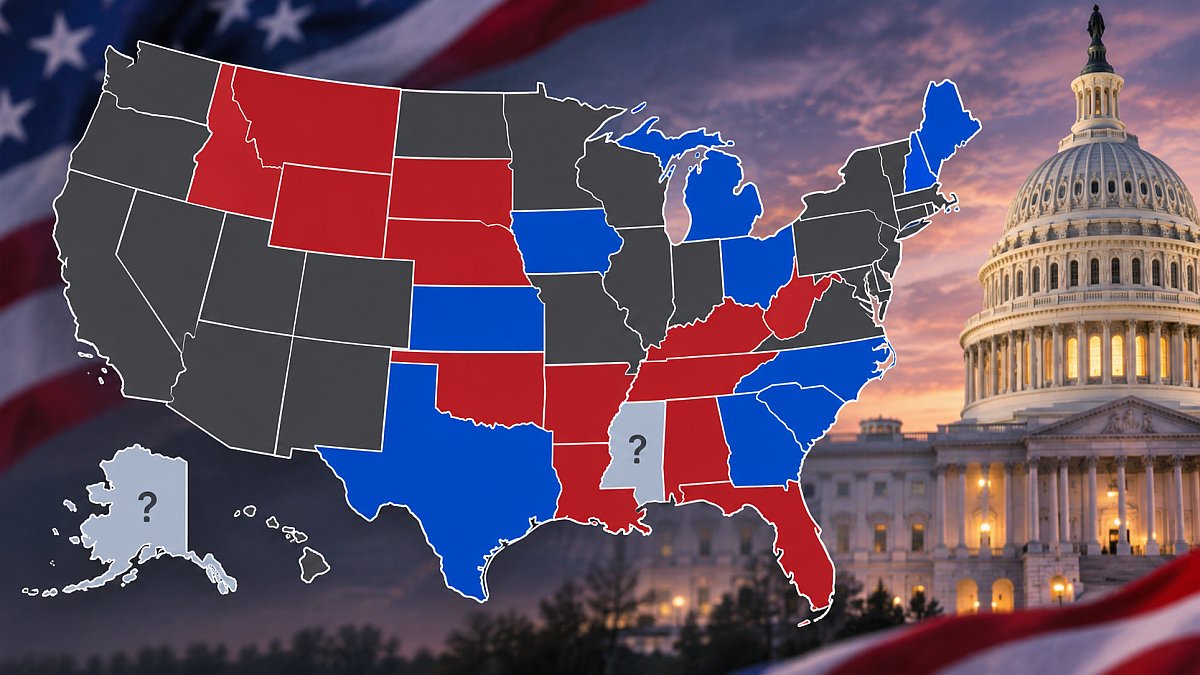
The 2026 midterm elections ended with Democrats taking control of Congress and breaking through in states that had been moving steadily toward Republicans for much of the past decade.
The final margins are still being settled Wednesday morning, but control of both chambers is no longer in doubt. Democrats won the House and Senate, flipped a string of Republican-held Senate seats and added major victories in governors’ races across the country. The remaining count will determine how large those majorities become.
Follow the latest national results on the Associated Press election pages for the U.S. Senate, U.S. House and governors’ races.
Where Congress Is Likely to Finish
- Senate: Around 55 Democrats to 45 Republicans. Democrats have already secured control of the chamber. Decision Desk HQ currently projects a 55-45 final split, with Alaska and Mississippi among the races that could still move the number by a seat. The AP Senate results map has the latest calls and vote totals.
- House: Democrats are comfortably above the 218 seats needed for control. More races remain unresolved, particularly in California and other western states, so the final majority could still grow considerably. The AP House results map shows the remaining district-by-district count.
- Governors: Democrats also made major gains in the states. Texas, Georgia, Ohio and Iowa all moved from Republican to Democratic control, while several other races remain close. The AP governor results page has the full national map.
The Senate result was built on a combination of Republican-held seats falling and Democratic incumbents or nominees holding where the GOP needed gains. Democrats won seats in North Carolina, Texas, South Carolina, Ohio, Kansas, Iowa and Maine while protecting major targets in Georgia, Michigan and New Hampshire.
Texas
- U.S. Senate: James Talarico (D) defeats Ken Paxton (R)
- Governor: Gina Hinojosa (D) defeats Greg Abbott (R)
- Bottom line: Democrats broke a three-decade Republican lock on statewide office.
Texas produced the most consequential set of results of the night. James Talarico defeated Republican Ken Paxton for the Senate seat after building a large lead Tuesday night, while Gina Hinojosa defeated three-term Republican Gov. Greg Abbott.
Hinojosa becomes the first Latina elected governor of Texas and the first Democrat to hold the office since Ann Richards. The AP Texas results page has the complete statewide returns, while The Texas Tribune has a detailed account of Hinojosa’s victory.
The shift was substantial. Donald Trump carried Texas by nearly 14 points in 2024, and Republicans had won every statewide election in the state since 1994. Two years later, Democrats won both of the marquee statewide races.
The House results added another disappointment for Republicans. The party had entered the election hoping a newly drawn congressional map would strengthen its delegation, but the broader Democratic swing erased much of the expected benefit.
South Carolina
- U.S. Senate: Annie Andrews (D) defeats Darline Graham (R)
- Governor: Republican hold
- Bottom line: A seat Republicans expected to keep became one of the most damaging losses on the Senate map.
Annie Andrews defeated Republican Darline Graham after maintaining a lead through most of Tuesday night’s count. The result represented a major swing from 2024, when Trump carried South Carolina by nearly 18 points.
Republicans had been forced to spend time and money defending the race late in the campaign, but South Carolina still looked more like a difficult hold than a likely Democratic pickup. Once it fell alongside Texas and North Carolina, the GOP’s Senate margin for error was effectively gone.
The latest statewide and congressional results are available through the AP South Carolina results page.
North Carolina
- U.S. Senate: Roy Cooper (D) flips the open Republican seat
- House: Democrats add congressional gains
- Bottom line: The most obvious Democratic pickup became the foundation for the eventual Senate majority.
Former Gov. Roy Cooper delivered one of the first major Democratic pickups of the night, winning the open Republican-held Senate seat and immediately changing the math for the rest of the chamber.
Once North Carolina was secured, Democrats no longer needed every competitive Republican seat to fall. Victories in Texas, South Carolina, Kansas, Ohio, Iowa and Maine could add to the majority rather than serve as the only route to 51.
The AP North Carolina results page has the statewide and congressional returns.
Ohio
- U.S. Senate: Sherrod Brown (D) defeats Jon Husted (R)
- Governor: Amy Acton (D) defeats Vivek Ramaswamy (R)
- Other statewide offices: Democrats also made additional gains
- Bottom line: Ohio swung back sharply after several cycles of Republican gains.
Sherrod Brown is returning to the Senate two years after losing his seat. Brown defeated Republican Sen. Jon Husted in the special election, adding another Democratic pickup in a state Republicans had increasingly viewed as part of their dependable national base.
The governor’s race moved the same way. Amy Acton defeated Republican Vivek Ramaswamy, while Democrats also made gains in other statewide offices. Taken together, the results represented a substantial reversal from Ohio’s recent movement toward Republicans.
Full results are available on the AP Ohio election page.
Kansas
- U.S. Senate: Adam Hamilton (D) defeats Sen. Roger Marshall (R)
- Governor: Cindy Holscher (D) and Ty Masterson (R) remain separated by less than one point
- Bottom line: Democrats won a Kansas Senate election for the first time since 1932.
Adam Hamilton defeated Republican Sen. Roger Marshall, becoming the first Democrat elected to the U.S. Senate from Kansas in 94 years. The AP called the race with Hamilton ahead 52% to 45% with about 90% of the vote counted.
Hamilton built the margin he needed in the state’s largest population centers, including the Kansas City and Wichita areas, while Marshall remained stronger across rural Kansas. Kansas Reflector has a detailed breakdown of the historic Senate result.
The governor’s race remains much closer. Democrat Cindy Holscher held an advantage of about 8,000 votes shortly after midnight, 50.4% to 49.6%, over Republican Ty Masterson. Kansas Reflector has the latest on that count.
The AP Kansas results page has the full statewide returns.
Iowa
- U.S. Senate: Josh Turek (D) defeats Ashley Hinson (R)
- Governor: Rob Sand (D) wins the open governor’s race
- Bottom line: Democrats won the two biggest statewide races in a state that had moved heavily toward Republicans.
Iowa had gone from one of the country’s most closely watched battlegrounds to a state Republicans were winning comfortably during the Trump era. Tuesday’s results cut sharply against that trend.
Josh Turek defeated Republican Rep. Ashley Hinson for the Senate seat, while Rob Sand won the open governor’s race. The combination made Iowa another example of Democratic strength extending well beyond the states the party had relied on in recent presidential elections.
The AP Iowa results page has the complete statewide and House results.
Maine
- U.S. Senate: Troy Jackson (D) defeats Sen. Susan Collins (R)
- Governor: Democratic hold
- Bottom line: Susan Collins’ long run of surviving difficult national environments finally ended.
Collins conceded to Democrat Troy Jackson early Wednesday, ending a Senate career that stretched back nearly three decades. Jackson became the first Democrat elected to represent Maine in the Senate since 1995.
The race drew extraordinary spending from both parties. Democratic and Republican groups poured more than $250 million into advertising, according to AdImpact data cited by Maine Public. Maine Public and NPR have a detailed account of the race and Collins’ defeat.
By the time Maine was called, Democrats had already broken through elsewhere. Jackson’s victory expanded the majority rather than deciding whether the party would have one.
Complete returns are available from the AP Maine results page.
Michigan
- U.S. Senate: Abdul El-Sayed (D) defeats Mike Rogers (R)
- Governor: Democratic hold
- Bottom line: Republicans failed to gain one of the Democratic seats they needed to offset losses elsewhere.
Michigan was important because Republicans needed victories on Democratic turf once their own Senate seats began falling. The state was one of the GOP’s better opportunities.
Instead, Abdul El-Sayed defeated Mike Rogers, keeping the seat in Democratic hands. The result was particularly notable after a difficult Democratic primary and the late-cycle decision by Democratic Rep. Haley Stevens to endorse Rogers.
The AP Michigan results page has the complete statewide count.
Georgia
- U.S. Senate: Jon Ossoff (D) wins reelection
- Governor: Keisha Lance Bottoms (D) flips the governor’s mansion
- Statewide offices: Democrats sweep statewide contests
- Bottom line: Georgia delivered Democratic gains well beyond the Senate race.
Jon Ossoff comfortably defended his Senate seat, denying Republicans another potential pickup. At the same time, former Atlanta Mayor Keisha Lance Bottoms won the governor’s race, ending Republican control of the office.
The gains extended down the ballot. The Atlanta Journal-Constitution reported that Democrats swept statewide offices and made significant gains in the state legislature. The AJC has a detailed look at the statewide results.
The AP Georgia results page has the full vote totals.
Mississippi
- U.S. Senate: Scott Colom (D) and Sen. Cindy Hyde-Smith (R) remain separated by a tiny margin
- Bottom line: A race expected to remain Republican became one of the final unresolved Senate contests.
Democrat Scott Colom and Republican Sen. Cindy Hyde-Smith remain virtually tied, leaving Mississippi as one of the few races that could still alter the final Senate margin.
The competitiveness of the race was itself notable. Mississippi had not been considered one of the central Democratic pickup opportunities entering Election Day, but Colom substantially outperformed recent Democratic candidates across parts of the state. Mississippi Today has detailed coverage of the remaining count.
The latest statewide totals are available on the AP Mississippi results page.
Alaska
- U.S. Senate: Dan Sullivan (R) narrowly leads
- Governor: Jonathan Kreiss-Tomkins (D) leads
- Bottom line: Alaska remains one of the last Senate races that can change the final size of the Democratic majority.
Republican Sen. Dan Sullivan remains narrowly ahead in the Senate race, with enough ballots outstanding that the contest may take additional time to resolve.
The governor’s race has moved more clearly toward Democrat Jonathan Kreiss-Tomkins, creating the possibility that Alaska produces a split result.
If Sullivan holds while Democrats take Mississippi, a 55-45 Senate remains the most likely endpoint in DDHQ’s current projection. An Alaska Senate flip would push the Democratic majority one seat higher.
The AP Alaska results page has the latest vote totals.
The House: How Large Does the Majority Get?
The House result was less concentrated in a handful of marquee races, but the accumulation of district-level losses was just as important. Democrats cleared the 218-seat threshold and flipped more than two dozen Republican-held districts as the national environment moved against the GOP.
A significant number of races remain unresolved, particularly in California and other western states where ballot counting routinely continues for days. That makes the eventual size of the Democratic majority harder to pin down than the Senate.
The AP House results map provides a cleaner district-by-district view of the remaining races and calls.
Republican redistricting efforts also failed to produce the gains party leaders had hoped for. AP reported that maps redrawn in several states at Trump’s urging did not prevent Democrats from taking the chamber, and Democrats even broke through in some districts Republicans had expected the new lines to protect.
The Governor Map Changed Almost as Much as Congress
The gubernatorial results deserve nearly as much attention as the congressional map. Democrats flipped Texas, Georgia, Ohio and Iowa while defending major governorships elsewhere.
The full national picture is available on the AP governor results map.
What the Final Map Could Look Like
The Senate is likely to finish somewhere around 55-45 Democratic, with Alaska and Mississippi capable of shifting that margin by a seat. The House majority will take longer to settle because of the number of unresolved western districts, but Democrats have already moved well beyond the minimum required for control.
What stands out is the breadth of the gains. Democrats flipped Republican-held Senate seats in the South, Midwest, Plains, Northeast and Texas while preventing Republicans from compensating with victories in Democratic-held states such as Michigan, Georgia and New Hampshire.
The governor’s races followed much the same pattern, with Republican-held offices falling in Texas, Georgia, Ohio and Iowa. Even several states that remained unresolved or Republican produced margins far closer than the GOP had expected entering Election Day.
The remaining count will determine the final numbers in Congress and settle the last handful of statewide races. The larger result is already set: Democrats will begin the next Congress with control of both chambers and a significantly stronger position in state governments than they held before Tuesday’s election.
Buckle-up for 2028!