


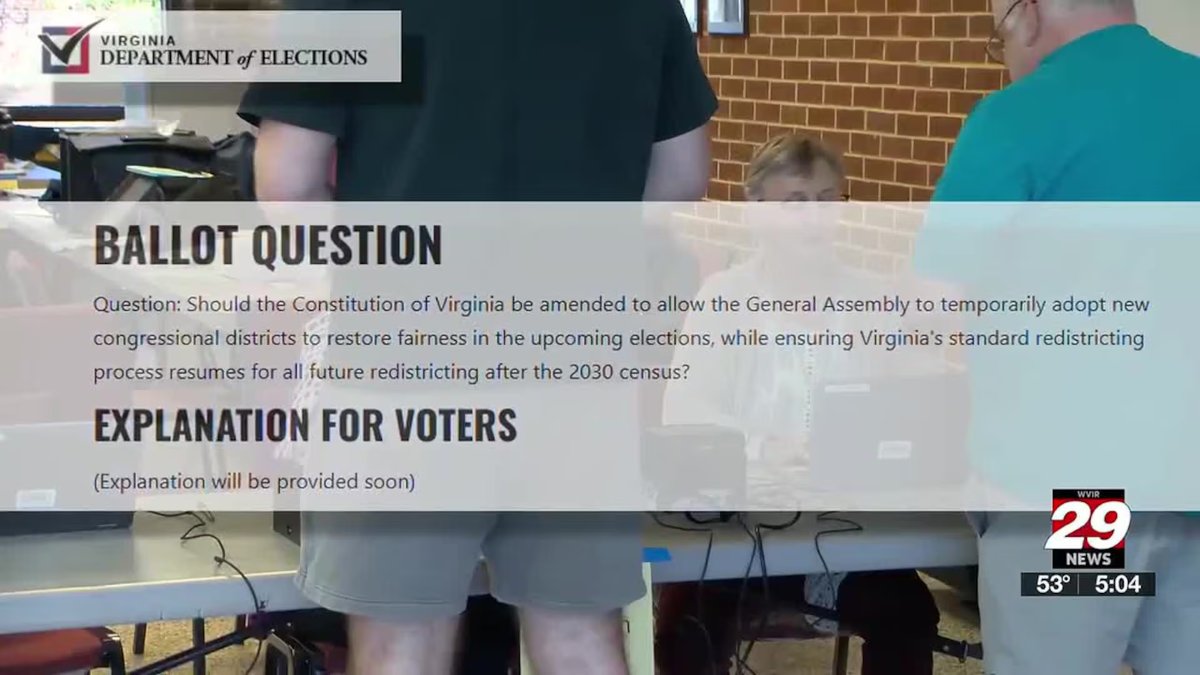
Virginia voters face an intentionally perplexing challenge with an upcoming April ballot measure on redistricting.
The question reads:
Should the Constitution of Virginia be amended to allow the General Assembly to temporarily adopt new congressional districts to restore fairness in the upcoming elections, while ensuring Virginia’s standard redistricting process resumes for all future redistricting after the 2030 census?
This isn’t a simple inquiry, it’s a linguistic riddle designed to baffle. They just want to “restore fairness,” what could go wrong?
Democrats, aiming to redraw Virginia’s congressional map, have crafted a ballot question that needs translation from legalese to plain English. It’s not just cumbersome, it’s deliberately misleading. The question masks an agenda to secure political advantage, suggesting continuity under the guise of change. If you’re confused, you’re in good company.
Manipulating Language
The ballot measure’s phrasing isn’t merely problematic, it’s a calculated barrier to understanding. Instead of informing voters, it complicates the decision-making process. This isn’t accidental. The tangled syntax creates uncertainty about what voters are actually approving.
This ambiguity is intentional. Virginia Democrats have woven this amendment in a way that prods undecided voters toward a skewed perception. Phrases like “restore fairness” are used without clarifying the fairness allegedly lost. It’s a sophisticated use of political jargon to obscure essential context, undermining voter clarity.
Under the Legal Veil
Embedded in this legal jargon is a drive to reshape the political scene. As reported by WTOP, this could grant Democrats up to four more U.S. House seats. It’s a significant prize hidden within misleading language, pretending to champion fairness while advancing a political strategy.
The measure proposes mid-decade redistricting, bending Virginia’s usual ten-year cycle, but only until 2030. This maneuver looks like clearing the political board while claiming to tidy it up. It’s a clear power grab by newly elected Virginia Democrats hoping to takeover the state.
Legal Turbulence
It’s no shock that such a contentious measure didn’t pass unchallenged. Legal disputes erupted over its language and legality. The Tazewell County circuit court initially struck down the measure. However, the Virginia Supreme Court eventually greenlit the referendum.
This tug-of-war suggests the desperation to shroud intentions in complexity. Democrats are fast-tracking this redistricting effort while legality remains shaky in judicial corridors. It’s less about improving governance and more about leveraging power disguised as process.
The 2020 Fix Forgotten
Ironically, this isn’t the first time Virginia has tackled redistricting woes. In the November 3, 2020 election, voters approved Virginia Question 1, establishing a Redistricting Commission. This 16-member team, a mix of legislators and citizens, took on the responsibility for drawing districts, shifting the power from the legislature. The aim? Curb the very kinds of partisan gamesmanship that this new measure reeks of. Disregarding the 2020 progress undermines voter efforts to create fair maps.
Conclusion: Read Between the Lines
Virginia voters should approach this ballot amended with open eyes and vote NO. Overly complex language should trigger caution, prompting voters to weigh what’s truly fair for representation. Stripping the proposal of its jargon might reveal its actual complexity and motives. In this political game, understanding is the ultimate strategy. Voters must reject this garbage.
The amendment should read: “We, the elected Democrats of Virginia, hate Donald Trump and want more Democrats in congress, Vote YES if you hate Donald Trump too”
At least it would be honest.