
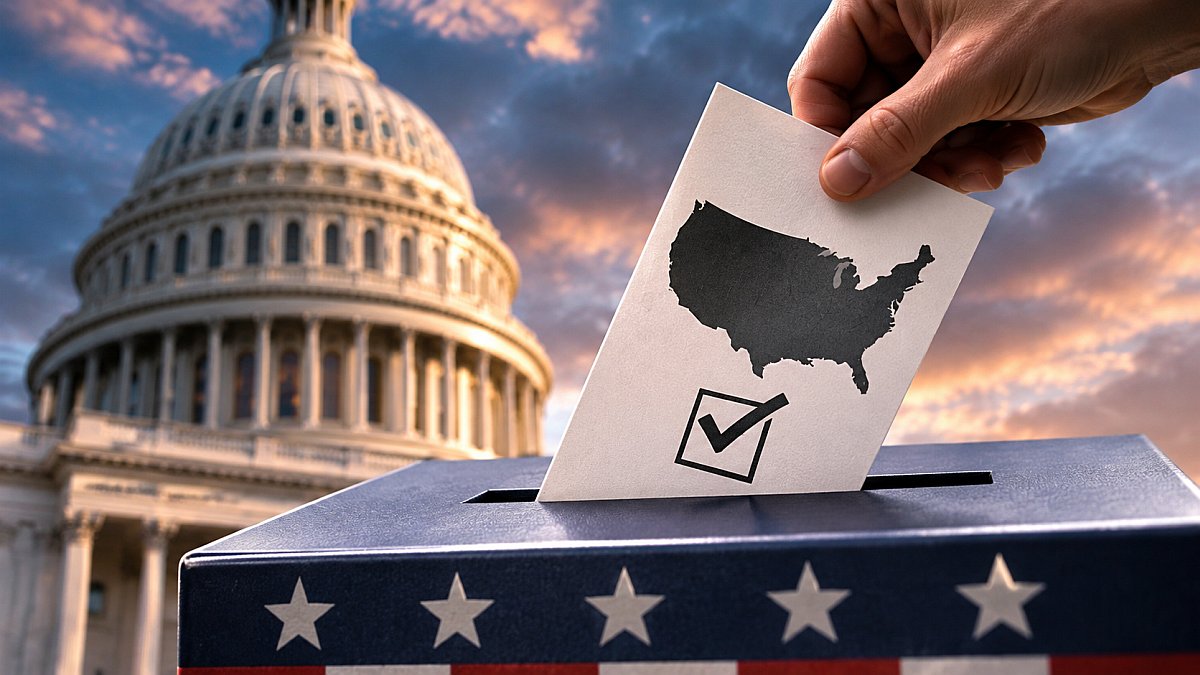
The National Popular Vote Interstate Compact may be closer than ever to taking effect after Democrats gained control of several state governments in the 2026 midterms. That means a proposal that has spent years largely in the background could soon face a much more practical question: Why would any state voluntarily agree to let voters elsewhere determine where its electoral votes go?
The Washington Post reports that Democratic victories in Arizona, Michigan, Nevada, Pennsylvania and Wisconsin have given compact supporters several new opportunities to add states. The agreement currently includes states representing 222 electoral votes and does not take effect until members control at least 270, the number required to win the presidency.
Those newly Democratic state governments collectively control enough electoral votes to put the compact over the threshold if enough of them join. The issue could therefore move quickly in 2027, well before the next presidential election.
What Happens to Your State’s Vote?
The compact is easy to understand once the legal and political arguments surrounding it are stripped away. Participating states agree that once the compact reaches 270 electoral votes, they will award all of their presidential electors to the candidate who wins the national popular vote.
Not the candidate who wins their state. The candidate who wins nationwide.
The compact’s own official explanation says participating states would calculate the total popular vote across all 50 states and the District of Columbia and award their electors to the national winner. That result would control even when voters inside a member state chose somebody else.
The easiest way to see the problem is to use a real election rather than a hypothetical one. Donald Trump won the national popular vote in 2024. If the compact had been active at the time, every participating state would have been required to award its electoral votes to Trump, including heavily Democratic states where Kamala Harris won by large margins.
New York voters chose Harris. Connecticut voters chose Harris. Massachusetts voters chose Harris. Under an activated National Popular Vote compact, those states would nevertheless have sent their electoral votes to Trump because voters in the country as a whole preferred him.
Now Reverse the Parties
Anyone tempted to view that example through partisan eyes should simply flip it around.
Imagine a future election in which Texas votes Republican by eight points. Florida votes Republican by six. The Republican nominee carries both states comfortably, but a Democrat wins the national popular vote by a narrow margin after piling up large margins in California, New York and other Democratic states.
If Texas and Florida had joined the compact, their Republican voters would watch their states award every electoral vote to the Democratic candidate they had just rejected.
That would not be a malfunction in the system or an unforeseen loophole. It is exactly how the National Popular Vote Interstate Compact is supposed to work.
The partisan identity of the winner is therefore beside the point. Any state joining the compact is agreeing in advance that its own presidential result may be discarded whenever it conflicts with the national result.
Why Would a State Want to Do That?
That is the part of this debate that deserves considerably more attention from state lawmakers. The United States does not conduct one federal presidential election administered under one set of national rules. It conducts elections in individual states, and those states appoint presidential electors under authority granted to them by the Constitution.
States currently possess something valuable in that system: control over their own electoral votes. Texas decides how Texas electors are awarded. New York decides how New York electors are awarded. Pennsylvania voters know that winning Pennsylvania means winning Pennsylvania’s electoral votes under the rules currently used there.
The compact asks states to voluntarily subordinate that decision to a national tally over which their own electorate has only a fraction of the influence. A Pennsylvania voter would still cast a ballot and that vote would still be included in the national total, but Pennsylvania itself could vote decisively for one candidate and award its electors to another.
That seems like an awful bargain for a state legislature to make on behalf of its voters. Instead of preserving the state’s influence over presidential elections, lawmakers would be agreeing that the state’s own result is secondary whenever it differs from the national outcome.
States Would Also Give Up Political Leverage
Supporters of the compact frequently complain, with some justification, that presidential candidates spend too much time in a handful of battleground states. Pennsylvania, Michigan, Wisconsin, Georgia, Arizona and Nevada have attracted enormous attention in recent elections while reliably Democratic and Republican states receive much less.
But being a competitive state also gives voters leverage. Presidential candidates visit. Campaigns advertise. Reporters focus on local concerns. Candidates have incentives to learn about industries and issues that matter to voters there because those voters control a discrete prize in the Electoral College.
It is not obvious why a state would want to surrender that leverage. Nevada has only six electoral votes, but a close presidential race can make Nevada extraordinarily important. Under a national popular vote, Nevada’s ballots would simply become one small portion of a national electorate exceeding 150 million voters.
That concern is not limited to Republicans. Democratic Nevada Gov. Steve Sisolak vetoed the compact in 2019, arguing that it could diminish the influence of smaller states. In his veto message, Sisolak said the compact could leave Nevada with less influence over presidential elections, not more.
The 2024 Election Shows Why Parties Should Be Careful
There is another reason state legislators should be reluctant to treat the compact as a partisan weapon: electoral coalitions change.
For years, many Democrats viewed the Electoral College as structurally favorable to Republicans because Democratic presidential candidates could win the popular vote while losing narrowly in decisive battleground states. Then Trump won both the Electoral College and the national popular vote in 2024.
The 2026 midterms provided another reminder that supposedly safe states can change quickly. Democrats won statewide races in Texas and Ohio that would have seemed extremely unlikely only a few years earlier. Texas is now being discussed as a possible 2028 battleground despite Trump carrying it by nearly 14 points in 2024.
Today’s partisan map is not guaranteed to be tomorrow’s map. A compact written when Democratic lawmakers assume the national popular vote benefits Democrats would operate exactly the same way if Republicans become better at winning the national vote. Democratic states would then be required to send their electors to Republican presidential candidates their residents opposed.
If the Country Wants a National Popular Vote, Say So Directly
There is a perfectly coherent argument for replacing the Electoral College with a national popular vote. People who believe the presidency should simply go to whichever candidate receives the most votes nationwide can advocate for that system openly.
But the National Popular Vote Interstate Compact takes a different route. It leaves the Electoral College formally intact while using state laws to produce the result of a national popular election. States continue holding presidential elections and appointing electors, except a member state’s own election may no longer determine which candidate receives those electors.
That is what lawmakers in Arizona, Michigan, Nevada, Pennsylvania and Wisconsin may soon be asked to approve after the Democratic victories of 2026. Whatever they think about the Electoral College itself, voters in those states should understand the bargain clearly before their legislatures sign them up for it.
A state joining the compact is not merely agreeing that the national popular vote matters. It is agreeing that someday its voters could choose Candidate A and watch their state award every electoral vote to Candidate B.
Republican state or Democratic state, that is an extraordinary amount of authority for any legislature to voluntarily strip away from the result produced by its own voters.