
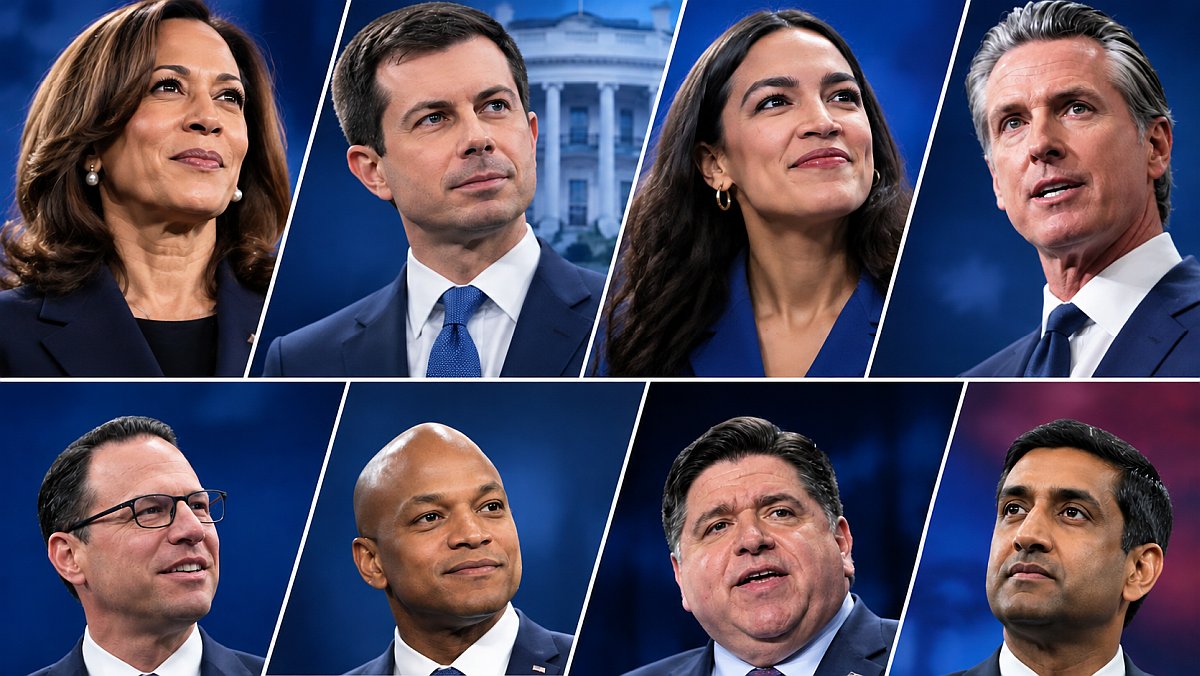
The votes from the 2026 midterms are barely finished being counted, but Democrats have already started looking toward the next election.
There is no clear 2028 frontrunner, and that may be the most important thing to know about the race right now. Former cabinet officials are publishing books, governors are building national political operations, outside groups are drafting candidates and several of the party’s biggest names are carefully leaving the door open. Reuters reported after the midterms that Democratic strategists could identify at least 30 people who might consider running. For anyone trying to keep track, our 2028 Democratic Primary page will follow the field as it develops.
That would sound excessive if Democrats had not done this before. The first Democratic debates of the 2020 cycle included 20 candidates spread across two nights, with several additional candidates failing to qualify. Four years earlier, Republicans began the 2016 campaign with 17 major candidates and had to split their first debate into a prime-time stage and an earlier undercard. PBS reported on the 20-candidate Democratic debate lineup in 2019.
The 2028 field has plenty of time to shrink before anyone actually votes, but one week after the midterms it is getting easier to see who is preparing for the possibility.
Pete Buttigieg Is Making the Most Obvious Moves
Pete Buttigieg may be doing the closest thing to running for president without actually announcing a campaign. The former transportation secretary spent the midterms traveling through roughly three dozen states as one of the Democratic Party’s most requested surrogates, campaigning in battleground districts as well as states that will matter in the 2028 primary.
Now he has a book coming. Buttigieg announced this week that Next will be released in January, giving him a ready-made reason to travel, give interviews and talk about the future of the country just as the presidential cycle begins to accelerate. He has already said he is “more inclined than not” to run for president again. The Washington Post noted that the book announcement follows one of the most extensive midterm travel schedules of any prospective candidate.
Buttigieg also made a consequential decision before the midterms by passing on open Senate and governor’s races in Michigan. That left him without a 2026 campaign of his own but also avoided tying him down to another office just as the presidential race begins.
AOC Has a Draft Movement Waiting for Her
Alexandria Ocasio-Cortez has been less explicit about her plans, but other progressives are not waiting for her to decide. A group called Ready for AOC launched after the midterms with plans to collect one million signatures and train thousands of organizers who could form the backbone of a presidential campaign if she enters the race.
The congresswoman has neither announced a campaign nor ruled one out. Her team spent the days after the midterms emphasizing the more than $3 million she directed to Democratic candidates and arguing that her political reach now extends well beyond her New York district. Post reporting detailed the new draft effort and its attempt to build campaign infrastructure before AOC makes any decision herself.
There is also a question about which race she would choose. Sen. Chuck Schumer is up for reelection in New York in 2028, leaving AOC with the possibility of a Senate campaign if she decides against a White House run. That uncertainty has not stopped supporters from treating her as one of the major names in the emerging presidential field.
Kamala Harris Still Hasn’t Decided
Former Vice President Kamala Harris remains the biggest known quantity and perhaps the biggest unresolved question. She has repeatedly said she has not decided whether to run again, and shortly before the midterms she acknowledged that she goes “back and forth” over the decision.
Harris nevertheless spent much of the fall behaving like someone who wanted to preserve the option. She campaigned in Michigan, Nevada, Mississippi, New Hampshire, Wisconsin and Georgia, appearing with candidates ranging from Abdul El-Sayed to Jon Ossoff and Scott Colom. Several of those states will be important in the 2028 nomination fight or general election. AP noted before Election Day that her travel schedule was already feeding speculation about another presidential campaign.
There are reasons for caution. Harris would be asking Democratic voters for another chance after losing the 2024 general election, and some Democrats have openly argued that the party needs a new generation of leadership. At the same time, she would begin any campaign with nationwide name recognition, an existing fundraising network and relationships built through two national campaigns and four years as vice president.
Newsom’s Decision May Depend on Harris
Gavin Newsom is perhaps the easiest candidate to imagine running and one of the hardest to place in the field because he has tied his decision to Harris. The California governor said in September that he would not run against her in a Democratic primary, arguing that their overlapping donor and political networks would make a head-to-head campaign pointless.
If Harris stays out, Newsom has already done much of the work expected of a future presidential candidate. He campaigned nationally during the midterms, raised money outside California and made his confrontation with Trump a major part of his political identity. California’s redrawn congressional map also helped Democrats pick up House seats in the midterms, giving Newsom another accomplishment to point toward. Chronicle analysis described the results as a significant boost to his national profile.
There is a clock on Newsom that several other candidates do not face. His term as governor ends in January, meaning he will soon lose the daily platform and institutional visibility that comes with running the country’s largest state. If he intends to run, the period after leaving office would naturally become his transition into presidential politics.
Josh Shapiro Has Pennsylvania and a New Political Operation
Pennsylvania Gov. Josh Shapiro emerged from the midterms with one of the stronger arguments available to any Democratic governor. He won reelection by roughly 22 points while Democrats captured full control of state government, giving him a large-state victory in a presidential battleground that neither party can afford to ignore.
Shapiro also launched a federal political action committee before Election Day and used it to support Democratic House candidates. All four of the competitive Pennsylvania candidates backed by the effort won, giving him both a fundraising vehicle and a national political network should he decide to go further. PhillyVoice reports that Democrats in Pennsylvania are already openly discussing the result as a potential national audition.
Shapiro has not committed to a presidential campaign, and his second gubernatorial term gives him less reason than some rivals to rush. But winning Pennsylvania by that kind of margin guarantees he will remain in any serious discussion about 2028.
Jon Ossoff Keeps Saying No, Which Hasn’t Stopped Anyone
Jon Ossoff is in the unusual position of becoming a much bigger presidential prospect while repeatedly insisting he has no interest in the job. Before Election Day, the Georgia senator said he had “zero interest” in running in 2028 and promised to serve his full Senate term.
Then he won reelection comfortably in one of the country’s most important battleground states while Democrats swept other statewide races in Georgia. The result immediately intensified the speculation he had spent months trying to shut down. The Post pointed out even before the election that presidential history is filled with politicians who firmly denied plans to run and later changed their minds.
Ossoff may mean exactly what he says. If so, Georgia still has another name worth watching: Sen. Raphael Warnock recently joked that he intends to run for “high office” in 2028 without specifying whether he meant reelection to the Senate or something larger.
Ro Khanna Already Has His Own Draft Committee
California Rep. Ro Khanna has been openly considering a presidential bid, and his allies have now moved beyond speculation. Former Rep. Jamaal Bowman and other progressive activists launched a “Run Ro” committee after the midterms designed specifically to encourage Khanna to enter the race.
The group’s pitch mixes economic populism, Medicare for All, AI regulation and Khanna’s role in pushing for the release of the Epstein files. Khanna told The Washington Post before the election that he expected to make a decision by the end of the year, although a public announcement could come later. The Post has more on the effort.
A Khanna campaign would also complicate the progressive side of the field. AOC has the larger national following, but Khanna has spent years building relationships with donors, labor groups and figures outside the traditional Democratic coalition. If both ran, the progressive vote would hardly belong to one candidate by default.
And That’s Before the Rest of the Governors and Senators
The list gets long quickly. Maryland Gov. Wes Moore has repeatedly said he does not plan to run in 2028, but he announced a new book this week titled Repair, which will inevitably keep him in the national conversation. Cory Booker has done little to discourage presidential speculation, while governors Andy Beshear and JB Pritzker remain obvious possibilities and Sen. Mark Kelly continues to appear on lists of potential contenders. Reuters reported after the midterms that party strategists could name at least 30 Democrats who might plausibly look at the race.
The field does not need to reach 30 to become historically crowded. Democrats put 20 candidates into the first 2020 primary debates, dividing them across two nights because they literally could not fit everyone into one workable debate. The 2016 Republican primary started with 17 major candidates and similarly required separate debate stages.
Anyone who remembers those campaigns knows what comes next. Candidates with little national support can stay alive for months, outside groups can keep potential campaigns afloat before formal announcements, and debate qualification rules suddenly become as important as polling. Our 2028 Presidential Candidates directory will track the names that move from speculation into actual campaigns.
The Midterms Gave Almost Everyone a Reason to Think About It
One reason the Democratic field could become so large is that the party just won a major national election without producing an obvious presidential heir in the process. Governors can argue that voters rewarded competent state government. Progressives can point to victories by candidates who ran on affordability, labor and economic populism. Moderates can point to strong Democratic performances in states such as Pennsylvania and Georgia. Nearly every faction can find something in the midterm results that supports its preferred direction.
That is very different from a primary that begins with a sitting Democratic president or vice president clearly controlling the party. Harris would have advantages if she runs, but she is not an incumbent and has not frozen the field. Newsom has effectively said he will wait on her decision, while most of the other potential contenders appear to be moving ahead with their own preparations.
Buttigieg has a book and a national travel network. AOC and Khanna have outside groups already building organizations around them. Shapiro has a fresh landslide and a federal PAC. Newsom has spent years creating a national profile. Harris has kept her network active, and several senators have emerged from the midterms with stronger national reputations than they had before Election Day.
None of that means all of them will run. Most probably will not. But presidential campaigns are often built during the period when everyone insists they are focused on something else, and that period has plainly begun.
As the 2028 field takes shape, follow the latest candidate news, polling, odds and campaign developments on our 2028 Presidential Election coverage page.