
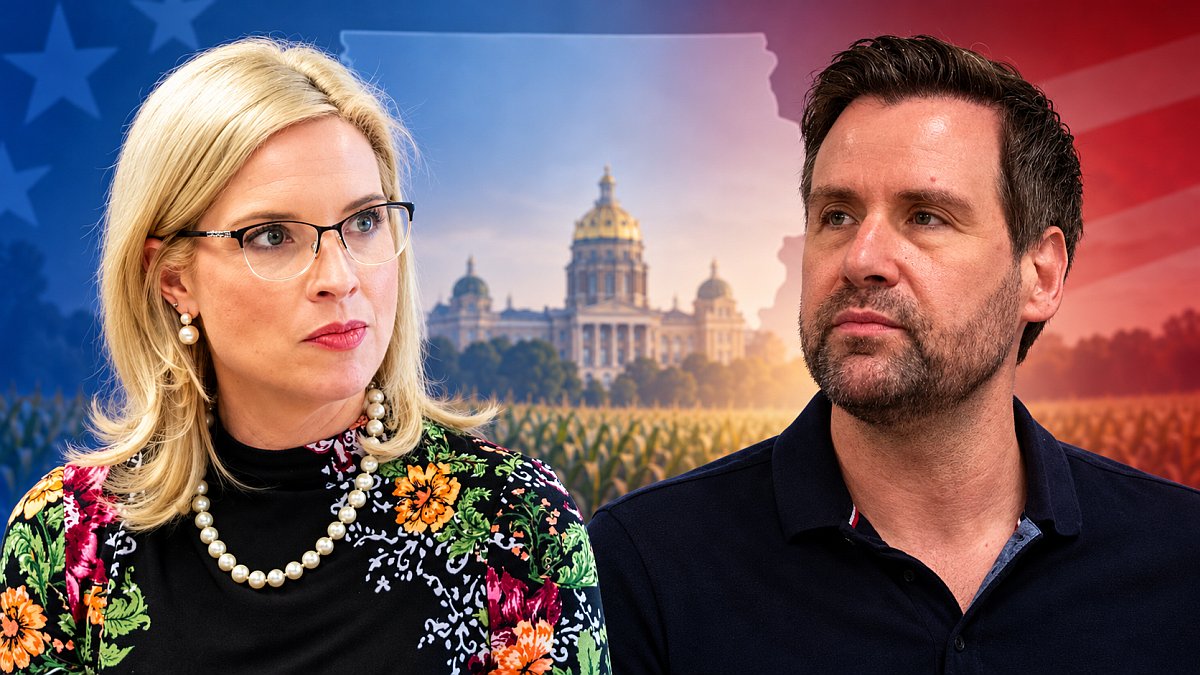
Ashley Hinson has moved back into the lead in Iowa’s U.S. Senate race, although calling it a lead requires a pretty generous definition of the word.
The latest RealClearPolling average has the Republican ahead of Democrat Josh Turek by just 0.1 points, 46.0% to 45.9%. That is effectively a tie, but it is still a notable reversal after several October polls had pushed Turek into the lead and raised the possibility that Democrats might actually steal a Senate seat in a state Donald Trump won by more than 13 points two years ago.
Two of the newest surveys have helped Hinson recover. Co/efficient found her ahead 49% to 46% in polling conducted Oct. 15-19, while Trafalgar had her ahead 46% to 44%. Those followed a stretch in which YouGov had Turek up one, Marist had him ahead by three and Suffolk University showed a four-point Democratic advantage.
The result is a race that keeps moving back and forth without really going anywhere. Iowa remains one of the closest contests on our 2026 Senate polling page, but the state underneath that race is not nearly as politically balanced as the polling average might suggest.
Iowa Has Moved a Long Way Since Obama
It is easy to forget how recently Iowa was considered one of the country’s classic swing states. Barack Obama carried it twice, winning 53.9% to 44.4% in 2008 and 52.0% to 46.2% in 2012. Those were not razor-thin victories either. Obama won Iowa by roughly 9.5 points the first time and nearly six points the second.
Then the state moved sharply toward Republicans. Trump won Iowa 51.2% to 41.7% in 2016, carried it again 53.1% to 44.9% against Joe Biden in 2020, and expanded the margin to 55.7% to 42.5% in 2024. You can see the full progression in Iowa’s presidential voting history.
That means Trump has now carried Iowa three elections in a row, with Republican margins of roughly 9.5, 8.2 and 13.2 points. Biden won the presidency in 2020 without winning Iowa, a significant change from the Obama years when Democrats viewed the state as part of their normal path to the White House.
The change has not been limited to presidential elections. Republicans control the governor’s office and have built large majorities in the state legislature, while Republican Joni Ernst won reelection to the Senate by more than six points in 2020.
Republicans Also Have a Big Registration Advantage
Party registration tells a similar story.
According to the Iowa Secretary of State’s Oct. 1 voter registration report, the state had 713,305 active registered Republicans and 533,238 active registered Democrats. That gives Republicans an advantage of just over 180,000 active voters.
There is an important catch. Iowa also had 572,152 active voters registered with no party, meaning Republicans cannot simply turn their registration advantage into an expected election margin. No-party voters are a larger group than registered Democrats and are more than capable of deciding a close statewide election.
Still, the trend is difficult to ignore. This is not the Iowa of 2008 or 2012, and Hinson does not need to recreate Trump’s 13-point victory to win the Senate race. She only needs to hold enough of the Republican coalition that has developed over the past decade.
That is what makes a 46-46 Senate race so interesting. Turek is clearly running far ahead of the Democratic presidential performance in Iowa two years ago, but the question is whether that improvement is quite enough.
Turek Is Still Running Well Ahead of Iowa’s Democratic Baseline
The fact that Hinson has regained a microscopic polling lead should not obscure how unusual this race remains.
Trump won Iowa by 13.2 points in 2024. If the Senate race ended anything like the current polling average, Hinson would be running roughly 13 points behind Trump’s margin while Turek would be performing dramatically better than the Democratic presidential ticket did two years ago.
That is a substantial Republican underperformance, and it helps explain why Democrats have poured so much attention into a Senate race that would have looked like a long shot at the beginning of the cycle. Turek has managed to keep the contest competitive despite running in a state where the recent partisan fundamentals lean clearly Republican.
The question now is how much underperformance Republicans can absorb and still win. If Iowa remains several points more Republican than the country as a whole, Hinson does not necessarily need a particularly strong Republican year. But if the anti-Republican movement showing up in other Midwestern races is large enough, Iowa is close enough for Turek to take advantage.
The Farm Economy Is Making Things More Complicated
One reason Iowa has not simply fallen into line with its recent presidential results is the farm economy.
Agriculture, tariffs, fuel prices and production costs have become central issues in the closing weeks of the race. Both campaigns have been competing heavily for rural voters, a group Republicans normally depend on to build statewide margins in Iowa.
That creates an unusual dynamic for Hinson. Rural Iowa remains heavily Republican, but she cannot afford substantial erosion there while also losing Democratic population centers such as Johnson and Linn counties by large margins. Turek does not need to win rural Iowa. He needs to lose it by less than recent Democratic candidates have.
Hinson, meanwhile, has argued that Republican policies on taxes, energy and trade will ultimately be better for Iowa producers, while Turek has tried to turn frustration over tariffs and farm costs against Republicans.
With so little separating the candidates, even modest movement among those voters could matter.
Prediction Markets Have Been a Little More Bullish on Hinson
While the polling average has bounced between the candidates, prediction markets have shown somewhat more stability.
As of Oct. 20, Kalshi’s Iowa Senate market had Hinson at about a 56% chance and Turek at 44%, with more than $5 million traded in the market. Earlier this month, Hinson’s price had been closer to 58%.
Those numbers are not polls, and they should not be treated as one. Prediction markets reflect what traders are willing to pay based on polling, fundamentals, campaign developments and their expectations about the race.
Still, the gap between the market and the polling is notable. Traders have generally kept Hinson modestly ahead even while individual surveys showed Turek leading, which may reflect some of the same Republican fundamentals that show up in Iowa’s registration numbers and recent election results.
RealClearPolling continues to rate the race a Toss Up, which is probably the more useful description of where things stand today.
Hinson Has Some Reason for Optimism but This Is Still a Toss-Up
The newest polling is unquestionably better news for Hinson than the surveys that put Turek ahead earlier this month. She has moved back in front of the average, two recent polls show her leading, and she is running in a state with roughly 180,000 more active registered Republicans than Democrats.
Iowa’s recent election history also gives Republicans a structural advantage that did not exist during the Obama years. Trump has won the state three times in a row, including by 13.2 points in 2024, and Republican voter registration has grown considerably.
None of that makes a 0.1-point polling lead comfortable. Turek has already demonstrated that he can run well ahead of the state’s recent Democratic baseline, and the latest collection of polls ranges from a four-point Turek lead to a three-point Hinson advantage.
For Republicans, however, the movement back toward Hinson offers some encouragement. If the national environment is bad for the GOP but Iowa remains meaningfully more Republican than the country, the state’s underlying partisan lean could still be enough to matter in a race this close.
That is why Iowa may ultimately tell us something bigger about the 2026 midterms. Turek does not have to turn Iowa blue again in the way Obama once did. He only has to overcome a Republican advantage that has grown considerably since those days.
Hinson’s slight polling lead suggests that advantage has not disappeared.
Follow the latest numbers on our 2026 Senate polls page and visit our 2026 Senate elections guide for the latest races around the country.