
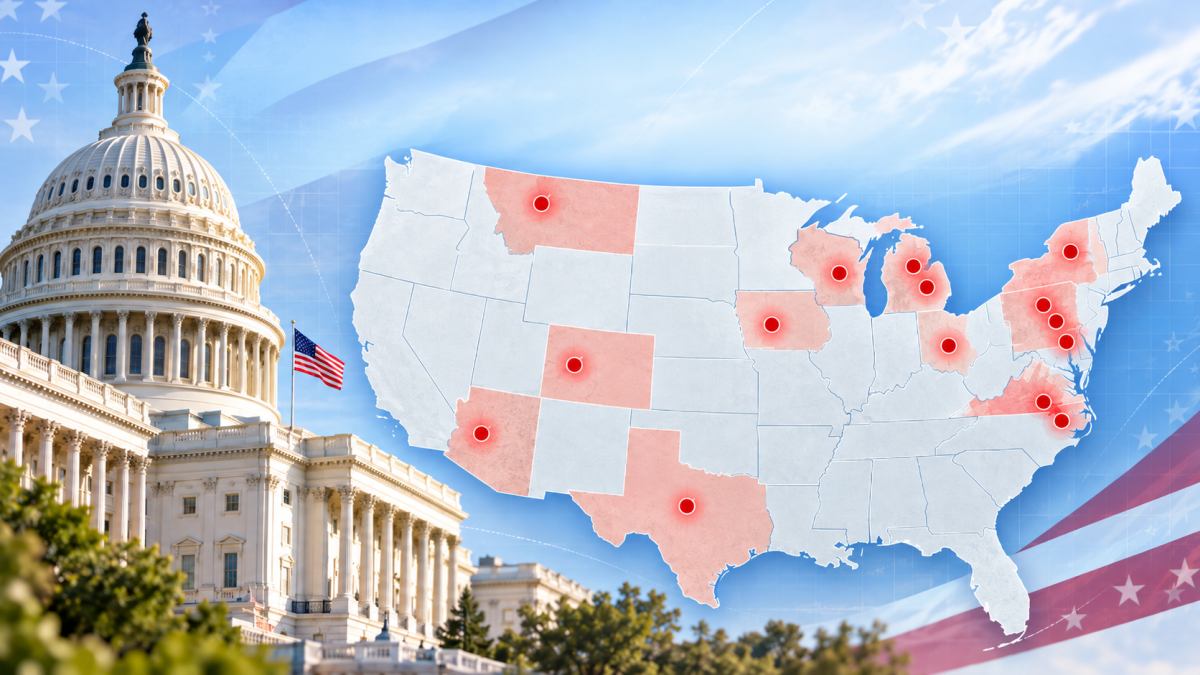
Back in August, we ranked the 10 House Republicans we thought were most vulnerable in the 2026 midterms. At the time, the Republican majority already looked fragile, with 19 House races rated as Toss Ups by the Cook Political Report and 15 of those seats held by Republicans.
Less than two months later, that list has aged in a way Republicans probably would have preferred to avoid. Three members of our original top 10 have moved from Toss Up to Lean Democrat, nearly everyone else remains in serious danger, and several Republicans who did not make the August list have since joined the battlefield.
The latest warning came Friday, when Cook moved another 11 House races toward Democrats. None of the 11 changes went in the Republican direction.
Three of Our Top 10 Have Moved to Lean Democrat
The clearest change involves three races we already considered among the most dangerous Republican defenses in the country. Rep. Mariannette Miller-Meeks in Iowa’s 1st District, Rep. Ryan Mackenzie in Pennsylvania’s 7th and Rep. Scott Perry in Pennsylvania’s 10th were all Toss Ups when we published our August ranking. Cook moved all three to Lean Democrat on Oct. 9.
A fourth Republican incumbent, Rep. Zach Nunn in Iowa’s 3rd District, also moved from Toss Up to Lean Democrat that day. Nunn did not make our August top 10, but his slide shows how much the Republican danger zone has expanded since summer. Cook now rates seven Republican-held seats as Lean Democrat. You can see the full Cook Political Report House ratings here.
Miller-Meeks ranked third on our August list after surviving 2024 by fewer than 1,000 votes. She is once again facing Democrat Christina Bohannan in an R+4 district, but the closeness of their last race has kept the seat near the center of the battlefield.
Mackenzie was No. 2 on our list. He represents Pennsylvania’s Lehigh Valley and faces Democrat Bob Brooks in a district Cook rates R+1. Perry, who ranked fifth, is again facing former television anchor Janelle Stelson after beating her by just over 5,000 votes in 2024. Cook now describes Perry as one of the most vulnerable House Republicans in the country.
The Rest of Our List Is Not Exactly Safe
Moving three of our original ten races into Lean Democrat does not mean the other seven Republicans have escaped danger. Juan Ciscomani in Arizona’s 6th, Gabe Evans in Colorado’s 8th, Mike Lawler in New York’s 17th, Max Miller in Ohio’s 7th, Rob Bresnahan in Pennsylvania’s 8th, Jen Kiggans in Virginia’s 2nd and Derrick Van Orden in Wisconsin’s 3rd are all still rated Toss Ups.
Some of them have obvious structural problems. Ciscomani and Evans represent districts Cook rates politically even, while Lawler represents a D+1 district and has already shown an ability to survive difficult political terrain. Kiggans is facing former Democratic Rep. Elaine Luria in a Hampton Roads rematch, while Van Orden is again running against Rebecca Cooke in western Wisconsin.
Others have problems that are much more candidate-specific. Max Miller represents an R+5 district that ordinarily should provide Republicans with considerably more breathing room, but allegations involving his ex-wife pushed the Ohio race into Toss Up territory earlier this year. Miller has denied the allegations.
The important part is that every Republican from our August top 10 remains either a Toss Up or Lean Democrat with just over two weeks left before Election Day. The list did not get safer. In several places, it got worse.
More Republicans Have Joined the Danger Zone
If we were rebuilding the ranking today, several names that did not make the August top 10 would deserve serious consideration. Nunn is the most obvious example after moving to Lean Democrat, but the Toss Up column now includes Republican Reps. Bill Huizenga in Michigan’s 4th, Tom Barrett in Michigan’s 7th, Monica De La Cruz in Texas’ 15th and Rob Wittman in Virginia’s 1st.
Those are not all the same kind of district. Huizenga represents an R+3 seat in western Michigan, Barrett’s district is politically even, Wittman’s Virginia district is R+3, and De La Cruz sits in an R+7 South Texas seat that Donald Trump carried by 18 points in 2024. Cook says polling has nevertheless shown De La Cruz in a very close race against Democrat Bobby Pulido.
That is what makes the October battlefield more troubling for Republicans than the one we were looking at in August. The party is no longer defending only the obvious swing seats. It is also having to pay attention to districts with a noticeable Republican lean.
Now the Trouble Is Spreading Into Redder Territory
Cook’s Oct. 16 update moved 11 House races toward Democrats, including several districts that would normally sit well outside the center of the battlefield. Five Republican races moved from Likely Republican to Lean Republican, while Montana’s open 1st District moved from Lean Republican to Toss Up. Trump carried that Montana district by 12 points in 2024. Cook’s full Oct. 16 analysis is available here.
Cook noted that Republican problems are particularly visible in Midwestern red states, including Ohio, Nebraska and Kansas, where voters have also made Senate races much more competitive than Republicans expected. Several districts Trump carried by double digits are now drawing serious outside spending from both parties.
That is a different kind of problem from defending Lawler in suburban New York or Evans in a politically even Colorado district. Republicans expected those races to be difficult. Having to spend additional money protecting seats in Trump-friendly territory stretches the battlefield in ways the party did not anticipate earlier in the year.
The Shift Has Been Building for Weeks
Friday’s changes were not an isolated event. One week earlier, Cook moved 18 House races toward Democrats, including the four Republican incumbents who shifted from Toss Up to Lean Democrat. Four additional races moved from Lean Republican into the Toss Up column. Cook’s Oct. 9 update also widened its expected range of Democratic gains to between nine and 19 seats.
Those ratings are judgments about the state of the races, not election results, and plenty can still change in the final weeks. Republicans continue to have substantial outside spending available, and several incumbents on this list have already demonstrated that they can survive difficult districts.
Still, the direction of the changes is hard to miss. Cook has now issued consecutive rounds of House ratings changes that moved entirely toward Democrats, while the number of Republican-held Toss Ups remains far larger than the Democratic total.
Republicans Are Having to Defend More Ground
Campaign spending is starting to reflect the changing map. The Congressional Leadership Fund, the major Republican House super PAC, has been shifting resources away from some races while redirecting money toward districts where Republicans now believe they need more help. Democrats, meanwhile, are raising and spending money in seats that looked far less competitive earlier in the cycle. The Associated Press reported on that reshuffling this week.
That creates a straightforward resource problem. Money spent trying to protect an R+5 or R+7 district cannot also be spent helping Republicans like Lawler, Ciscomani or Kiggans in seats that were always expected to be close.
The original August list already showed Republicans defending several different kinds of vulnerable members, including freshmen, incumbents in politically even districts and lawmakers facing strong rematch challengers. What has changed is the number of races demanding attention at the same time.
Our August List Was Bad. The October Map Is Worse
When we published our 10 Most Vulnerable House Republicans on Aug. 25, the basic argument was that Republicans had very little room for error. At the time, Cook had 15 Republican-held seats in the Toss Up column.
Today, Cook has 21 Toss Ups overall, including 16 Republican-held seats, along with seven more Republican-held districts rated Lean Democrat. Three members from our original top five are now in that Lean Democrat category, while every other Republican on our August list remains a Toss Up.
Republicans do not have to lose every one of those races to lose control of the House, and some members currently in difficult races will almost certainly survive. The problem is simply how many places are competitive at once.
In August, the question was whether Republicans could protect their most vulnerable members. By mid-October, they are having to answer a harder one: how many vulnerable members can they afford to protect at the same time?