
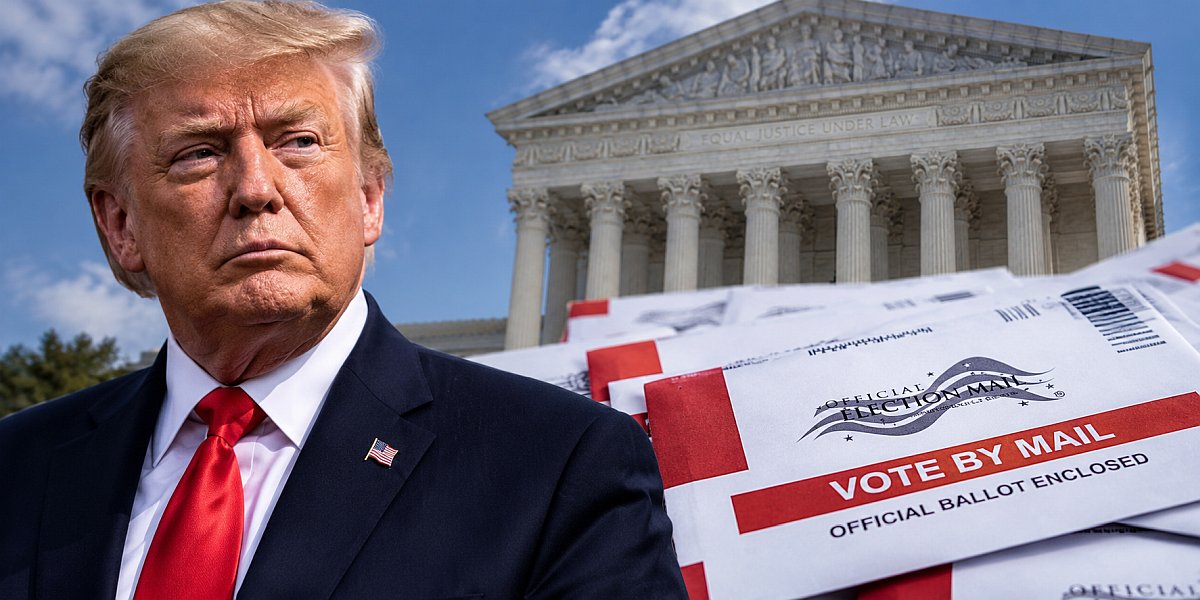
The Supreme Court has blocked the Trump administration from imposing new restrictions on mail ballots before the 2026 midterm elections, leaving the existing system largely unchanged just seven weeks before Election Day.
The decision is being celebrated by Democrats and voting rights groups as a victory for voters. Election officials also argued that changing the rules this late could have caused serious problems, including legitimate ballots being delayed or rejected.
Those concerns are real. But so is the other side of the argument: the Court has effectively decided that the safer course is to leave the current system alone rather than add another layer of verification to millions of ballots moving through the mail.
That may be the least disruptive choice for November. It is not necessarily the best long term answer for election integrity.
What Trump Wanted to Change
The dispute grew out of an executive order President Trump signed in March aimed at tightening federal election procedures. The U.S. Postal Service later adopted rules that would have required states and local election officials to provide information about voters receiving mail ballots and use federally approved ballot envelopes with identifying barcodes.
Under the plan, states using the mail to distribute ballots would have been required to submit voter information through a Postal Service system. Ballot envelopes also would have been subject to new design and tracking requirements.
The administration argued that the changes would give the Postal Service a better way to verify and track election mail. Opponents argued that the federal government was inserting itself into an area traditionally controlled by the states and that the Postal Service did not have the legal authority to impose those requirements.
The timing became another major problem. The Postal Service issued its final rule in August, less than 70 days before the Nov. 3 election. Some states had already begun preparing or sending mail ballots by the time the legal fight reached its final stages.
Federal judges blocked the rules, and the administration asked the Supreme Court to let them take effect while the litigation continued.
The Supreme Court Said No
On Monday, the Supreme Court rejected that request. The unsigned order said the government was unlikely to succeed in overturning the lower court injunction and had not satisfied the requirements for emergency relief.
That means states can continue using their existing mail voting procedures for the midterms. The decision was 7 to 2, with Justices Samuel Alito and Clarence Thomas dissenting. Reuters reported that the ruling is likely to keep the new Postal Service requirements from being used at all in this year’s election.
Justice Brett Kavanaugh offered an important distinction. He agreed that the rules should not take effect for the midterms, but he did not conclude that the underlying idea was necessarily unlawful.
Kavanaugh wrote that there was at least a reasonable possibility that the Postal Service had the authority to adopt such rules. His problem was the timing. With voting already beginning in some places, state and local officials simply did not have enough time to rebuild their systems around the new requirements.
That is a much narrower objection than saying additional safeguards for mail voting are inherently improper.
A Bad Time to Change the Rules
The strongest argument for the Court’s decision is practical.
Elections are complicated operations involving thousands of local officials, printers, databases, postal facilities and deadlines. Changing the requirements for millions of ballots shortly before an election creates opportunities for mistakes of its own.
That concern was not limited to Democrats. Republican election officials were among those warning the Court that trying to implement the Postal Service system now could lead to delays and confusion.
There were also questions about whether the new federal system was ready. A whistleblower raised concerns about the technology being developed to implement the rules and warned that problems could interfere with ballot delivery. The Postal Service inspector general subsequently announced a review of those allegations, according to Reuters.
That makes it difficult to argue that the Court should have forced every affected state to adopt an untested system weeks before a national election.
But the Security Question Doesn’t Go Away
Where the decision is less satisfying is what happens next.
Mail voting involves ballots leaving the controlled environment of a polling place and traveling through homes, mailboxes, election offices and the Postal Service before they are counted. States use signature checks, voter registration records, ballot tracking and other procedures to protect that process, but those safeguards vary considerably from state to state.
That alone is a reasonable reason to ask whether better national standards for federal elections are possible.
Trump’s proposal attempted to add another layer of verification and tracking. There were legitimate legal questions about whether a president or the Postal Service had the authority to impose it without Congress, and there were serious practical problems with trying to do it in the middle of an election.
But those problems should not end the conversation about the underlying issue.
Opponents of Trump’s proposal frequently point out that documented (keyword: documented) mail ballot fraud is rare. That is relevant but also debatable, and not a reason to avoid strengthening the system. The fact that large scale fraud has not been demonstrated is not an argument against reasonable safeguards. Election integrity is supposed to prevent problems before they become large enough to matter.
There should be room between claiming that mail voting is hopelessly corrupt and insisting that the current system needs no improvement.
The Court Chose the Status Quo
For the 2026 election, the Supreme Court has chosen stability. Given how close we are to Election Day, there is a practical case for doing exactly that, despite the potential downfalls.
But stability and security are not the same thing. The decision leaves Americans with the same patchwork of state mail voting systems they had before this fight began. Some states rely heavily on mail voting, others use it more narrowly, and the procedures for requesting, verifying, tracking and returning ballots vary across the country.
If stronger verification and tracking requirements make sense, they should be debated and built well before the next election, not imposed at the last minute through an executive order and a Postal Service regulation. Congress and the states have plenty of time to have that debate after November.
The Supreme Court may be right that September is too late to rebuild the machinery of a November election. But that should not become an excuse to stop asking whether the machinery can be made better.