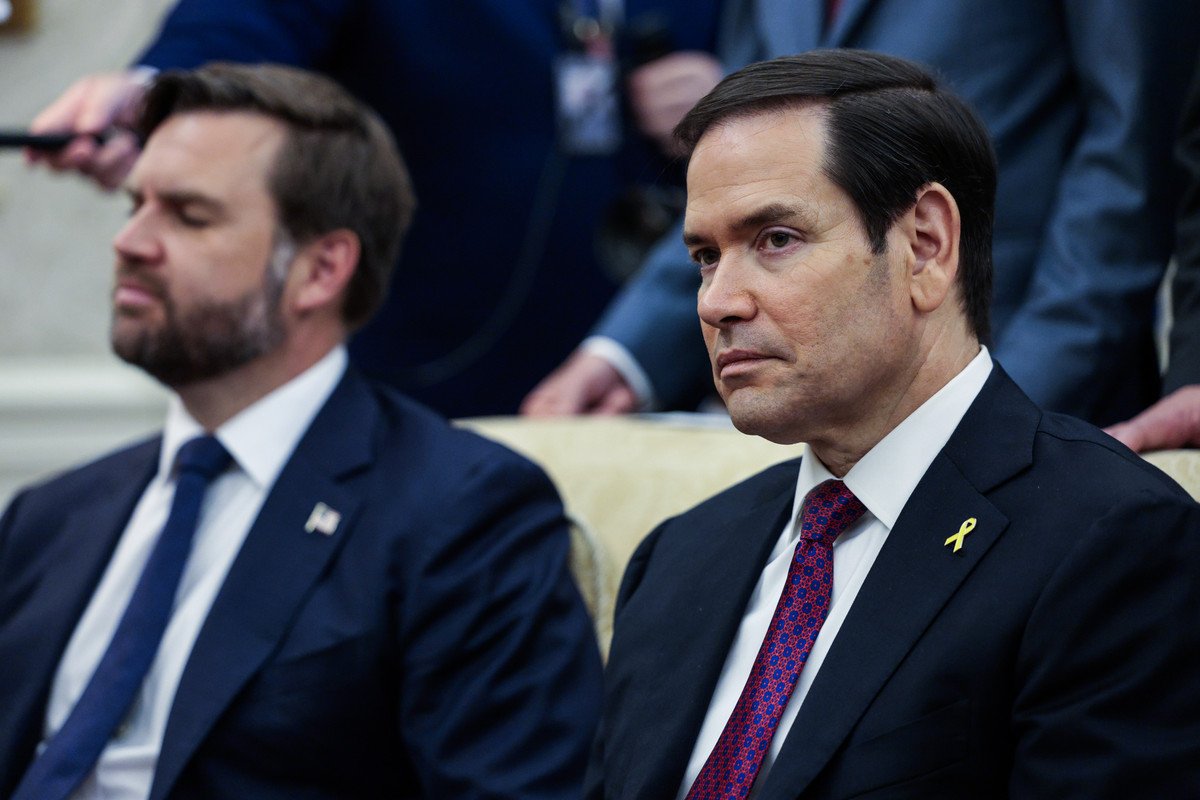
Marco Rubio’s rise in the early 2028 Republican presidential race just got considerably harder to dismiss.
A new Emerson College national poll released Thursday gives Rubio a striking 20-point advantage over Vice President JD Vance in a potential Republican primary, 44% to 24%. Ron DeSantis follows at 9%, with Tucker Carlson at 5% and Ted Cruz at 4%. Emerson College Polling conducted the survey from Nov. 14 through Nov. 16.
One poll nearly two years before the first presidential votes should be treated cautiously, especially when other recent surveys still show Vance ahead. But Rubio’s movement is no longer confined to one poll. Cygnal had him narrowly ahead immediately after the midterms, Echelon showed him gaining six points from October to November even while Vance remained in front, and the latest Emerson survey produced the biggest Rubio lead yet.
Emerson Shows a Post-Midterm Breakthrough for Rubio
The Emerson result stands out because Rubio was already competitive with Vance in the firm’s earlier polling. He was within roughly a point of the vice president in Emerson surveys conducted in May and July, so the latest result is better viewed as a post-midterm breakthrough than a rise that suddenly began on Election Day.
The new poll also tested the Republican field in two different ways. Before respondents were shown a list of names, 35.5% volunteered Rubio as their preferred 2028 Republican nominee while 20.1% named Vance. Ron DeSantis received 7.2%, Thomas Massie 6.6% and Donald Trump 6.5%.
When the same prospective Republican primary and caucus voters were then shown a list of possible candidates, Rubio climbed to 43.6% while Vance registered 24.0%. DeSantis followed at 9.4%, Donald Trump Jr. at 6.0%, Tucker Carlson at 5.0% and Ted Cruz at 3.7%.
Those questions were asked of roughly 418 voters who said they would participate in a Republican primary or caucus. Emerson’s approximately three-point margin of error applies to the full 1,000-person national survey, not specifically to that smaller Republican subgroup. Emerson’s release provides the topline results.
Rubio’s Gains Are Showing Up Elsewhere
The Emerson result is an outlier in its size, but not in showing Rubio becoming more competitive.
Cygnal conducted a national survey immediately after the midterms, on Nov. 4 and Nov. 5, and found Rubio leading Vance by roughly three points. That was one of the first clear post-election signs that Rubio had moved into a more competitive position.
Echelon Insights tells a different story, but the direction is still notable. In October, Echelon had Vance at 38% and Rubio at 20%. Its November survey put Vance at 40% and Rubio at 26%, meaning Rubio gained six points while Vance gained two. Vance still held a 14-point advantage, but Rubio’s support clearly moved upward.
That is what makes the current picture more interesting than a single shock poll. The surveys disagree sharply on who leads, but Rubio’s improvement appears even in polling that still shows Vance comfortably ahead.
Our Polling Average Still Has Vance Ahead
Our own 2028 Republican polling average, which uses the latest eligible survey from nine qualifying pollsters over the past 60 days, still has Vance in front. The current Election Central average puts Vance at 34.7%, Rubio at 31.0%, DeSantis at 9.6% and Donald Trump Jr. at 8.0%, giving Vance a 3.7-point advantage.
That broader average helps put the Emerson result in perspective. The individual surveys are all over the place. Emerson has Rubio ahead by 20 points, AtlasIntel had him ahead by 13 and Cygnal by three. On the other side, Echelon has Vance ahead by 14, Harvard-Harris by 19, NY Times/Siena by 10 and the Financial Times by 14.
RealClearPolling uses a different mix and averaging method and currently has Rubio narrowly ahead by 1.4 points. The two averages therefore tell slightly different stories, which is another reminder that the 2028 Republican race is still unsettled.
The more consistent takeaway is not that Rubio has definitively taken the lead. It is that he has become much more competitive with Vance, and several recent surveys now show a race that looked far more one-sided earlier in the year.
What Changed After the Midterms?
Rubio’s stronger position comes as Republicans reassess the party’s direction following the 2026 midterms. Vance remains closely associated with the Trump administration and was one of its most visible campaign surrogates. Rubio, meanwhile, has spent most of his time focused on foreign policy as Secretary of State.
That distinction has become more important as Republicans begin thinking seriously about what the party should look like after Trump. Vance represents the newer populist wing of the GOP, with greater skepticism of foreign intervention and less attachment to traditional Republican economic policies. Rubio remains closer to the party’s older national-security and free-market traditions, even though he has also become one of the most important figures in the Trump administration.
That split does not mean Republican voters have settled on Rubio. Far from it. Vance still leads comfortably in some surveys, Rubio has not announced a presidential campaign, and recent reporting suggests that people familiar with Rubio’s thinking still view a 2028 run as uncertain.
Rubio Was Already Competitive Before Election Day
It is also important not to rewrite the timeline. Rubio’s rise did not begin entirely after the midterms.
Emerson already had him within about a point of Vance in both May and July. Another late October survey had Rubio ahead before voters ever went to the polls. What the post-midterm period appears to have done is accelerate the movement and make it much more visible.
That is why the Emerson 44-24 result is better described as a breakthrough than a sudden emergence. Rubio was already in the conversation. Now he is showing signs of becoming a much more serious rival to Vance in the polling.
Vance Has Not Even Decided Yet
The timing is particularly interesting because Vance said this week that he has not made a decision about 2028. In an interview with Laura Ingraham, he said he expects to decide sometime in 2027 and acknowledged that a presidential campaign requires enough time to build fundraising and organizational infrastructure before the first primaries and caucuses.
Meanwhile, Cruz is positioning himself for another run, DeSantis continues to leave the door open, and Republican donors have been encouraging Rubio to consider entering. Rubio himself has repeatedly tried to avoid discussing 2028.
That makes the Emerson result less important as a prediction than as another sign of how quickly the Republican race has changed. Vance still leads several recent surveys. Rubio now leads others, including one by 20 points, and has moved narrowly ahead in the national polling average.
For a race that once looked like it might become a Vance coronation, the field suddenly looks much more competitive.
Follow the developing field on our 2028 Republican Primary page, see the latest surveys on our 2028 Presidential Polls tracker, and follow the full field on our 2028 Presidential Candidates page.