
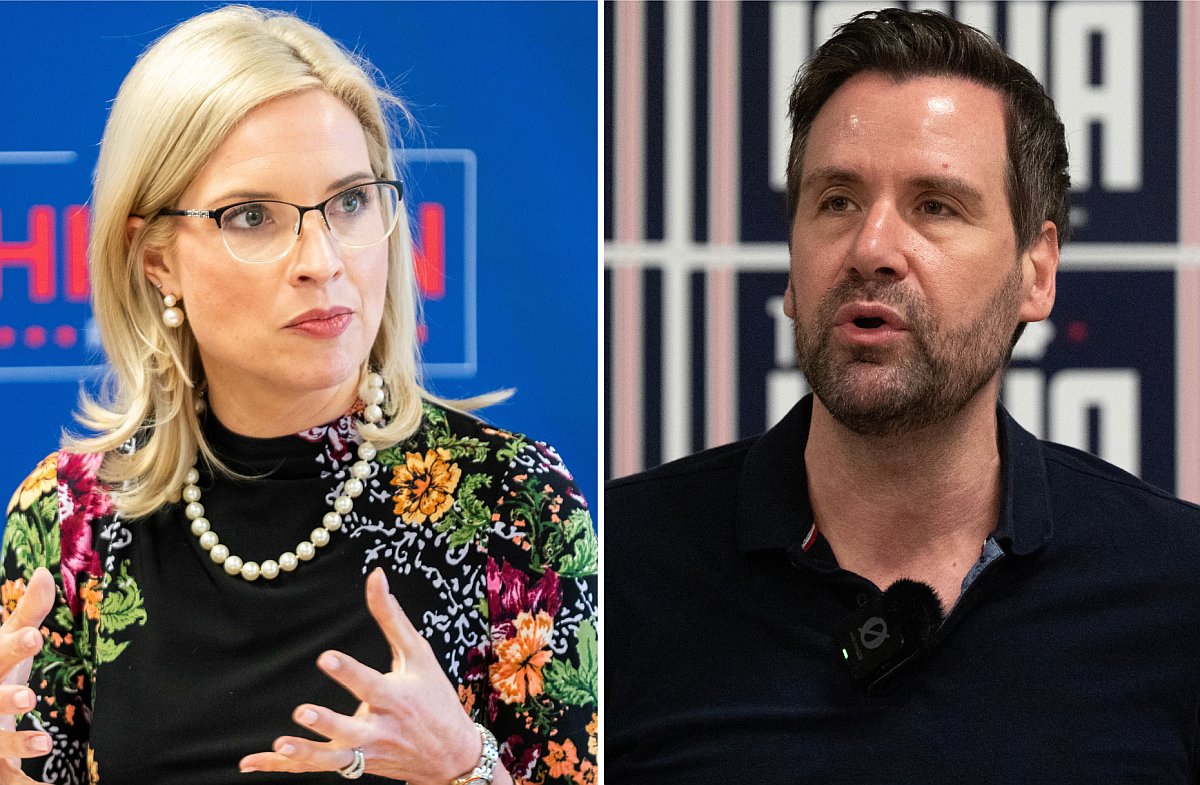
A new poll out of Iowa has the kind of numbers that immediately grab attention: Democrats ahead in the Senate race, ahead in the governor’s race and leading Republicans on the congressional ballot in a state Donald Trump carried by 13 points less than two years ago. But anyone who followed the 2024 election probably remembers what happened the last time an Iowa poll produced a political earthquake.
Three days before that election, the highly regarded Des Moines Register Iowa Poll conducted by Selzer & Co. showed Kamala Harris leading Trump 47% to 44%. Trump went on to win Iowa with 55.7% of the vote to Harris’s 42.5%, a margin of more than 13 points. The final poll had missed the actual margin by roughly 16 points. Iowa’s certified results show Trump received 927,019 votes to Harris’s 707,278.
So when another Iowa poll suddenly shows a Democrat with a substantial lead, there is an obvious reason to be skeptical. The question is whether this is another outlier, or whether the rest of the polling provides evidence that Iowa really has become more competitive since 2024.
First, the New Poll
The Marist Poll released Tuesday surveyed 1,050 registered Iowa voters from Sept. 17 through Sept. 20. Interviews were conducted by live telephone interviewers, text and online. The margin of error is plus or minus 4.4 percentage points.
Marist Poll (Sept. 17-20, 1,050 registered voters, ±4.4 points)
- Josh Turek (D): 50%
- Ashley Hinson (R): 42%
That’s an eight-point Democratic advantage in a state Trump just won by double digits. There is one important caveat: Marist surveyed registered voters, not likely voters. With about six weeks until Election Day, the people who actually vote could look different from the broader group of registered voters. The eight-point lead also shouldn’t be treated as an exact measurement. With a ±4.4-point margin of error, there is plenty of uncertainty about the actual size of the gap.
Remember That Famous 2024 Iowa Poll?
The comparison with 2024 is unavoidable. The final Selzer poll was conducted Oct. 28 through Oct. 31 among 808 likely Iowa voters and carried a margin of error of ±3.4 percentage points.
Des Moines Register/Mediacom Iowa Poll (Oct. 28-31, 2024, 808 likely voters, ±3.4 points)
- Kamala Harris (D): 47%
- Donald Trump (R): 44%
The actual result looked nothing like it.
Actual Iowa presidential result (Nov. 5, 2024)
- Donald Trump (R): 55.73%
- Kamala Harris (D): 42.52%
The miss was enormous, especially because Selzer had built a strong reputation for polling Iowa. But there was another important detail at the time: other polls were telling a very different story. An Emerson College survey conducted Nov. 1 and Nov. 2 had Trump ahead 53% to 43%, much closer to what happened on Election Day.
That’s worth remembering when looking at the new Marist survey. Rather than relying on one surprising poll, we can compare it with the other Iowa polling released this month.
What Are the Other Iowa Polls Saying?
Marist’s eight-point Turek lead is clearly on the Democratic end of recent polling. But the broader set of September surveys also does not show the kind of Republican advantage one might expect from looking at Trump’s 2024 result alone.
Trafalgar Group (Sept. 16-18, 1,089 likely voters)
- Ashley Hinson (R): 44.0%
- Josh Turek (D): 42.1%
co/efficient (Sept. 14-16, 831 likely voters)
- Ashley Hinson (R): 46%
- Josh Turek (D): 42%
Cygnal (Sept. 9-11, 500 likely voters)
- Ashley Hinson (R): 42.9%
- Josh Turek (D): 42.9%
YouGov (Sept. 3-8, likely voters)
- Josh Turek (D): 45%
- Ashley Hinson (R): 43%
These polls use different methodologies and voter screens, and several were sponsored by Republican-aligned organizations, so they shouldn’t be treated as interchangeable. Still, the pattern is useful. Marist’s eight-point margin is much larger than what the other recent polls have found, but several surveys have shown a close race. Marist may be overstating Turek’s advantage, but the recent polling as a whole looks very different from Iowa’s 13-point presidential result in 2024.
Look at the Rest of the Marist Poll
The Senate race isn’t the only result that stands out. If Turek’s lead were the only unusual number in the survey, it would be easier to write it off as a questionable sample. Instead, Marist finds a similar Democratic advantage across several different questions.
Generic congressional ballot
- Democratic candidate: 50%
- Republican candidate: 45%
Iowa governor
- Rob Sand (D): 54%
- Zach Lahn (R): 42%
Trump job approval
- Approve: 41%
- Disapprove: 58%
These are separate questions measuring different things, but all three point in the same general direction. The voters Marist reached are considerably less Republican than Iowa’s 2024 presidential results. That doesn’t mean the November electorate will look the same, but it does mean the Senate result isn’t the only number in the poll suggesting a different political environment from two years ago.
Voters Expect a Different Result
One of the most interesting findings in the poll has received much less attention. Marist asked voters not only whom they support, but whom they expect to win. Respondents give Turek an eight-point lead when asked how they plan to vote, but when Marist asks who they think will actually win the Senate race, the result flips dramatically.
Who Iowa voters expect to win the Senate race
- Ashley Hinson (R): 59%
- Josh Turek (D): 37%
So the same voters who give Turek an eight-point lead still overwhelmingly expect Hinson to win. The same thing happens with the congressional ballot. Registered voters tell Marist they prefer the Democratic congressional candidate 50% to 45%, but when asked which party’s candidate they expect to win, Republicans come out ahead.
Who Iowa voters expect to win congressional races
- Republican candidate: 54%
- Democratic candidate: 42%
Those expectation questions are not forecasts, and voters can obviously be wrong about who they think will win. But the disconnect is worth noting. Marist found voters currently leaning Democratic in their own choices while still expecting Republicans to win the races.
The Economy May Be Part of the Story
Marist also asked Iowans about their own finances, and those numbers provide another piece of context for the political results.
Change in family finances over the past year
- Gotten worse: 46%
- Stayed about the same: 39%
- Gotten better: 15%
Nearly half of registered voters say their household finances have deteriorated over the past year, while only 15% say they have improved. Trump is also a factor in how many Iowans say they are approaching the congressional elections. Forty-three percent say their congressional vote is mostly a vote against Trump, compared with 22% who describe their vote as mostly for Trump. Another 35% say Trump isn’t much of a factor in their decision.
There is some national context for those numbers. A separate NPR/PBS News/Marist national poll found Democrats ahead 53% to 41% on the congressional ballot among registered voters, while Trump’s national approval stood at 39%. That national poll doesn’t tell us what will happen in Iowa, but it shows that the Iowa survey was conducted during a period when Marist was also finding Democrats ahead among registered voters nationally.
So, Should Anyone Believe the Eight-Point Lead?
The experience of 2024 is a good reason to be careful with any surprising Iowa poll, especially one that produces a result considerably different from other surveys. Marist’s eight-point Turek advantage is substantially larger than most recent Iowa Senate polling. It also surveyed registered voters rather than likely voters. Both are important cautions when reading the result.
But the 2024 Selzer miss doesn’t tell us whether Marist is right or wrong in 2026. They are different pollsters, using different methodologies, measuring different races in different elections. The other polling is more useful for that question. YouGov has also shown Turek narrowly ahead. Cygnal recently had the race tied. Trafalgar and co/efficient have Hinson ahead, but by much smaller margins than Trump’s 2024 victory in the state.
There are also other signs in the Marist poll that Iowa’s political environment has changed since 2024. Democrats lead the generic congressional ballot, Sand leads the governor’s race, Trump is underwater on job approval and a large share of voters say their personal finances have gotten worse.
None of that proves Turek is actually eight points ahead. Marist could be capturing an electorate that looks different once likely voters are isolated, and its Senate margin could turn out to be too large. More polling over the next several weeks should give us a better idea of whether the eight-point result was an outlier.
After what happened in Iowa in 2024, the useful thing isn’t to obsess over one surprising number. Watch the next few polls and see whether the rest of the numbers keep telling the same story.