
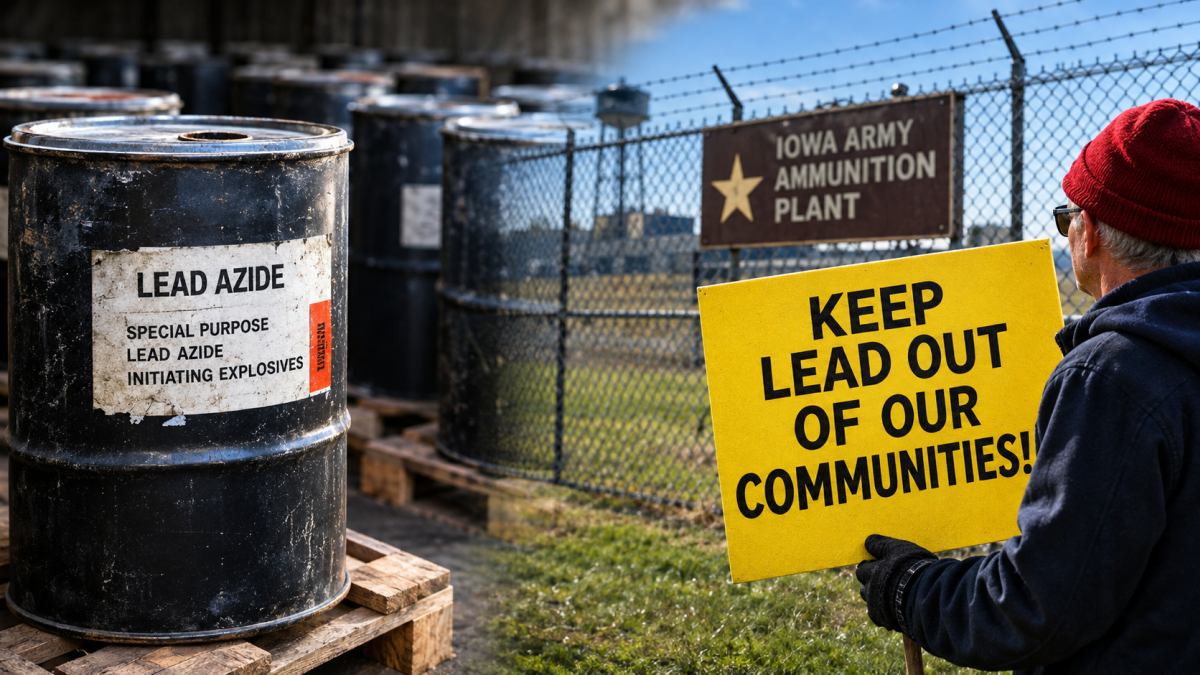
The United States Army is preparing to blow up nearly five tons of toxic explosives in southeastern Iowa, potentially sending dust containing lead into the atmosphere just before Thanksgiving. Nearby residents are being encouraged to temporarily leave their homes, FEMA is helping arrange accommodations, and officials in neighboring states are preparing for possible environmental contamination.
As of Tuesday, Nov. 24, the operation is scheduled for approximately 9 a.m. Central time on Wednesday, Nov. 25, at the Iowa Army Ammunition Plant near Middletown. The material consists of 68 barrels containing approximately 9,700 pounds of lead azide, a lead-based explosive compound formerly used in military detonators. According to the Associated Press, the barrels represent the nation’s entire remaining stockpile of the compound.
The Army maintains that a controlled detonation is now safer than attempting to move or treat the deteriorating material. That explains why the military wants to blow it up, but it leaves a considerably bigger question unanswered. How did the federal government allow thousands of pounds of hazardous explosives to sit in storage across multiple presidential administrations until destroying them in a potentially populated area became the preferred option?
What Is Supposed to Happen in Iowa?
The Army intends to destroy the unstable explosives at the ammunition plant using measures designed to limit the release of lead particles into the surrounding environment. The operation has already been postponed several times because of public safety concerns, legal challenges and the need for favorable weather conditions.
According to the Army’s Nov. 24 public safety advisory, residents in Middletown and immediately surrounding affected areas are being encouraged to temporarily relocate. FEMA is assisting with transportation, lodging, food and other necessities. The relocation is recommended rather than mandatory.
An emergency alert sent Tuesday also advised residents up to 20 miles away to remain indoors with their windows closed during the operation. Earlier Army modeling showed that lead particles could travel more than 100 miles under certain weather conditions, although those projections do not establish that dangerous concentrations of lead will reach communities at that distance.
The potential environmental effects have attracted attention well beyond Iowa. Missouri activated its state emergency operations center on Tuesday, while Illinois established a dedicated information page to address concerns about air quality, public health and possible contamination.
Why Does the Army Need to Blow It Up?
Lead azide was historically used in military ammunition, but the armed forces moved away from the compound approximately 15 years ago because of safety and handling concerns. The remaining inventory was no longer needed for ammunition production, yet it continued to sit in government storage.
In March 2026, an inspection revealed that the material had undergone serious chemical deterioration. Military explosives specialists subsequently determined that disturbing the containers could trigger an accidental explosion. Federal officials also expressed concern about leaving the deteriorating stockpile in storage as winter approaches.
Acting Army Secretary Adam Telle explained at a Tuesday press conference that the military considers a planned detonation with environmental safeguards preferable to an uncontrolled explosion that could occur without warning or protective measures. The Army is not arguing that its plan is risk-free. Its argument is that the available alternatives now present greater risks.
Whether that assessment is correct or not, it is worth examining why the government is confronting such a limited set of options after possessing the material for so many years.
A Problem Spanning Five Presidential Terms
The history of deteriorating lead azide at the Iowa ammunition plant goes back at least two decades. A 2014 Army publication identified concerns dating to 2004 about an aging stockpile at the same facility. As PolitiFact noted, it remains unclear whether that earlier inventory included the exact material scheduled for destruction this week. Nevertheless, the military was familiar with the broader problem long before the current emergency.
Federal officials provided additional historical details during Tuesday’s briefing. According to a timeline published by KWQC, some of the material in the national stockpile is more than 60 years old. The remaining inventory was consolidated at the Iowa facility in 2009 as part of a military base realignment effort.
Here is how the problem stretches across successive presidential administrations:
- George W. Bush (2001-2009): The military documented concerns about deteriorating lead azide at the Iowa facility as early as 2004, although the connection between that inventory and the current stockpile remains unclear.
- Barack Obama (2009-2017): The national stockpile was consolidated in Iowa in 2009. By approximately 2011, the military had moved away from using lead azide, but the remaining explosives stayed in storage.
- Donald Trump, first term (2017-2021): The stockpile remained at the Iowa facility without permanent disposal.
- Joe Biden (2021-2025): The material continued to be stored in Iowa throughout another presidential term.
- Donald Trump, second term (2025-present): The plant’s operating contractor began seeking disposal services in 2025. Serious deterioration was identified in March 2026, and the Army ultimately selected a controlled detonation as its disposal method.
Trump blamed the Obama administration on Monday for improperly storing the explosives in 2009. While that was when the national inventory was consolidated in Iowa, the material subsequently remained there throughout Trump’s first presidency, Biden’s presidency and nearly two years of Trump’s second term.
There is no evidence that every president was personally aware of the stockpile or that each administration received the same warnings about its condition. The responsibility for maintaining and eventually disposing of the material, however, remained with the federal government regardless of who occupied the White House.
The Army Originally Pursued a Different Disposal Method
One of the more interesting developments came Tuesday from Iowa Public Radio, which obtained records showing that the Army initially pursued chemical neutralization rather than detonation.
American Ordnance, the contractor operating the ammunition plant, contacted a hazardous waste disposal company called MuniRem Environmental in September 2025. That was approximately six months before the Army informed federal environmental regulators that the barrels had become dangerously unstable.
The records reveal several important developments in the disposal effort:
- September 2025: American Ordnance sought a disposal quote from MuniRem Environmental.
- March 2026: An expert panel reportedly recommended chemical treatment, and the Army subsequently awarded MuniRem a contract.
- May 4, 2026: MuniRem submitted its proposed treatment plan following laboratory testing.
- May 8, 2026: The Army selected controlled detonation instead.
- May 14, 2026: MuniRem was informed that the treatment portion of its contract would not proceed.
The company’s chief executive maintains that chemical neutralization remained a viable alternative. The Army disputes that assessment, arguing that the condition of the material made the proposed treatment too dangerous to perform.
Successful laboratory testing does not necessarily establish that a chemical treatment could have been safely carried out on the deteriorating stockpile. The contractor’s account does, however, raise questions about the Army’s decision-making process and whether pursuing permanent disposal years earlier would have prevented the current emergency.
Trump, the Courts and Iowa’s Incoming Governor
Environmental organizations challenged the Environmental Protection Agency’s emergency permit for the operation, raising concerns about the potential spread of lead dust, insufficient public notification and the adequacy of the government’s monitoring and cleanup plans.
Trump intervened Monday, directing the Army to wait for a federal appeals court decision. He also demanded that Democratic Iowa Gov.-elect Rob Sand agree to the operation and suggested that he would hold Sand responsible for the consequences if it did not proceed. Sand, who does not take office until January, responded that the decision belongs to the current federal administration and called for greater transparency.
The Eighth Circuit Court of Appeals lifted its temporary hold Monday, clearing the way for the Army to proceed. The judges considered the risks posed by the planned operation alongside the potentially greater consequences of an uncontrolled explosion. The decision did not constitute a final resolution of the underlying legal challenge.
Iowa’s outgoing Republican governor, Kim Reynolds, subsequently expressed support for the Army’s plan after consulting federal officials. Republican Sen. Joni Ernst, meanwhile, expressed frustration that the situation had been allowed to deteriorate this far.
“These materials should never have been allowed to get to this point, and Iowans are right to be frustrated,” Ernst said, according to Iowa Public Radio.
A bipartisan group of Iowa and Illinois lawmakers also sent a letter to the Army and EPA on Nov. 19 requesting additional safety information and further consideration of alternative disposal methods. The concern over how this situation developed has extended well beyond party lines.
What About the Lead Left Behind?
Destroying the explosives addresses the immediate danger of an accidental explosion, but it does not eliminate the lead contained in the material. Lead exposure can cause serious health problems, particularly in young children and during pregnancy. The possibility of airborne particles settling on residential property, farmland and waterways is central to the concerns raised by surrounding communities.
The federal government’s emergency permit includes requirements for environmental sampling, monitoring, public notification and cleanup. The actual extent of contamination, however, cannot be established until environmental measurements are collected following the operation.
Residents seeking current safety information, relocation assistance or projected exposure maps should consult the following official resources rather than rely on earlier maps circulating on social media:
- U.S. Army Ammunition Plant updates
- Iowa Health and Human Services
- Illinois environmental and public health updates
- FEMA assistance: 1-800-621-3362
Residents in affected areas should follow official relocation and shelter instructions and wait for clearance from authorities before returning home or resuming normal outdoor activities.
How Was This Allowed to Happen?
The Army may well be correct that a controlled detonation is now the safest available option. Accepting that assessment does not require accepting the years of federal management decisions that preceded it.
The military stopped using the compound roughly 15 years ago. Why was permanent disposal not completed at the time? What inspections were conducted during the intervening years, who was responsible for maintaining the material, and why did the disposal effort apparently not become urgent until 2025 and 2026? Congress should also examine the decision to abandon chemical treatment and determine whether earlier intervention would have made that option more practical.
Those questions apply to the military bureaucracy, its contractors and the federal officials responsible for overseeing them across multiple administrations. There should be a reasonably straightforward accounting of who was responsible for the stockpile, what was known about its condition over the years and what decisions were made about its eventual disposal.
Instead, after years of storage under Republican and Democratic presidents alike, the federal government finds itself preparing to detonate nearly five tons of toxic explosives in Iowa and asking American families to temporarily leave their homes the day before Thanksgiving.
Even if the operation goes exactly as planned, that should not be the end of the story.